

Interaction with External Fields
175
6.2 ATOMS IN A MAGNETIC FIELD
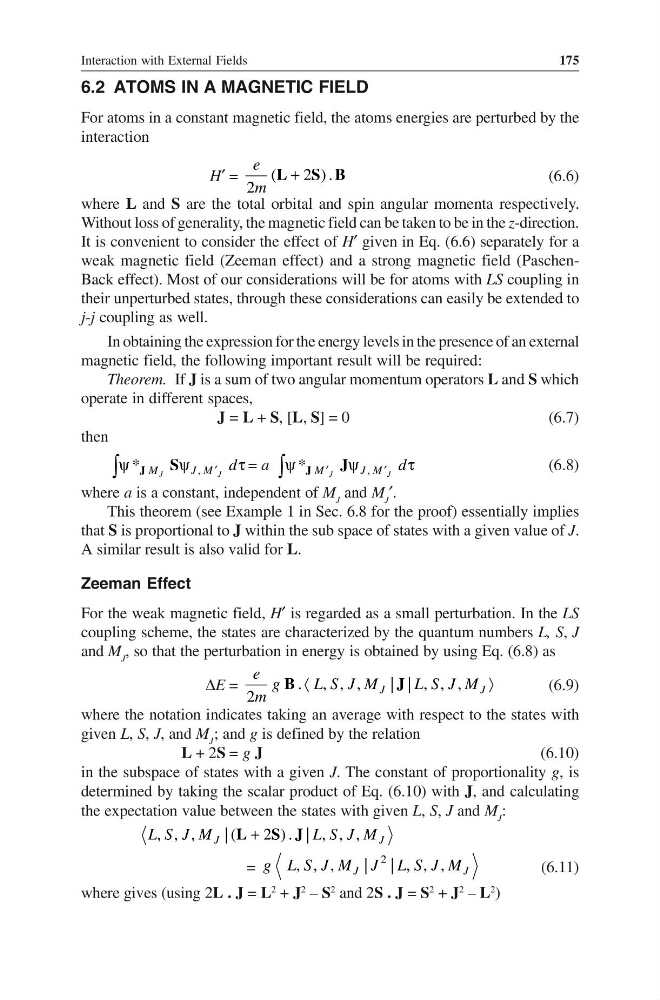
For atoms in a constant magnetic field, the atoms energies are perturbed by the
interaction
H′ =
(
2 ).
2
e
m
+
L S B
(6.6)
where L and S are the total orbital and spin angular momenta respectively.
Without loss of generality, the magnetic field can be taken to be in the z-direction.
It is convenient to consider the effect of H′ given in Eq. (6.6) separately for a
weak magnetic field (Zeeman effect) and a strong magnetic field (PaschenBack effect). Most of our considerations will be for atoms with LS coupling in
their unperturbed states, through these considerations can easily be extended to
j-j coupling as well.
In obtaining the expression for the energy levels in the presence of an external
magnetic field, the following important result will be required:
Theorem. If J is a sum of two angular momentum operators L and S which
operate in different spaces,
J = L + S, [L, S] = 0
(6.7)
then
,
* J
J
M
J M d
′
ψ
ψ
τ
∫ J S
= a
,
* J
J
M
J M d
′
′
ψ
ψ
τ
∫ J J
(6.8)
where a is a constant, independent of M J and M J ′.
This theorem (see Example 1 in Sec. 6.8 for the proof) essentially implies
that S is proportional to J within the sub space of states with a given value of J.
A similar result is also valid for L.
Zeeman Effect
For the weak magnetic field, H′ is regarded as a small perturbation. In the LS
coupling scheme, the states are characterized by the quantum numbers L, S, J
and M J , so that the perturbation in energy is obtained by using Eq. (6.8) as
∆E =
. , , ,
| | , , ,
2
J
J
e g
L S J M
L S J M
m
〈
〉
B
J
(6.9)
where the notation indicates taking an average with respect to the states with
given L, S, J, and M J ; and g is defined by the relation
L + 2S = g J
(6.10)
in the subspace of states with a given J. The constant of proportionality g, is
determined by taking the scalar product of Eq. (6.10) with J, and calculating
the expectation value between the states with given L, S, J and M J :
, , ,
|(
2 ). | , , ,
J
J
L S J M
L S J M
+
L
S J
=
2
, , ,
| | , , ,
J
J
g L S J M J L S J M
(6.11)
where gives (using 2L . J = L
2
+ J
2
– S
2
and 2S . J = S
2
+ J
2
– L
2
)
175
6.2 ATOMS IN A MAGNETIC FIELD
For atoms in a constant magnetic field, the atoms energies are perturbed by the
interaction
H′ =
(
2 ).
2
e
m
+
L S B
(6.6)
where L and S are the total orbital and spin angular momenta respectively.
Without loss of generality, the magnetic field can be taken to be in the z-direction.
It is convenient to consider the effect of H′ given in Eq. (6.6) separately for a
weak magnetic field (Zeeman effect) and a strong magnetic field (PaschenBack effect). Most of our considerations will be for atoms with LS coupling in
their unperturbed states, through these considerations can easily be extended to
j-j coupling as well.
In obtaining the expression for the energy levels in the presence of an external
magnetic field, the following important result will be required:
Theorem. If J is a sum of two angular momentum operators L and S which
operate in different spaces,
J = L + S, [L, S] = 0
(6.7)
then
,
* J
J
M
J M d
′
ψ
ψ
τ
∫ J S
= a
,
* J
J
M
J M d
′
′
ψ
ψ
τ
∫ J J
(6.8)
where a is a constant, independent of M J and M J ′.
This theorem (see Example 1 in Sec. 6.8 for the proof) essentially implies
that S is proportional to J within the sub space of states with a given value of J.
A similar result is also valid for L.
Zeeman Effect
For the weak magnetic field, H′ is regarded as a small perturbation. In the LS
coupling scheme, the states are characterized by the quantum numbers L, S, J
and M J , so that the perturbation in energy is obtained by using Eq. (6.8) as
∆E =
. , , ,
| | , , ,
2
J
J
e g
L S J M
L S J M
m
〈
〉
B
J
(6.9)
where the notation indicates taking an average with respect to the states with
given L, S, J, and M J ; and g is defined by the relation
L + 2S = g J
(6.10)
in the subspace of states with a given J. The constant of proportionality g, is
determined by taking the scalar product of Eq. (6.10) with J, and calculating
the expectation value between the states with given L, S, J and M J :
, , ,
|(
2 ). | , , ,
J
J
L S J M
L S J M
+
L
S J
=
2
, , ,
| | , , ,
J
J
g L S J M J L S J M
(6.11)
where gives (using 2L . J = L
2
+ J
2
– S
2
and 2S . J = S
2
+ J
2
– L
2
)