

Elements of Modern Physics
174
In Chapter 5, the structure and the energy levels of atoms and molecules were
discussed. Here, their interaction with external electromagnetic fields will be
considered. While the time independent fields allow the investigation and
modification of the energy levels to suit our convarience, it is the time dependent
fields which lead to transitions between the states. These effects are of great
importance not only in deducing atomic and molecular properties, but also in
devising useful practical applications such as the lasers and masers.
6.1 THE HAMILTONIAN
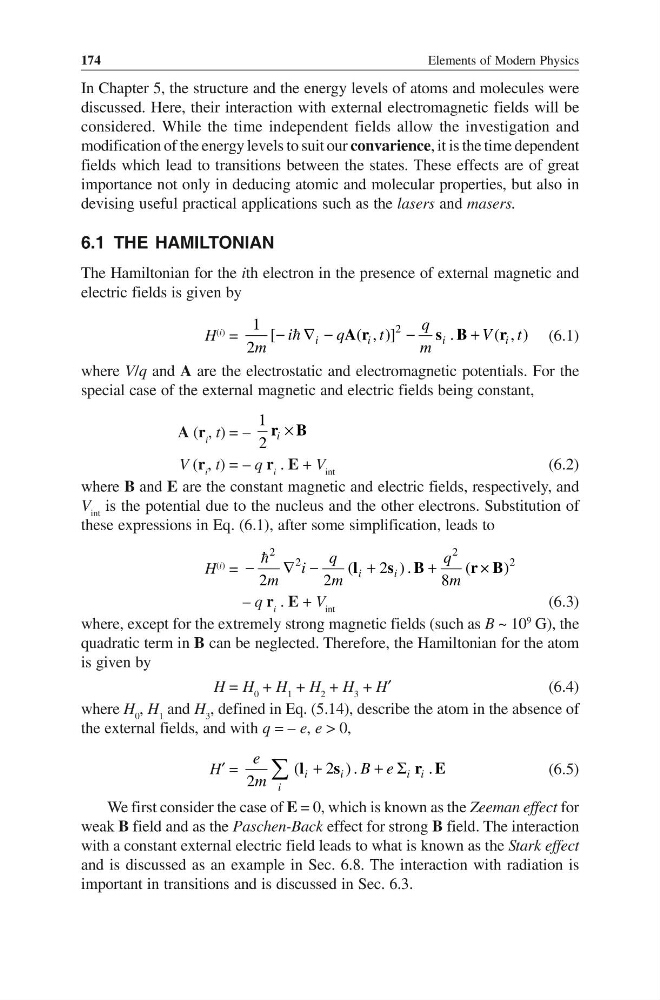
The Hamiltonian for the ith electron in the presence of external magnetic and
electric fields is given by
H
(i)
=
2
1 [
( ,) ]
.
( ,)
2
i
i
i
i
q
i
q
t
V
t
m
m
− ∇ −
−
+
A r
s B
r
(6.1)
where V/q and A are the electrostatic and electromagnetic potentials. For the
special case of the external magnetic and electric fields being constant,
A (r i , t) = –
1
2
i ×
r B
V (r i , t) = – q r i . E + V int
(6.2)
where B and E are the constant magnetic and electric fields, respectively, and
V int is the potential due to the nucleus and the other electrons. Substitution of
these expressions in Eq. (6.1), after some simplification, leads to
H
(i)
=
2
2
2
2
(
2 ).
(
)
2
2
8
i
i
q
q
i
×
m
m
m
−
∇ −
+
+
l
s B
r B
– q r i . E + V int
(6.3)
where, except for the extremely strong magnetic fields (such as B ~ 10
9
G), the
quadratic term in B can be neglected. Therefore, the Hamiltonian for the atom
is given by
H = H 0 + H 1 + H 2 + H 3 + H′
(6.4)
where H 0 , H 1 and H 3 , defined in Eq. (5.14), describe the atom in the absence of
the external fields, and with q = – e, e > 0,
H′ =
(
2 ).
.
2
i
i
i i
i
e
B e
m
+
+ Σ
∑ l s
r E
(6.5)
We first consider the case of E = 0, which is known as the Zeeman effect for
weak B field and as the Paschen-Back effect for strong B field. The interaction
with a constant external electric field leads to what is known as the Stark effect
and is discussed as an example in Sec. 6.8. The interaction with radiation is
important in transitions and is discussed in Sec. 6.3.
174
In Chapter 5, the structure and the energy levels of atoms and molecules were
discussed. Here, their interaction with external electromagnetic fields will be
considered. While the time independent fields allow the investigation and
modification of the energy levels to suit our convarience, it is the time dependent
fields which lead to transitions between the states. These effects are of great
importance not only in deducing atomic and molecular properties, but also in
devising useful practical applications such as the lasers and masers.
6.1 THE HAMILTONIAN
The Hamiltonian for the ith electron in the presence of external magnetic and
electric fields is given by
H
(i)
=
2
1 [
( ,) ]
.
( ,)
2
i
i
i
i
q
i
q
t
V
t
m
m
− ∇ −
−
+
A r
s B
r
(6.1)
where V/q and A are the electrostatic and electromagnetic potentials. For the
special case of the external magnetic and electric fields being constant,
A (r i , t) = –
1
2
i ×
r B
V (r i , t) = – q r i . E + V int
(6.2)
where B and E are the constant magnetic and electric fields, respectively, and
V int is the potential due to the nucleus and the other electrons. Substitution of
these expressions in Eq. (6.1), after some simplification, leads to
H
(i)
=
2
2
2
2
(
2 ).
(
)
2
2
8
i
i
q
q
i
×
m
m
m
−
∇ −
+
+
l
s B
r B
– q r i . E + V int
(6.3)
where, except for the extremely strong magnetic fields (such as B ~ 10
9
G), the
quadratic term in B can be neglected. Therefore, the Hamiltonian for the atom
is given by
H = H 0 + H 1 + H 2 + H 3 + H′
(6.4)
where H 0 , H 1 and H 3 , defined in Eq. (5.14), describe the atom in the absence of
the external fields, and with q = – e, e > 0,
H′ =
(
2 ).
.
2
i
i
i i
i
e
B e
m
+
+ Σ
∑ l s
r E
(6.5)
We first consider the case of E = 0, which is known as the Zeeman effect for
weak B field and as the Paschen-Back effect for strong B field. The interaction
with a constant external electric field leads to what is known as the Stark effect
and is discussed as an example in Sec. 6.8. The interaction with radiation is
important in transitions and is discussed in Sec. 6.3.