

Elements of Modern Physics
154
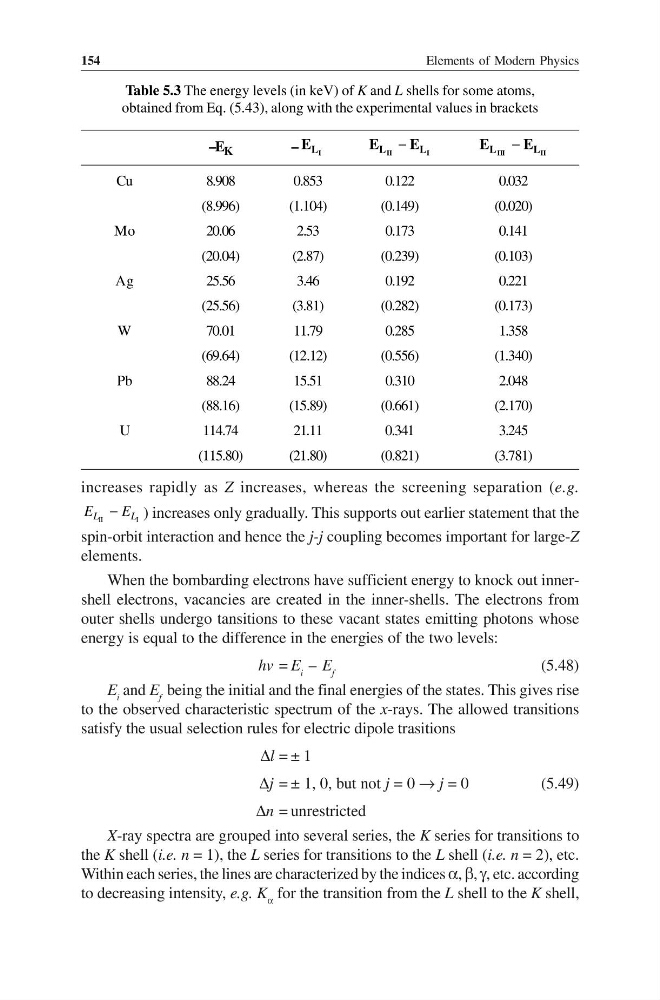
Table 5.3 The energy levels (in keV) of K and L shells for some atoms,
obtained from Eq. (5.43), along with the experimental values in brackets
–E K
– I
L
E
−
II
I
L
L
E
E
−
III
II
L
L
E
E
Cu
8.908
0.853
0.122
0.032
(8.996)
(1.104)
(0.149)
(0.020)
Mo
20.06
2.53
0.173
0.141
(20.04)
(2.87)
(0.239)
(0.103)
Ag
25.56
3.46
0.192
0.221
(25.56)
(3.81)
(0.282)
(0.173)
W
70.01
11.79
0.285
1.358
(69.64)
(12.12)
(0.556)
(1.340)
Pb
88.24
15.51
0.310
2.048
(88.16)
(15.89)
(0.661)
(2.170)
U
114.74
21.11
0.341
3.245
(115.80)
(21.80)
(0.821)
(3.781)
increases rapidly as Z increases, whereas the screening separation (e.g.
II
I
L
L
E
E
−
) increases only gradually. This supports out earlier statement that the
spin-orbit interaction and hence the j-j coupling becomes important for large-Z
elements.
When the bombarding electrons have sufficient energy to knock out innershell electrons, vacancies are created in the inner-shells. The electrons from
outer shells undergo tansitions to these vacant states emitting photons whose
energy is equal to the difference in the energies of the two levels:
hv = E i – E f
(5.48)
E i and E f being the initial and the final energies of the states. This gives rise
to the observed characteristic spectrum of the x-rays. The allowed transitions
satisfy the usual selection rules for electric dipole trasitions
∆l = ± 1
∆j = ± 1, 0, but not j = 0 → j = 0
(5.49)
∆n = unrestricted
X-ray spectra are grouped into several series, the K series for transitions to
the K shell (i.e. n = 1), the L series for transitions to the L shell (i.e. n = 2), etc.
Within each series, the lines are characterized by the indices α, β, γ, etc. according
to decreasing intensity, e.g. K α for the transition from the L shell to the K shell,
154
Table 5.3 The energy levels (in keV) of K and L shells for some atoms,
obtained from Eq. (5.43), along with the experimental values in brackets
–E K
– I
L
E
−
II
I
L
L
E
E
−
III
II
L
L
E
E
Cu
8.908
0.853
0.122
0.032
(8.996)
(1.104)
(0.149)
(0.020)
Mo
20.06
2.53
0.173
0.141
(20.04)
(2.87)
(0.239)
(0.103)
Ag
25.56
3.46
0.192
0.221
(25.56)
(3.81)
(0.282)
(0.173)
W
70.01
11.79
0.285
1.358
(69.64)
(12.12)
(0.556)
(1.340)
Pb
88.24
15.51
0.310
2.048
(88.16)
(15.89)
(0.661)
(2.170)
U
114.74
21.11
0.341
3.245
(115.80)
(21.80)
(0.821)
(3.781)
increases rapidly as Z increases, whereas the screening separation (e.g.
II
I
L
L
E
E
−
) increases only gradually. This supports out earlier statement that the
spin-orbit interaction and hence the j-j coupling becomes important for large-Z
elements.
When the bombarding electrons have sufficient energy to knock out innershell electrons, vacancies are created in the inner-shells. The electrons from
outer shells undergo tansitions to these vacant states emitting photons whose
energy is equal to the difference in the energies of the two levels:
hv = E i – E f
(5.48)
E i and E f being the initial and the final energies of the states. This gives rise
to the observed characteristic spectrum of the x-rays. The allowed transitions
satisfy the usual selection rules for electric dipole trasitions
∆l = ± 1
∆j = ± 1, 0, but not j = 0 → j = 0
(5.49)
∆n = unrestricted
X-ray spectra are grouped into several series, the K series for transitions to
the K shell (i.e. n = 1), the L series for transitions to the L shell (i.e. n = 2), etc.
Within each series, the lines are characterized by the indices α, β, γ, etc. according
to decreasing intensity, e.g. K α for the transition from the L shell to the K shell,