

Atoms and Molecules
155
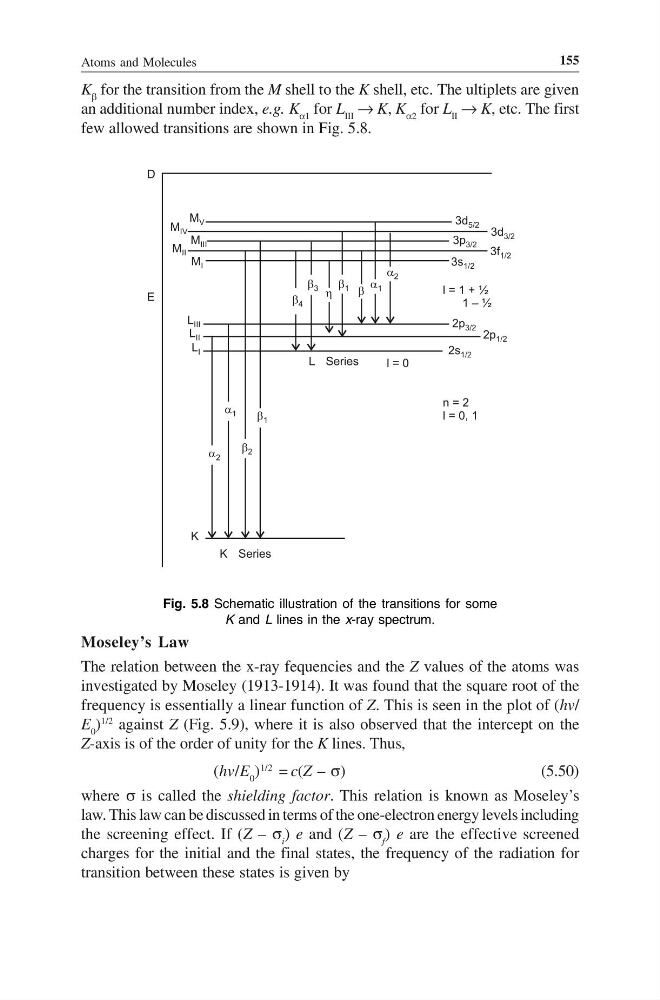
K β for the transition from the M shell to the K shell, etc. The ultiplets are given
an additional number index, e.g. K α1 for L III → K, K α2 for L II → K, etc. The first
few allowed transitions are shown in Fig. 5.8.
M V
M IV M III
M II M I
3d 5/2 3d 3/2
3p 3/2 3f 1/2
3s 1/2
b 4
b 3 h
b 1 b
a 1
a 2
l = 1 + ½
1 – ½
2p 3/2 2p 1/2
2s 1/2
L Series
l = 0
n = 2
l = 0, 1
L III
L II
L I
a 2
a 1
b 2
b 1
K
K Series
E
D
Fig. 5.8 Schematic illustration of the transitions for some
K and L lines in the x-ray spectrum.
Moseley’s Law
The relation between the x-ray fequencies and the Z values of the atoms was
investigated by Moseley (1913-1914). It was found that the square root of the
frequency is essentially a linear function of Z. This is seen in the plot of (hv/
E 0 )
1/2
against Z (Fig. 5.9), where it is also observed that the intercept on the
Z-axis is of the order of unity for the K lines. Thus,
(hv/E 0 )
1/2
= c(Z – σ)
(5.50)
where σ is called the shielding factor. This relation is known as Moseley’s
law. This law can be discussed in terms of the one-electron energy levels including
the screening effect. If (Z – σ i ) e and (Z – σ f ) e are the effective screened
charges for the initial and the final states, the frequency of the radiation for
transition between these states is given by
155
K β for the transition from the M shell to the K shell, etc. The ultiplets are given
an additional number index, e.g. K α1 for L III → K, K α2 for L II → K, etc. The first
few allowed transitions are shown in Fig. 5.8.
M V
M IV M III
M II M I
3d 5/2 3d 3/2
3p 3/2 3f 1/2
3s 1/2
b 4
b 3 h
b 1 b
a 1
a 2
l = 1 + ½
1 – ½
2p 3/2 2p 1/2
2s 1/2
L Series
l = 0
n = 2
l = 0, 1
L III
L II
L I
a 2
a 1
b 2
b 1
K
K Series
E
D
Fig. 5.8 Schematic illustration of the transitions for some
K and L lines in the x-ray spectrum.
Moseley’s Law
The relation between the x-ray fequencies and the Z values of the atoms was
investigated by Moseley (1913-1914). It was found that the square root of the
frequency is essentially a linear function of Z. This is seen in the plot of (hv/
E 0 )
1/2
against Z (Fig. 5.9), where it is also observed that the intercept on the
Z-axis is of the order of unity for the K lines. Thus,
(hv/E 0 )
1/2
= c(Z – σ)
(5.50)
where σ is called the shielding factor. This relation is known as Moseley’s
law. This law can be discussed in terms of the one-electron energy levels including
the screening effect. If (Z – σ i ) e and (Z – σ f ) e are the effective screened
charges for the initial and the final states, the frequency of the radiation for
transition between these states is given by