

Atoms and Molecules
153
E n,l = E n
(0)
+
2
/
2
0
1
(
1)
4
−
−
−
πε
r b
Z
e
Z
e
r
a n
(0)
2 2
2
|
|
4
3
1/ 2
4
n
Z
E
n
j
n
α
+
−
+
(5.43)
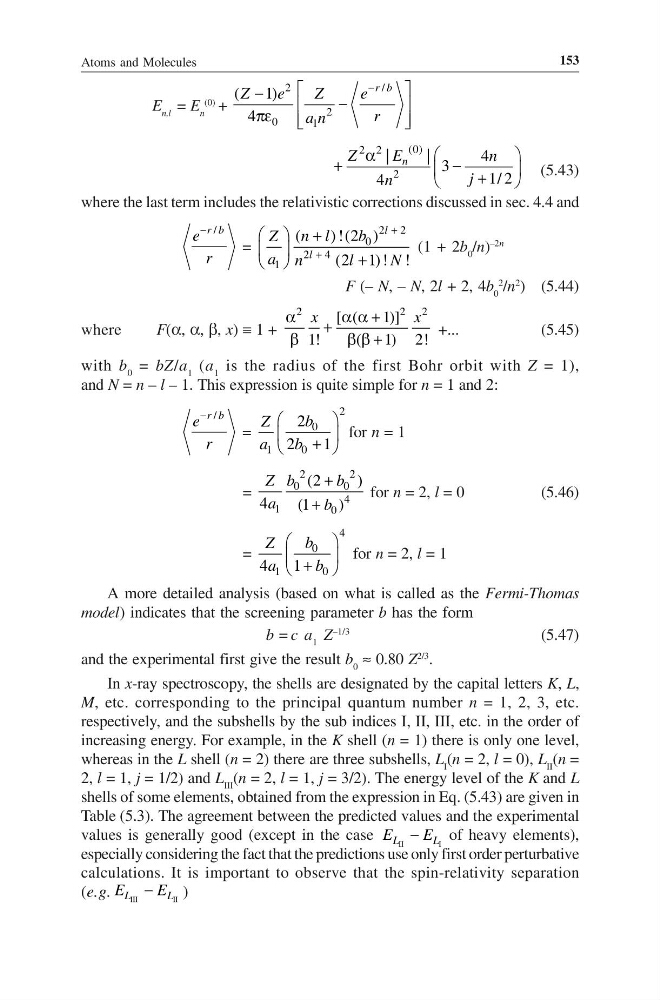
where the last term includes the relativistic corrections discussed in sec. 4.4 and
/
r b
e
r
−
=
2 2
0
2 4
1
(
)!(2 )
(2 1) ! !
+
+
+
+
l
l
n l
b
Z
a n
l
N
(1 + 2b 0 /n)
–2n
F (– N, – N, 2l + 2, 4b 0
2
/n
2
) (5.44)
where
F(α, α, β, x) ≡ 1 +
2
2 2
[ (
1)]
1!
( 1) 2!
x
x
α
α α+
+
β
ββ+
+...
(5.45)
with b 0 = bZ/a 1 (a 1 is the radius of the first Bohr orbit with Z = 1),
and N = n – l – 1. This expression is quite simple for n = 1 and 2:
/
r b
e
r
−
=
2
0
1
0
2
2
1
b
Z
a
b
+
for n = 1
=
2
2
0
0
4
1
0
(2
)
4
(1
)
b
b
Z
a
b
+
+
for n = 2, l = 0
(5.46)
=
4
0
1
0
4
1
b
Z
a
b
+
for n = 2, l = 1
A more detailed analysis (based on what is called as the Fermi-Thomas
model) indicates that the screening parameter b has the form
b = c a 1 Z
–1/3
(5.47)
and the experimental first give the result b 0 ≈ 0.80 Z
2/3
.
In x-ray spectroscopy, the shells are designated by the capital letters K, L,
M, etc. corresponding to the principal quantum number n = 1, 2, 3, etc.
respectively, and the subshells by the sub indices I, II, III, etc. in the order of
increasing energy. For example, in the K shell (n = 1) there is only one level,
whereas in the L shell (n = 2) there are three subshells, L I (n = 2, l = 0), L II (n =
2, l = 1, j = 1/2) and L III (n = 2, l = 1, j = 3/2). The energy level of the K and L
shells of some elements, obtained from the expression in Eq. (5.43) are given in
Table (5.3). The agreement between the predicted values and the experimental
values is generally good (except in the case
II
I
L
L
E
E
−
of heavy elements),
especially considering the fact that the predictions use only first order perturbative
calculations. It is important to observe that the spin-relativity separation
(e.g. III
II
L
L
E
E
−
)
153
E n,l = E n
(0)
+
2
/
2
0
1
(
1)
4
−
−
−
πε
r b
Z
e
Z
e
r
a n
(0)
2 2
2
|
|
4
3
1/ 2
4
n
Z
E
n
j
n
α
+
−
+
(5.43)
where the last term includes the relativistic corrections discussed in sec. 4.4 and
/
r b
e
r
−
=
2 2
0
2 4
1
(
)!(2 )
(2 1) ! !
+
+
+
+
l
l
n l
b
Z
a n
l
N
(1 + 2b 0 /n)
–2n
F (– N, – N, 2l + 2, 4b 0
2
/n
2
) (5.44)
where
F(α, α, β, x) ≡ 1 +
2
2 2
[ (
1)]
1!
( 1) 2!
x
x
α
α α+
+
β
ββ+
+...
(5.45)
with b 0 = bZ/a 1 (a 1 is the radius of the first Bohr orbit with Z = 1),
and N = n – l – 1. This expression is quite simple for n = 1 and 2:
/
r b
e
r
−
=
2
0
1
0
2
2
1
b
Z
a
b
+
for n = 1
=
2
2
0
0
4
1
0
(2
)
4
(1
)
b
b
Z
a
b
+
+
for n = 2, l = 0
(5.46)
=
4
0
1
0
4
1
b
Z
a
b
+
for n = 2, l = 1
A more detailed analysis (based on what is called as the Fermi-Thomas
model) indicates that the screening parameter b has the form
b = c a 1 Z
–1/3
(5.47)
and the experimental first give the result b 0 ≈ 0.80 Z
2/3
.
In x-ray spectroscopy, the shells are designated by the capital letters K, L,
M, etc. corresponding to the principal quantum number n = 1, 2, 3, etc.
respectively, and the subshells by the sub indices I, II, III, etc. in the order of
increasing energy. For example, in the K shell (n = 1) there is only one level,
whereas in the L shell (n = 2) there are three subshells, L I (n = 2, l = 0), L II (n =
2, l = 1, j = 1/2) and L III (n = 2, l = 1, j = 3/2). The energy level of the K and L
shells of some elements, obtained from the expression in Eq. (5.43) are given in
Table (5.3). The agreement between the predicted values and the experimental
values is generally good (except in the case
II
I
L
L
E
E
−
of heavy elements),
especially considering the fact that the predictions use only first order perturbative
calculations. It is important to observe that the spin-relativity separation
(e.g. III
II
L
L
E
E
−
)