

Elements of Modern Physics
152
When the high-velocity electrons reach the anode, they are subjected to
large accelerations in the vectorial sense by the strong electrostatic interaction
with the nuclei of the anode, which causes them to emit electromagnetic radiation.
This radiation due to deceleration, called bremsstrahlung, forms the continuous
radiation of the x-rays from an x-rays tube. As might be expressed from this
mechanism, the maximum energy of the radiation an electron with energy e
times V (V is the voltage difference in the tube) can emit is eV so that the
highest frequency in the continuous spectrum is
v max =
e
h
V
(5.40a)
This relation povides a means of obtaining an accurate measurement of the
ratio e/h. As V increases, the intensity increases at all frequencies, and v max
increases in proportion to V. It is also found that as the nuclear charge Z increases
(V being the same), v max remains unaltered but the intensity increases (since the
decelerating forces increase with Z).
In contrast to the continuous spectrum, the line spectrum is independent of
the accelerating voltage V, but depends only on the material of which the anode
is made. When the fast-moving electrons strike the atoms of the anode, they
will occasionally knock out an electron in one of the inner shells, creating a
vacancy there. Subsequently, an electron from an outer shell will undergo a
transition to the vacant level by emitting a photon of energy equal to the difference
in the energies of the two levels. This gives rise to the observed characteristic
line spectrum whose frequencies depend only on the energy levels of the atoms
in the anode.
Emission Spectrum
The line spectrum of x-rays is due to transitions between states in the inner
shells of heavy metals (Z > 30), for which the nuclear interaction is dominant.
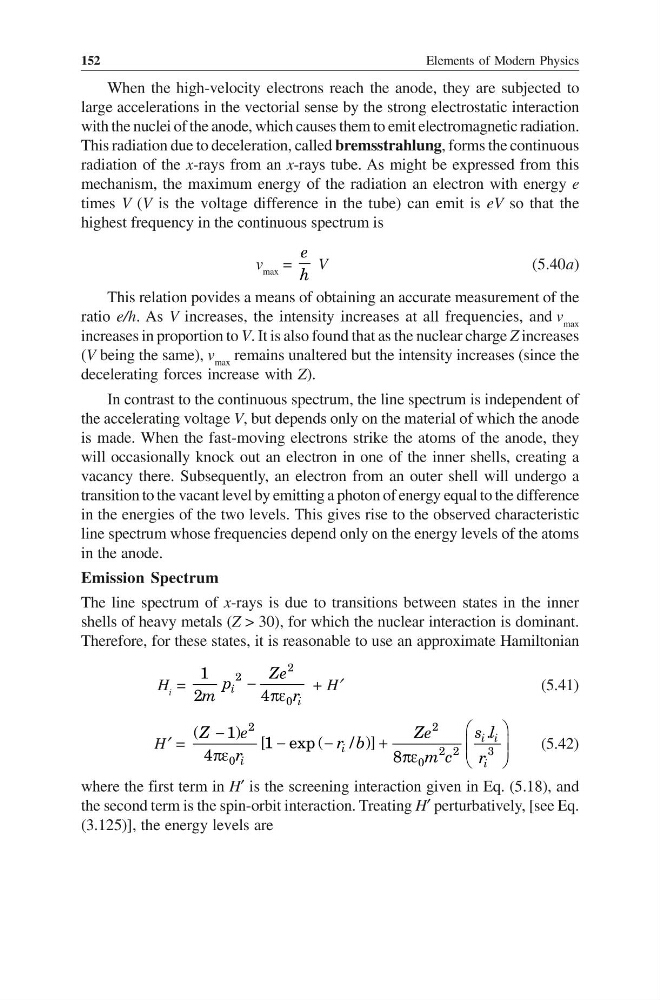
Therefore, for these states, it is reasonable to use an approximate Hamiltonian
H i =
2
2
0
1
2
4
i
i
Ze
p
m
r
− πε
+ H′
(5.41)
H′ =
−
−
−
+
πε
πε
2
2
2 2
3
0
0
.
(
1) [1 exp (
/ )]
4
8
i i
i
i
i
s l
Z
e
Ze
r b
r
m c
r
(5.42)
where the first term in H′ is the screening interaction given in Eq. (5.18), and
the second term is the spin-orbit interaction. Treating H′ perturbatively, [see Eq.
(3.125)], the energy levels are
152
When the high-velocity electrons reach the anode, they are subjected to
large accelerations in the vectorial sense by the strong electrostatic interaction
with the nuclei of the anode, which causes them to emit electromagnetic radiation.
This radiation due to deceleration, called bremsstrahlung, forms the continuous
radiation of the x-rays from an x-rays tube. As might be expressed from this
mechanism, the maximum energy of the radiation an electron with energy e
times V (V is the voltage difference in the tube) can emit is eV so that the
highest frequency in the continuous spectrum is
v max =
e
h
V
(5.40a)
This relation povides a means of obtaining an accurate measurement of the
ratio e/h. As V increases, the intensity increases at all frequencies, and v max
increases in proportion to V. It is also found that as the nuclear charge Z increases
(V being the same), v max remains unaltered but the intensity increases (since the
decelerating forces increase with Z).
In contrast to the continuous spectrum, the line spectrum is independent of
the accelerating voltage V, but depends only on the material of which the anode
is made. When the fast-moving electrons strike the atoms of the anode, they
will occasionally knock out an electron in one of the inner shells, creating a
vacancy there. Subsequently, an electron from an outer shell will undergo a
transition to the vacant level by emitting a photon of energy equal to the difference
in the energies of the two levels. This gives rise to the observed characteristic
line spectrum whose frequencies depend only on the energy levels of the atoms
in the anode.
Emission Spectrum
The line spectrum of x-rays is due to transitions between states in the inner
shells of heavy metals (Z > 30), for which the nuclear interaction is dominant.
Therefore, for these states, it is reasonable to use an approximate Hamiltonian
H i =
2
2
0
1
2
4
i
i
Ze
p
m
r
− πε
+ H′
(5.41)
H′ =
−
−
−
+
πε
πε
2
2
2 2
3
0
0
.
(
1) [1 exp (
/ )]
4
8
i i
i
i
i
s l
Z
e
Ze
r b
r
m c
r
(5.42)
where the first term in H′ is the screening interaction given in Eq. (5.18), and
the second term is the spin-orbit interaction. Treating H′ perturbatively, [see Eq.
(3.125)], the energy levels are