

Atoms and Molecules
151
their spectra, particularly their fine structure, corresponding to transitions
between states with same quantum numbers, are qualitatively similar.
3. Isoelectronic sequences: Atoms and ions with the same electronic
configuration form what is known as an isoelectronic sequence, e.g.
A, K
+
, Ca
++
. The members of the sequence differ only in the charge of the
nucleus. As such, their spectra will be similar, except that their frequencies
increase systematically with the increase in the charge of the nucleus.
This was noted in Sec. 4.6 for H, He
+
, Li
++
.
5.5 X-RAY SPECTRA
In Sec. 5.4, atomic spectra governed by the outer or valence electrons were
discussed. At the other extreme are the x-ray spectra which are produced by
the electrons in the inner shells of heavy atoms. For these electorns, the interaction
with the nucleus dominates over other interactions, which allows a relatively
simple description of the x-ray spectra.
X-rays are produced when solid targets are bombarded with fast electrons.
An x-ray tube consists of an evacuated bulb in which a heated cathode serves
as a source of electrons (thermionic emission). The electrons are accelerated
through a potential difference of the order of 50 kV, and made to strike the
anode made of heavy metals (Cu, W, Pt, etc.). While most of the electron
energy is liberated at the anode in the form of heat (the anode therefore, has
to be cooled), about 1 to 3% of it is converted into high frequency radiation–
the x-ray radiation which has a wavelength of the order of 10
–10
m.
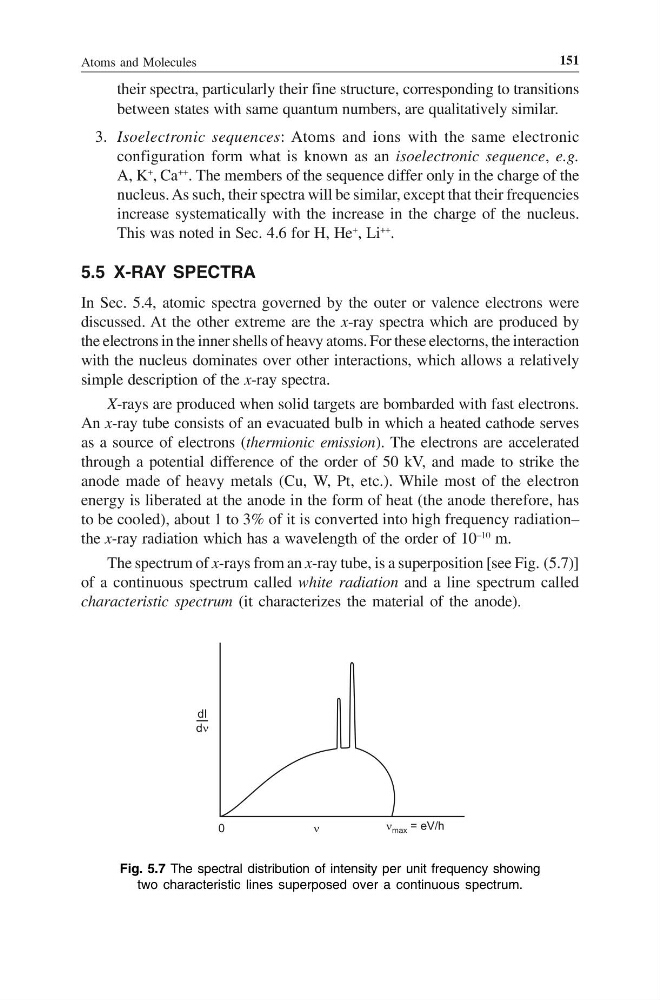
The spectrum of x-rays from an x-ray tube, is a superposition [see Fig. (5.7)]
of a continuous spectrum called white radiation and a line spectrum called
characteristic spectrum (it characterizes the material of the anode).
dI
dn
0
n
n max = eV/h
Fig. 5.7 The spectral distribution of intensity per unit frequency showing
two characteristic lines superposed over a continuous spectrum.
151
their spectra, particularly their fine structure, corresponding to transitions
between states with same quantum numbers, are qualitatively similar.
3. Isoelectronic sequences: Atoms and ions with the same electronic
configuration form what is known as an isoelectronic sequence, e.g.
A, K
+
, Ca
++
. The members of the sequence differ only in the charge of the
nucleus. As such, their spectra will be similar, except that their frequencies
increase systematically with the increase in the charge of the nucleus.
This was noted in Sec. 4.6 for H, He
+
, Li
++
.
5.5 X-RAY SPECTRA
In Sec. 5.4, atomic spectra governed by the outer or valence electrons were
discussed. At the other extreme are the x-ray spectra which are produced by
the electrons in the inner shells of heavy atoms. For these electorns, the interaction
with the nucleus dominates over other interactions, which allows a relatively
simple description of the x-ray spectra.
X-rays are produced when solid targets are bombarded with fast electrons.
An x-ray tube consists of an evacuated bulb in which a heated cathode serves
as a source of electrons (thermionic emission). The electrons are accelerated
through a potential difference of the order of 50 kV, and made to strike the
anode made of heavy metals (Cu, W, Pt, etc.). While most of the electron
energy is liberated at the anode in the form of heat (the anode therefore, has
to be cooled), about 1 to 3% of it is converted into high frequency radiation–
the x-ray radiation which has a wavelength of the order of 10
–10
m.
The spectrum of x-rays from an x-ray tube, is a superposition [see Fig. (5.7)]
of a continuous spectrum called white radiation and a line spectrum called
characteristic spectrum (it characterizes the material of the anode).
dI
dn
0
n
n max = eV/h
Fig. 5.7 The spectral distribution of intensity per unit frequency showing
two characteristic lines superposed over a continuous spectrum.