

Elements of Modern Physics
150
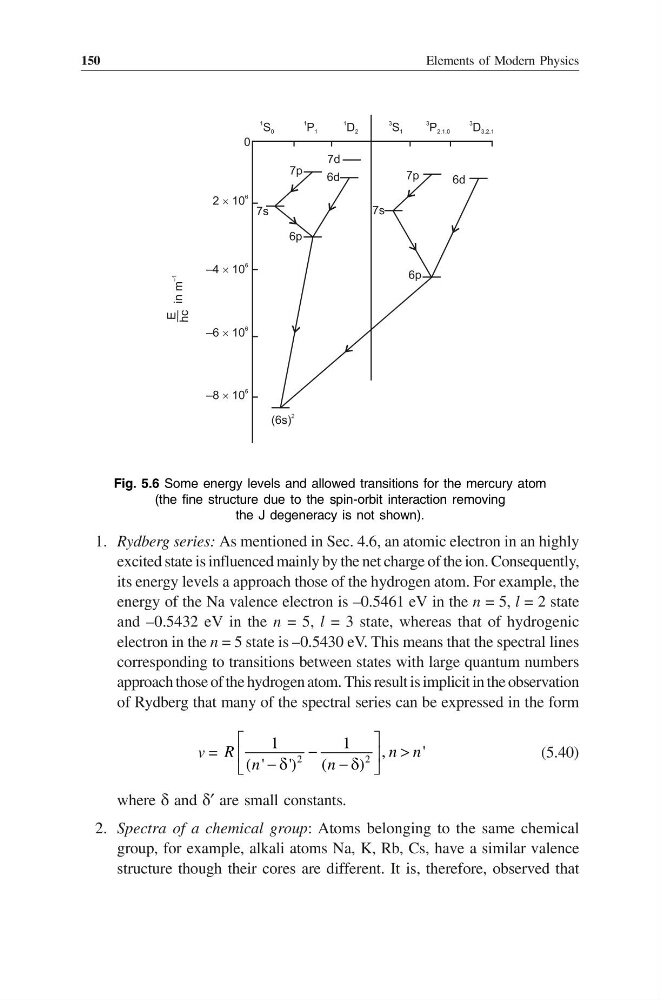
Fig. 5.6 Some energy levels and allowed transitions for the mercury atom
(the fine structure due to the spin-orbit interaction removing
the J degeneracy is not shown).
1. Rydberg series: As mentioned in Sec. 4.6, an atomic electron in an highly
excited state is influenced mainly by the net charge of the ion. Consequently,
its energy levels a approach those of the hydrogen atom. For example, the
energy of the Na valence electron is –0.5461 eV in the n = 5, l = 2 state
and –0.5432 eV in the n = 5, l = 3 state, whereas that of hydrogenic
electron in the n = 5 state is –0.5430 eV. This means that the spectral lines
corresponding to transitions between states with large quantum numbers
approach those of the hydrogen atom. This result is implicit in the observation
of Rydberg that many of the spectral series can be expressed in the form
v =
2
2
1
1
,
'
( '
')
(
)
R
nn
n
n
−
>
− δ
− δ
(5.40)
where δ and δ′ are small constants.
2. Spectra of a chemical group: Atoms belonging to the same chemical
group, for example, alkali atoms Na, K, Rb, Cs, have a similar valence
structure though their cores are different. It is, therefore, observed that
150
Fig. 5.6 Some energy levels and allowed transitions for the mercury atom
(the fine structure due to the spin-orbit interaction removing
the J degeneracy is not shown).
1. Rydberg series: As mentioned in Sec. 4.6, an atomic electron in an highly
excited state is influenced mainly by the net charge of the ion. Consequently,
its energy levels a approach those of the hydrogen atom. For example, the
energy of the Na valence electron is –0.5461 eV in the n = 5, l = 2 state
and –0.5432 eV in the n = 5, l = 3 state, whereas that of hydrogenic
electron in the n = 5 state is –0.5430 eV. This means that the spectral lines
corresponding to transitions between states with large quantum numbers
approach those of the hydrogen atom. This result is implicit in the observation
of Rydberg that many of the spectral series can be expressed in the form
v =
2
2
1
1
,
'
( '
')
(
)
R
nn
n
n
−
>
− δ
− δ
(5.40)
where δ and δ′ are small constants.
2. Spectra of a chemical group: Atoms belonging to the same chemical
group, for example, alkali atoms Na, K, Rb, Cs, have a similar valence
structure though their cores are different. It is, therefore, observed that