

Elements of Modern Physics
148
only J = 2, 1 for j 1 = 3/2, j 2 = 1/2. Finally, for l = 1 and n′ = n, the electrons are
in the same subshell. There is only one set of antisymmetric states corresponding
to j 1 = 1/2, j 2 = 3/2 and j 1 = 3/2, j 2 = 1/2. Furthermore, the Pauli exclusion
principle restricts the allowed states to (3/2, 3/2) 2,0 , {(3/2, 1/2), (1/2, 3/2)} 2,1
and (1/2, 1/2) 0 for (j 1 , j 2 ) J , where the last state is the ground state. It should be
observed that the number of final levels and the allowed J values are the same
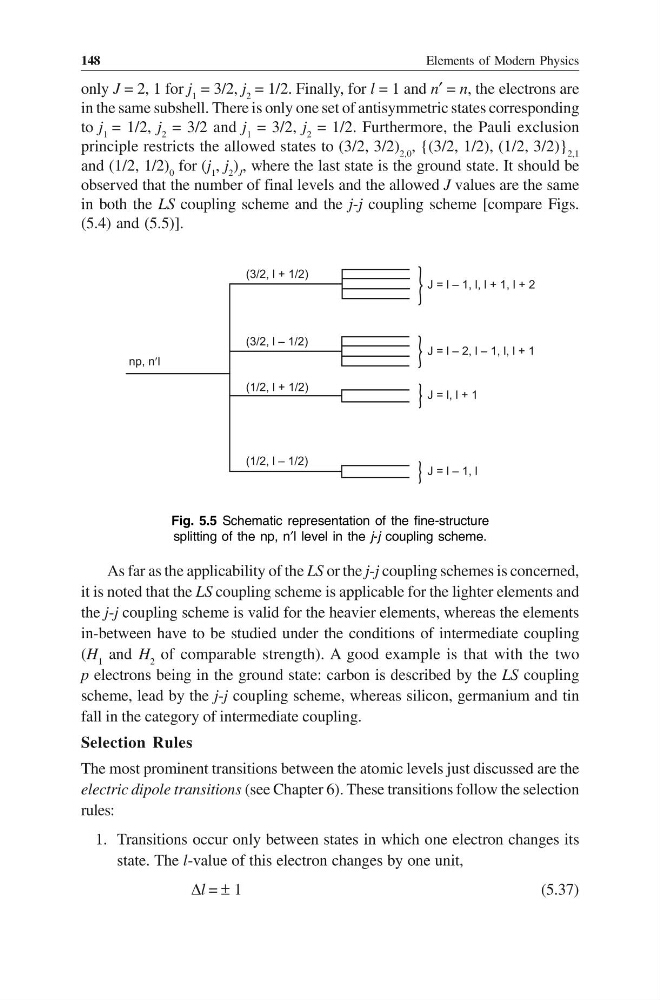
in both the LS coupling scheme and the j-j coupling scheme [compare Figs.
(5.4) and (5.5)].
Fig. 5.5 Schematic representation of the fine-structure
splitting of the np, n′l level in the j-j coupling scheme.
As far as the applicability of the LS or the j-j coupling schemes is concerned,
it is noted that the LS coupling scheme is applicable for the lighter elements and
the j-j coupling scheme is valid for the heavier elements, whereas the elements
in-between have to be studied under the conditions of intermediate coupling
(H 1 and H 2 of comparable strength). A good example is that with the two
p electrons being in the ground state: carbon is described by the LS coupling
scheme, lead by the j-j coupling scheme, whereas silicon, germanium and tin
fall in the category of intermediate coupling.
Selection Rules
The most prominent transitions between the atomic levels just discussed are the
electric dipole transitions (see Chapter 6). These transitions follow the selection
rules:
1. Transitions occur only between states in which one electron changes its
state. The l-value of this electron changes by one unit,
∆l = ± 1
(5.37)
148
only J = 2, 1 for j 1 = 3/2, j 2 = 1/2. Finally, for l = 1 and n′ = n, the electrons are
in the same subshell. There is only one set of antisymmetric states corresponding
to j 1 = 1/2, j 2 = 3/2 and j 1 = 3/2, j 2 = 1/2. Furthermore, the Pauli exclusion
principle restricts the allowed states to (3/2, 3/2) 2,0 , {(3/2, 1/2), (1/2, 3/2)} 2,1
and (1/2, 1/2) 0 for (j 1 , j 2 ) J , where the last state is the ground state. It should be
observed that the number of final levels and the allowed J values are the same
in both the LS coupling scheme and the j-j coupling scheme [compare Figs.
(5.4) and (5.5)].
Fig. 5.5 Schematic representation of the fine-structure
splitting of the np, n′l level in the j-j coupling scheme.
As far as the applicability of the LS or the j-j coupling schemes is concerned,
it is noted that the LS coupling scheme is applicable for the lighter elements and
the j-j coupling scheme is valid for the heavier elements, whereas the elements
in-between have to be studied under the conditions of intermediate coupling
(H 1 and H 2 of comparable strength). A good example is that with the two
p electrons being in the ground state: carbon is described by the LS coupling
scheme, lead by the j-j coupling scheme, whereas silicon, germanium and tin
fall in the category of intermediate coupling.
Selection Rules
The most prominent transitions between the atomic levels just discussed are the
electric dipole transitions (see Chapter 6). These transitions follow the selection
rules:
1. Transitions occur only between states in which one electron changes its
state. The l-value of this electron changes by one unit,
∆l = ± 1
(5.37)