

Atoms and Molecules
147
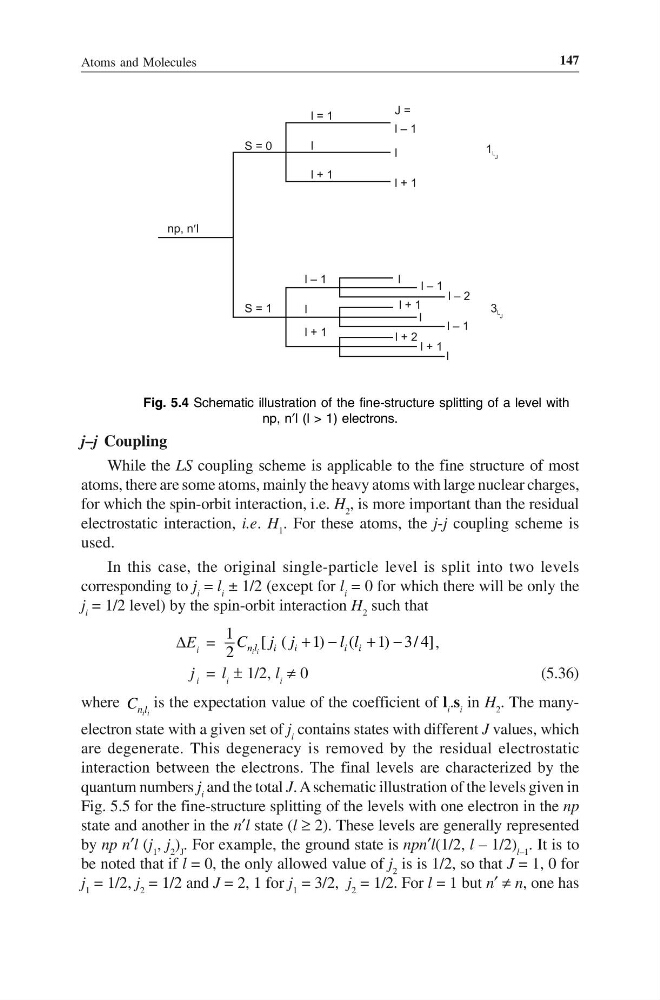
Fig. 5.4 Schematic illustration of the fine-structure splitting of a level with
np, n′l (l > 1) electrons.
j–j Coupling
While the LS coupling scheme is applicable to the fine structure of most
atoms, there are some atoms, mainly the heavy atoms with large nuclear charges,
for which the spin-orbit interaction, i.e. H 2 , is more important than the residual
electrostatic interaction, i.e. H 1 . For these atoms, the j-j coupling scheme is
used.
In this case, the original single-particle level is split into two levels
corresponding to j i = l i ± 1/2 (except for l i = 0 for which there will be only the
j i = 1/2 level) by the spin-orbit interaction H 2 such that
∆E i =
1
[ (
1)
( 1) 3/4]
2 i i
n l
i
i
i i
C j j
l l
+ −
+ −
,
j i = l i ± 1/2, l i ≠ 0
(5.36)
where
i i
n l
C is the expectation value of the coefficient of l i .s i in H 2 . The manyelectron state with a given set of j i contains states with different J values, which
are degenerate. This degeneracy is removed by the residual electrostatic
interaction between the electrons. The final levels are characterized by the
quantum numbers j i and the total J. A schematic illustration of the levels given in
Fig. 5.5 for the fine-structure splitting of the levels with one electron in the np
state and another in the n′l state (l ≥ 2). These levels are generally represented
by np n′l (j 1 , j 2 ) J . For example, the ground state is npn′l(1/2, l – 1/2) l–1 . It is to
be noted that if l = 0, the only allowed value of j 2 is is 1/2, so that J = 1, 0 for
j 1 = 1/2, j 2 = 1/2 and J = 2, 1 for j 1 = 3/2, j 2 = 1/2. For l = 1 but n′ ≠ n, one has
147
Fig. 5.4 Schematic illustration of the fine-structure splitting of a level with
np, n′l (l > 1) electrons.
j–j Coupling
While the LS coupling scheme is applicable to the fine structure of most
atoms, there are some atoms, mainly the heavy atoms with large nuclear charges,
for which the spin-orbit interaction, i.e. H 2 , is more important than the residual
electrostatic interaction, i.e. H 1 . For these atoms, the j-j coupling scheme is
used.
In this case, the original single-particle level is split into two levels
corresponding to j i = l i ± 1/2 (except for l i = 0 for which there will be only the
j i = 1/2 level) by the spin-orbit interaction H 2 such that
∆E i =
1
[ (
1)
( 1) 3/4]
2 i i
n l
i
i
i i
C j j
l l
+ −
+ −
,
j i = l i ± 1/2, l i ≠ 0
(5.36)
where
i i
n l
C is the expectation value of the coefficient of l i .s i in H 2 . The manyelectron state with a given set of j i contains states with different J values, which
are degenerate. This degeneracy is removed by the residual electrostatic
interaction between the electrons. The final levels are characterized by the
quantum numbers j i and the total J. A schematic illustration of the levels given in
Fig. 5.5 for the fine-structure splitting of the levels with one electron in the np
state and another in the n′l state (l ≥ 2). These levels are generally represented
by np n′l (j 1 , j 2 ) J . For example, the ground state is npn′l(1/2, l – 1/2) l–1 . It is to
be noted that if l = 0, the only allowed value of j 2 is is 1/2, so that J = 1, 0 for
j 1 = 1/2, j 2 = 1/2 and J = 2, 1 for j 1 = 3/2, j 2 = 1/2. For l = 1 but n′ ≠ n, one has