

Elements of Modern Physics
138
the He (helium) are in states n = 1, l = 0, m l = 0 and m s = ± 1/2, the configuration
being (1s)
2
. The configuration of Na is (1s)
2
(2s)
2
(2p)
6
3s, while that of Sr is
(1s)
2
(2s)
2
(2p)
6
(3d)
2
(3p)
6
(3d)
10
(4s)
2
(4p)
6
(5s)
2
the total number of electrons
being 38.
The electronic configurations are summarized in Table 5.1, showing the
order in which the subshells are filled. The exceptions (shown in bold type)
along with the configuration of the unfilled shells are Cr–(4s) (3d)
5
, Cu – 4s
(3d)
10
, Nb – 5s (4d)
4
, Mo–5s (4d)
5
, Ru–5s (4d)
7
, Rh –5s (4d)
8
, Pd – (4d)
10
and
no electrons in the 5s shell, Ag–5s (4d)
10
, La – (5d) and no electrons in the 4f
shell, Gd–5d (4f)
7
, Pt – 6s (5d)
9
and Au–6s (5d)
10
. Apart from these, of the
heavy elements (Z = 89 to 102), Ac, Pa, U, Np, Pu, Am, Cm, Bk have the
configuration 6d(5f)
Z–89
. The has the configuration (6d)
2
with no electrons in 5f
shell, while Cf, E, Fm, Md, No have the configuration (5f)
Z–88
with no electrons
in the 6d shell. Some important consequences of the electronic configurations
of the atoms are now discussed.
Ionization Potential
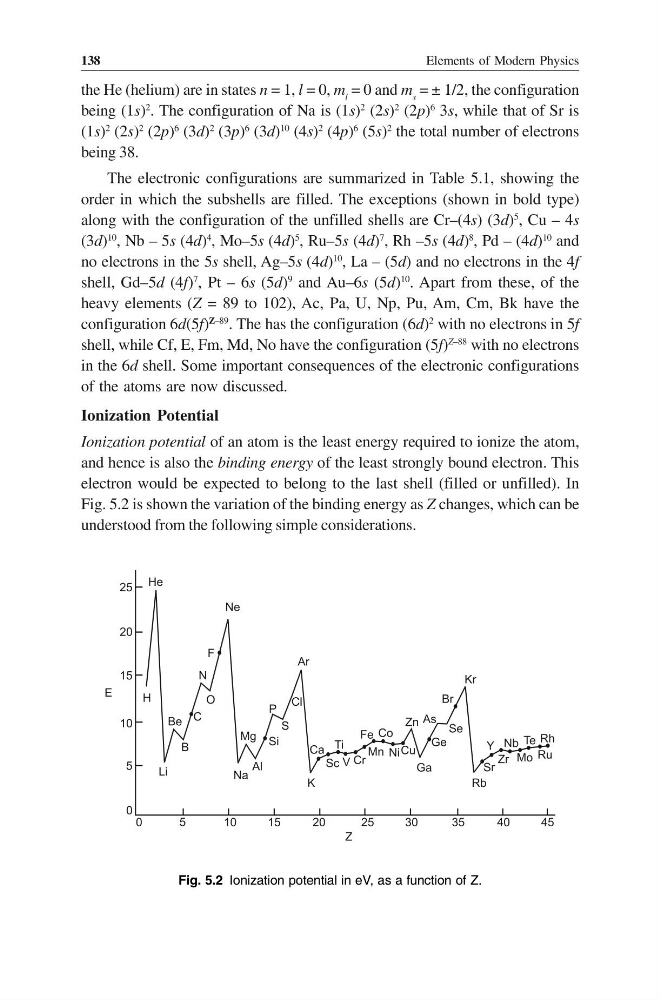
Ionization potential of an atom is the least energy required to ionize the atom,
and hence is also the binding energy of the least strongly bound electron. This
electron would be expected to belong to the last shell (filled or unfilled). In
Fig. 5.2 is shown the variation of the binding energy as Z changes, which can be
understood from the following simple considerations.
Fig. 5.2 Ionization potential in eV, as a function of Z.
138
the He (helium) are in states n = 1, l = 0, m l = 0 and m s = ± 1/2, the configuration
being (1s)
2
. The configuration of Na is (1s)
2
(2s)
2
(2p)
6
3s, while that of Sr is
(1s)
2
(2s)
2
(2p)
6
(3d)
2
(3p)
6
(3d)
10
(4s)
2
(4p)
6
(5s)
2
the total number of electrons
being 38.
The electronic configurations are summarized in Table 5.1, showing the
order in which the subshells are filled. The exceptions (shown in bold type)
along with the configuration of the unfilled shells are Cr–(4s) (3d)
5
, Cu – 4s
(3d)
10
, Nb – 5s (4d)
4
, Mo–5s (4d)
5
, Ru–5s (4d)
7
, Rh –5s (4d)
8
, Pd – (4d)
10
and
no electrons in the 5s shell, Ag–5s (4d)
10
, La – (5d) and no electrons in the 4f
shell, Gd–5d (4f)
7
, Pt – 6s (5d)
9
and Au–6s (5d)
10
. Apart from these, of the
heavy elements (Z = 89 to 102), Ac, Pa, U, Np, Pu, Am, Cm, Bk have the
configuration 6d(5f)
Z–89
. The has the configuration (6d)
2
with no electrons in 5f
shell, while Cf, E, Fm, Md, No have the configuration (5f)
Z–88
with no electrons
in the 6d shell. Some important consequences of the electronic configurations
of the atoms are now discussed.
Ionization Potential
Ionization potential of an atom is the least energy required to ionize the atom,
and hence is also the binding energy of the least strongly bound electron. This
electron would be expected to belong to the last shell (filled or unfilled). In
Fig. 5.2 is shown the variation of the binding energy as Z changes, which can be
understood from the following simple considerations.
Fig. 5.2 Ionization potential in eV, as a function of Z.