

Atoms and Molecules
137
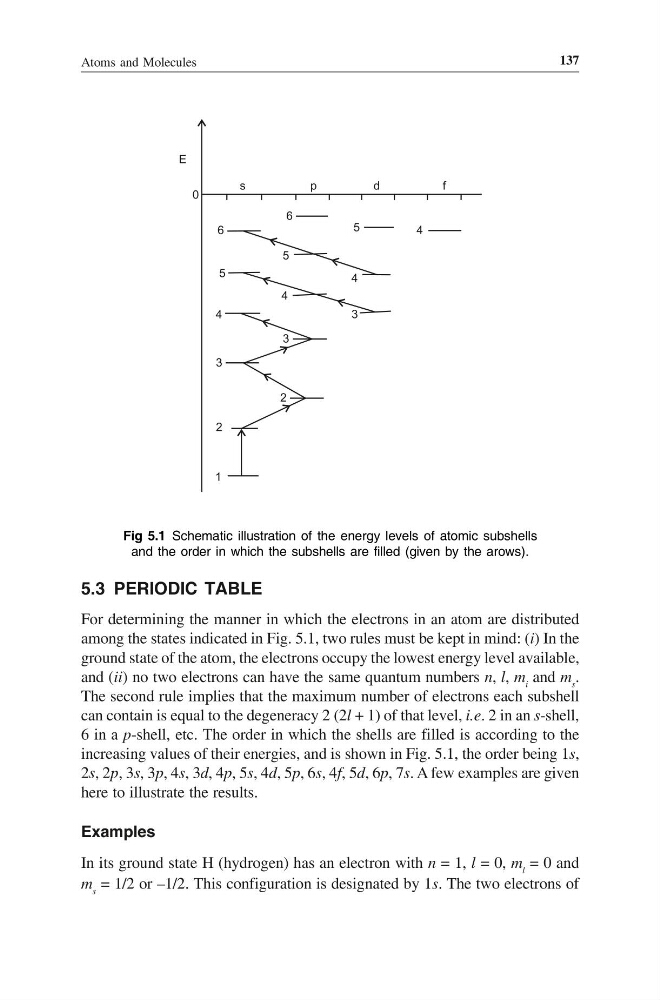
Fig 5.1 Schematic illustration of the energy levels of atomic subshells
and the order in which the subshells are filled (given by the arows).
5.3 PERIODIC TABLE
For determining the manner in which the electrons in an atom are distributed
among the states indicated in Fig. 5.1, two rules must be kept in mind: (i) In the
ground state of the atom, the electrons occupy the lowest energy level available,
and (ii) no two electrons can have the same quantum numbers n, l, m i and m s .
The second rule implies that the maximum number of electrons each subshell
can contain is equal to the degeneracy 2 (2l + 1) of that level, i.e. 2 in an s-shell,
6 in a p-shell, etc. The order in which the shells are filled is according to the
increasing values of their energies, and is shown in Fig. 5.1, the order being 1s,
2s, 2p, 3s, 3p, 4s, 3d, 4p, 5s, 4d, 5p, 6s, 4f, 5d, 6p, 7s. A few examples are given
here to illustrate the results.
Examples
In its ground state H (hydrogen) has an electron with n = 1, l = 0, m l = 0 and
m s = 1/2 or –1/2. This configuration is designated by 1s. The two electrons of
137
Fig 5.1 Schematic illustration of the energy levels of atomic subshells
and the order in which the subshells are filled (given by the arows).
5.3 PERIODIC TABLE
For determining the manner in which the electrons in an atom are distributed
among the states indicated in Fig. 5.1, two rules must be kept in mind: (i) In the
ground state of the atom, the electrons occupy the lowest energy level available,
and (ii) no two electrons can have the same quantum numbers n, l, m i and m s .
The second rule implies that the maximum number of electrons each subshell
can contain is equal to the degeneracy 2 (2l + 1) of that level, i.e. 2 in an s-shell,
6 in a p-shell, etc. The order in which the shells are filled is according to the
increasing values of their energies, and is shown in Fig. 5.1, the order being 1s,
2s, 2p, 3s, 3p, 4s, 3d, 4p, 5s, 4d, 5p, 6s, 4f, 5d, 6p, 7s. A few examples are given
here to illustrate the results.
Examples
In its ground state H (hydrogen) has an electron with n = 1, l = 0, m l = 0 and
m s = 1/2 or –1/2. This configuration is designated by 1s. The two electrons of