

Elements of Modern Physics
112
V 3 =
2 2
2 2
0
( )
8
π
δ
πε
e
e
Z
m c
r
(4.54)
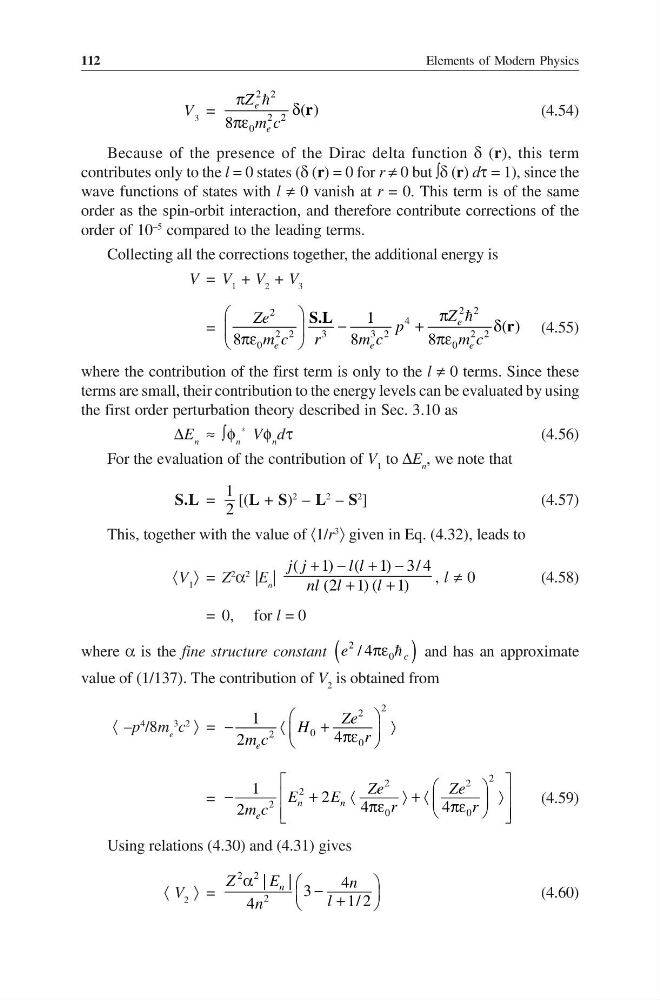
Because of the presence of the Dirac delta function δ (r), this term
contributes only to the l = 0 states (δ (r) = 0 for r ≠ 0 but ∫δ (r) dτ = 1), since the
wave functions of states with l ≠ 0 vanish at r = 0. This term is of the same
order as the spin-orbit interaction, and therefore contribute corrections of the
order of 10
–5
compared to the leading terms.
Collecting all the corrections together, the additional energy is
V = V 1 + V 2 + V 3
=
2 2
2
4
2 2
3
3 2
2 2
0
0
1
( )
8
8
8
π
−
+
δ
πε
πε
e
e
e
e
Z
Ze
p
m c
r
m c
m c
S.L
r
(4.55)
where the contribution of the first term is only to the l ≠ 0 terms. Since these
terms are small, their contribution to the energy levels can be evaluated by using
the first order perturbation theory described in Sec. 3.10 as
∆E n ≈ ∫φ n
*
Vφ n dτ
(4.56)
For the evaluation of the contribution of V 1 to ∆E n , we note that
S.L =
1
2
[(L + S)
2
– L
2
– S
2
]
(4.57)
This, together with the value of 〈1/r
3
〉 given in Eq. (4.32), leads to
〈V 1 〉 = Z
2
α
2
|E n |
( 1) ( 1) 3/4
(2 1) ( 1)
j j
l l
nl l
l
+ − + −
+
+
, l ≠ 0
(4.58)
= 0, for l = 0
where α is the fine structure constant (
)
2
0
/ 4
c
e
πε and has an approximate
value of (1/137). The contribution of V 2 is obtained from
〈 –p
4
/8m e
3
c
2
〉 =
2
2
0
2
0
1
4
2 e
Ze
H
r
m c
−
〈
+
〉
πε
=
2
2
2
2
2
0
0
1
2
4
4
2
n
n
e
Ze
Ze
E
E
r
r
m c
−
+
〈
〉+ 〈
〉
πε
πε
(4.59)
Using relations (4.30) and (4.31) gives
〈 V 2 〉 =
2 2
2
| |
4
3
1/ 2
4
n
Z
E
n
l
n
α
−
+
(4.60)
112
V 3 =
2 2
2 2
0
( )
8
π
δ
πε
e
e
Z
m c
r
(4.54)
Because of the presence of the Dirac delta function δ (r), this term
contributes only to the l = 0 states (δ (r) = 0 for r ≠ 0 but ∫δ (r) dτ = 1), since the
wave functions of states with l ≠ 0 vanish at r = 0. This term is of the same
order as the spin-orbit interaction, and therefore contribute corrections of the
order of 10
–5
compared to the leading terms.
Collecting all the corrections together, the additional energy is
V = V 1 + V 2 + V 3
=
2 2
2
4
2 2
3
3 2
2 2
0
0
1
( )
8
8
8
π
−
+
δ
πε
πε
e
e
e
e
Z
Ze
p
m c
r
m c
m c
S.L
r
(4.55)
where the contribution of the first term is only to the l ≠ 0 terms. Since these
terms are small, their contribution to the energy levels can be evaluated by using
the first order perturbation theory described in Sec. 3.10 as
∆E n ≈ ∫φ n
*
Vφ n dτ
(4.56)
For the evaluation of the contribution of V 1 to ∆E n , we note that
S.L =
1
2
[(L + S)
2
– L
2
– S
2
]
(4.57)
This, together with the value of 〈1/r
3
〉 given in Eq. (4.32), leads to
〈V 1 〉 = Z
2
α
2
|E n |
( 1) ( 1) 3/4
(2 1) ( 1)
j j
l l
nl l
l
+ − + −
+
+
, l ≠ 0
(4.58)
= 0, for l = 0
where α is the fine structure constant (
)
2
0
/ 4
c
e
πε and has an approximate
value of (1/137). The contribution of V 2 is obtained from
〈 –p
4
/8m e
3
c
2
〉 =
2
2
0
2
0
1
4
2 e
Ze
H
r
m c
−
〈
+
〉
πε
=
2
2
2
2
2
0
0
1
2
4
4
2
n
n
e
Ze
Ze
E
E
r
r
m c
−
+
〈
〉+ 〈
〉
πε
πε
(4.59)
Using relations (4.30) and (4.31) gives
〈 V 2 〉 =
2 2
2
| |
4
3
1/ 2
4
n
Z
E
n
l
n
α
−
+
(4.60)