

The One-Electron Atom
113
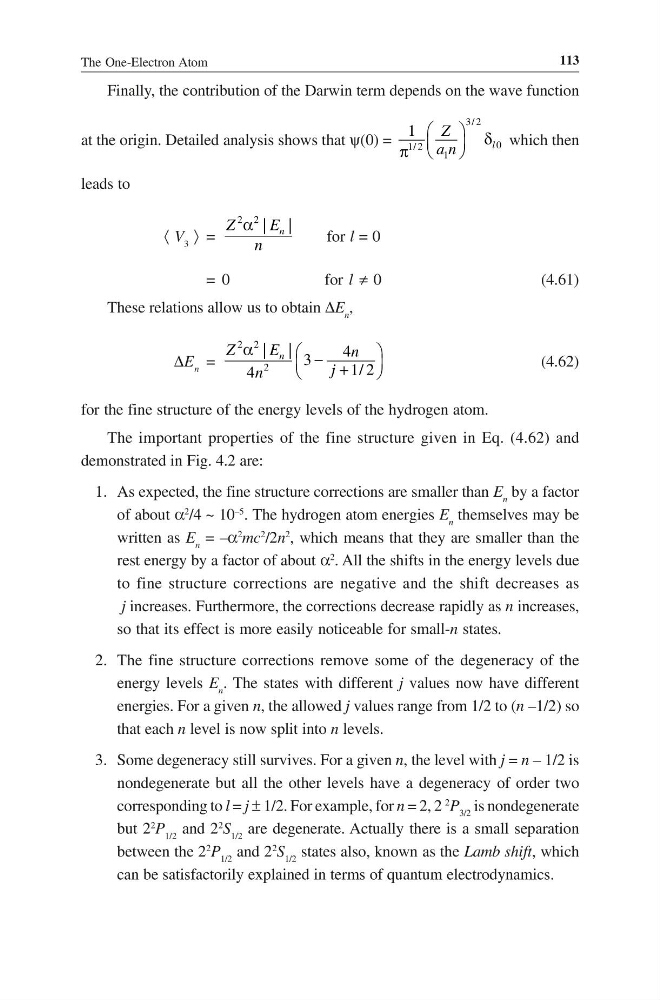
Finally, the contribution of the Darwin term depends on the wave function
at the origin. Detailed analysis shows that ψ(0) =
3/ 2
0
1/ 2
1
1
l
Z
a n
δ
π
which then
leads to
〈 V 3 〉 =
2 2 | |
n
Z
E
n
α
for l = 0
= 0
for l ≠ 0
(4.61)
These relations allow us to obtain ∆E n ,
∆E n =
2 2
2
| |
4
3
1/ 2
4
n
Z
E
n
j
n
α
−
+
(4.62)
for the fine structure of the energy levels of the hydrogen atom.
The important properties of the fine structure given in Eq. (4.62) and
demonstrated in Fig. 4.2 are:
1. As expected, the fine structure corrections are smaller than E n by a factor
of about α
2
/4 ~ 10
–5
. The hydrogen atom energies E n themselves may be
written as E n = –α
2
mc
2
/2n
2
, which means that they are smaller than the
rest energy by a factor of about α
2
. All the shifts in the energy levels due
to fine structure corrections are negative and the shift decreases as
j increases. Furthermore, the corrections decrease rapidly as n increases,
so that its effect is more easily noticeable for small-n states.
2. The fine structure corrections remove some of the degeneracy of the
energy levels E n . The states with different j values now have different
energies. For a given n, the allowed j values range from 1/2 to (n –1/2) so
that each n level is now split into n levels.
3. Some degeneracy still survives. For a given n, the level with j = n – 1/2 is
nondegenerate but all the other levels have a degeneracy of order two
corresponding to l = j ± 1/2. For example, for n = 2, 2
2
P 3/2 is nondegenerate
but 2
2
P 1/2 and 2
2
S 1/2 are degenerate. Actually there is a small separation
between the 2
2
P 1/2 and 2
2
S 1/2 states also, known as the Lamb shift, which
can be satisfactorily explained in terms of quantum electrodynamics.
113
Finally, the contribution of the Darwin term depends on the wave function
at the origin. Detailed analysis shows that ψ(0) =
3/ 2
0
1/ 2
1
1
l
Z
a n
δ
π
which then
leads to
〈 V 3 〉 =
2 2 | |
n
Z
E
n
α
for l = 0
= 0
for l ≠ 0
(4.61)
These relations allow us to obtain ∆E n ,
∆E n =
2 2
2
| |
4
3
1/ 2
4
n
Z
E
n
j
n
α
−
+
(4.62)
for the fine structure of the energy levels of the hydrogen atom.
The important properties of the fine structure given in Eq. (4.62) and
demonstrated in Fig. 4.2 are:
1. As expected, the fine structure corrections are smaller than E n by a factor
of about α
2
/4 ~ 10
–5
. The hydrogen atom energies E n themselves may be
written as E n = –α
2
mc
2
/2n
2
, which means that they are smaller than the
rest energy by a factor of about α
2
. All the shifts in the energy levels due
to fine structure corrections are negative and the shift decreases as
j increases. Furthermore, the corrections decrease rapidly as n increases,
so that its effect is more easily noticeable for small-n states.
2. The fine structure corrections remove some of the degeneracy of the
energy levels E n . The states with different j values now have different
energies. For a given n, the allowed j values range from 1/2 to (n –1/2) so
that each n level is now split into n levels.
3. Some degeneracy still survives. For a given n, the level with j = n – 1/2 is
nondegenerate but all the other levels have a degeneracy of order two
corresponding to l = j ± 1/2. For example, for n = 2, 2
2
P 3/2 is nondegenerate
but 2
2
P 1/2 and 2
2
S 1/2 are degenerate. Actually there is a small separation
between the 2
2
P 1/2 and 2
2
S 1/2 states also, known as the Lamb shift, which
can be satisfactorily explained in terms of quantum electrodynamics.