

The One-Electron Atom
111
B =
2
3
0
×
4
πε
c
e
m
Ze
m c
r
r v
(4.49)
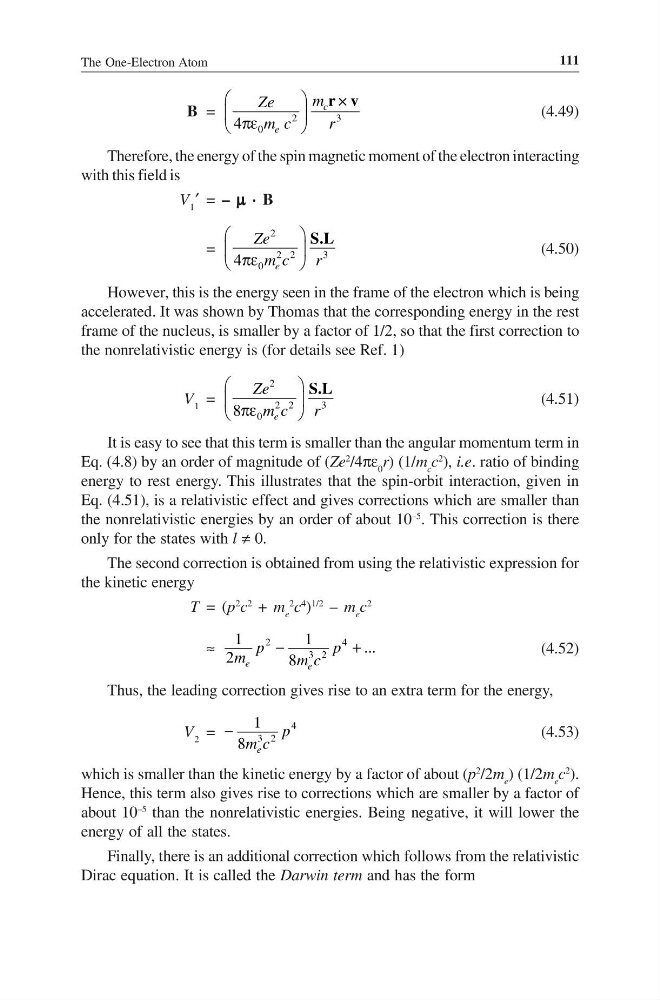
Therefore, the energy of the spin magnetic moment of the electron interacting
with this field is
V 1 ′ = – µ ⋅
µ ⋅
µ ⋅
µ ⋅
µ ⋅ B
=
2
2 2
3
0
4
πε
e
Ze
m c
r
S.L
(4.50)
However, this is the energy seen in the frame of the electron which is being
accelerated. It was shown by Thomas that the corresponding energy in the rest
frame of the nucleus, is smaller by a factor of 1/2, so that the first correction to
the nonrelativistic energy is (for details see Ref. 1)
V 1 =
2
2 2
3
0
8
πε
e
Ze
m c
r
S.L
(4.51)
It is easy to see that this term is smaller than the angular momentum term in
Eq. (4.8) by an order of magnitude of (Ze
2
/4πε 0 r) (1/m c c
2
), i.e. ratio of binding
energy to rest energy. This illustrates that the spin-orbit interaction, given in
Eq. (4.51), is a relativistic effect and gives corrections which are smaller than
the nonrelativistic energies by an order of about 10
–5
. This correction is there
only for the states with l ≠ 0.
The second correction is obtained from using the relativistic expression for
the kinetic energy
T = (p
2
c
2
+ m e
2
c
4
)
1/2
– m e c
2
≈
2
4
3 2
1
1
...
2
8
e
e
p
p
m
m c
−
+
(4.52)
Thus, the leading correction gives rise to an extra term for the energy,
V 2 =
4
3 2
1
8 e
p
m c
−
(4.53)
which is smaller than the kinetic energy by a factor of about (p
2
/2m e ) (1/2m e c
2
).
Hence, this term also gives rise to corrections which are smaller by a factor of
about 10
–5
than the nonrelativistic energies. Being negative, it will lower the
energy of all the states.
Finally, there is an additional correction which follows from the relativistic
Dirac equation. It is called the Darwin term and has the form
111
B =
2
3
0
×
4
πε
c
e
m
Ze
m c
r
r v
(4.49)
Therefore, the energy of the spin magnetic moment of the electron interacting
with this field is
V 1 ′ = – µ ⋅
µ ⋅
µ ⋅
µ ⋅
µ ⋅ B
=
2
2 2
3
0
4
πε
e
Ze
m c
r
S.L
(4.50)
However, this is the energy seen in the frame of the electron which is being
accelerated. It was shown by Thomas that the corresponding energy in the rest
frame of the nucleus, is smaller by a factor of 1/2, so that the first correction to
the nonrelativistic energy is (for details see Ref. 1)
V 1 =
2
2 2
3
0
8
πε
e
Ze
m c
r
S.L
(4.51)
It is easy to see that this term is smaller than the angular momentum term in
Eq. (4.8) by an order of magnitude of (Ze
2
/4πε 0 r) (1/m c c
2
), i.e. ratio of binding
energy to rest energy. This illustrates that the spin-orbit interaction, given in
Eq. (4.51), is a relativistic effect and gives corrections which are smaller than
the nonrelativistic energies by an order of about 10
–5
. This correction is there
only for the states with l ≠ 0.
The second correction is obtained from using the relativistic expression for
the kinetic energy
T = (p
2
c
2
+ m e
2
c
4
)
1/2
– m e c
2
≈
2
4
3 2
1
1
...
2
8
e
e
p
p
m
m c
−
+
(4.52)
Thus, the leading correction gives rise to an extra term for the energy,
V 2 =
4
3 2
1
8 e
p
m c
−
(4.53)
which is smaller than the kinetic energy by a factor of about (p
2
/2m e ) (1/2m e c
2
).
Hence, this term also gives rise to corrections which are smaller by a factor of
about 10
–5
than the nonrelativistic energies. Being negative, it will lower the
energy of all the states.
Finally, there is an additional correction which follows from the relativistic
Dirac equation. It is called the Darwin term and has the form