

Elements of Modern Physics
110
It therefore follows from Eqs. (4.47) and (4.44), that j takes on integral
values if s takes integral values, and half-integral values if s takes half-integral
values.
An electron n an atom is characterized by the quantum numbers n, l, s
and j. In spectroscopic notation, the state of such an electron is designated by
n
2s + 1
L j
(4.48)
The superscript 2s + 1 gives the multiplicity of the state for l ≥ s, as can be
deduced from Eq. (4.46). The subscript in the notation describes the total angular
momentum. In place of L, a letter which conventionally denotes a particular
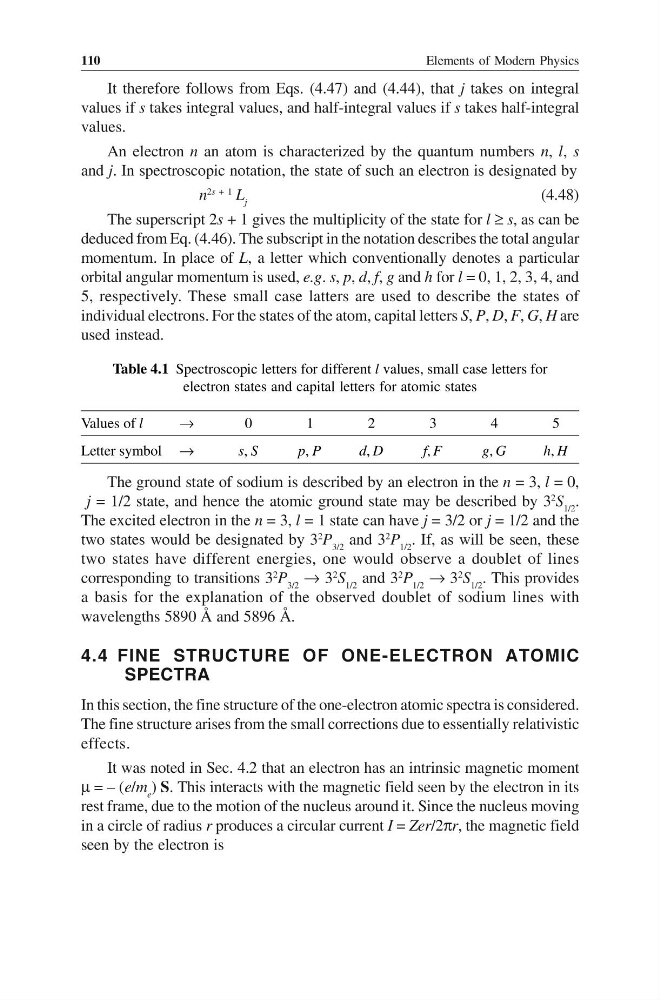
orbital angular momentum is used, e.g. s, p, d, f, g and h for l = 0, 1, 2, 3, 4, and
5, respectively. These small case latters are used to describe the states of
individual electrons. For the states of the atom, capital letters S, P, D, F, G, H are
used instead.
Table 4.1 Spectroscopic letters for different l values, small case letters for
electron states and capital letters for atomic states
Values of l
→
0
1
2
3
4
5
Letter symbol →
s, S
p, P
d, D
f, F
g, G
h, H
The ground state of sodium is described by an electron in the n = 3, l = 0,
j = 1/2 state, and hence the atomic ground state may be described by 3
2
S 1/2 .
The excited electron in the n = 3, l = 1 state can have j = 3/2 or j = 1/2 and the
two states would be designated by 3
2
P 3/2 and 3
2
P 1/2 . If, as will be seen, these
two states have different energies, one would observe a doublet of lines
corresponding to transitions 3
2
P 3/2 → 3
2
S 1/2 and 3
2
P 1/2 → 3
2
S 1/2 . This provides
a basis for the explanation of the observed doublet of sodium lines with
wavelengths 5890 Å and 5896 Å.
4.4 FINE STRUCTURE OF ONE-ELECTRON ATOMIC
SPECTRA
In this section, the fine structure of the one-electron atomic spectra is considered.
The fine structure arises from the small corrections due to essentially relativistic
effects.
It was noted in Sec. 4.2 that an electron has an intrinsic magnetic moment
µ = – (e/m e ) S. This interacts with the magnetic field seen by the electron in its
rest frame, due to the motion of the nucleus around it. Since the nucleus moving
in a circle of radius r produces a circular current I = Zer/2πr, the magnetic field
seen by the electron is
110
It therefore follows from Eqs. (4.47) and (4.44), that j takes on integral
values if s takes integral values, and half-integral values if s takes half-integral
values.
An electron n an atom is characterized by the quantum numbers n, l, s
and j. In spectroscopic notation, the state of such an electron is designated by
n
2s + 1
L j
(4.48)
The superscript 2s + 1 gives the multiplicity of the state for l ≥ s, as can be
deduced from Eq. (4.46). The subscript in the notation describes the total angular
momentum. In place of L, a letter which conventionally denotes a particular
orbital angular momentum is used, e.g. s, p, d, f, g and h for l = 0, 1, 2, 3, 4, and
5, respectively. These small case latters are used to describe the states of
individual electrons. For the states of the atom, capital letters S, P, D, F, G, H are
used instead.
Table 4.1 Spectroscopic letters for different l values, small case letters for
electron states and capital letters for atomic states
Values of l
→
0
1
2
3
4
5
Letter symbol →
s, S
p, P
d, D
f, F
g, G
h, H
The ground state of sodium is described by an electron in the n = 3, l = 0,
j = 1/2 state, and hence the atomic ground state may be described by 3
2
S 1/2 .
The excited electron in the n = 3, l = 1 state can have j = 3/2 or j = 1/2 and the
two states would be designated by 3
2
P 3/2 and 3
2
P 1/2 . If, as will be seen, these
two states have different energies, one would observe a doublet of lines
corresponding to transitions 3
2
P 3/2 → 3
2
S 1/2 and 3
2
P 1/2 → 3
2
S 1/2 . This provides
a basis for the explanation of the observed doublet of sodium lines with
wavelengths 5890 Å and 5896 Å.
4.4 FINE STRUCTURE OF ONE-ELECTRON ATOMIC
SPECTRA
In this section, the fine structure of the one-electron atomic spectra is considered.
The fine structure arises from the small corrections due to essentially relativistic
effects.
It was noted in Sec. 4.2 that an electron has an intrinsic magnetic moment
µ = – (e/m e ) S. This interacts with the magnetic field seen by the electron in its
rest frame, due to the motion of the nucleus around it. Since the nucleus moving
in a circle of radius r produces a circular current I = Zer/2πr, the magnetic field
seen by the electron is