

The One-Electron Atom
109
These relations introduce the new idea of intrinsic spin angular momentum
whose quantum numbers take half-integral values in contrast to the integral
values taken by the quantum numbers of angular momentum originating from
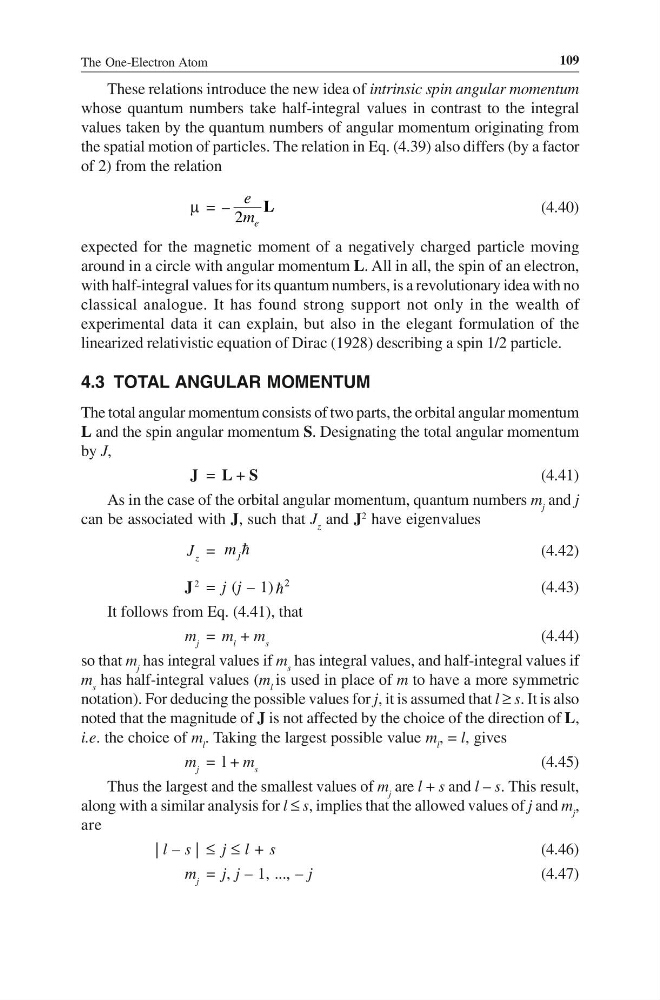
the spatial motion of particles. The relation in Eq. (4.39) also differs (by a factor
of 2) from the relation
µ = – 2 e
e
m
L
(4.40)
expected for the magnetic moment of a negatively charged particle moving
around in a circle with angular momentum L. All in all, the spin of an electron,
with half-integral values for its quantum numbers, is a revolutionary idea with no
classical analogue. It has found strong support not only in the wealth of
experimental data it can explain, but also in the elegant formulation of the
linearized relativistic equation of Dirac (1928) describing a spin 1/2 particle.
4.3 TOTAL ANGULAR MOMENTUM
The total angular momentum consists of two parts, the orbital angular momentum
L and the spin angular momentum S. Designating the total angular momentum
by J,
J = L + S
(4.41)
As in the case of the orbital angular momentum, quantum numbers m j and j
can be associated with J, such that J z and J
2
have eigenvalues
J z = j
m
(4.42)
J
2
= j (j – 1)
2
(4.43)
It follows from Eq. (4.41), that
m j = m l + m s
(4.44)
so that m j has integral values if m s has integral values, and half-integral values if
m s has half-integral values (m l is used in place of m to have a more symmetric
notation). For deducing the possible values for j, it is assumed that l ≥ s. It is also
noted that the magnitude of J is not affected by the choice of the direction of L,
i.e. the choice of m l . Taking the largest possible value m l , = l, gives
m j = l + m s
(4.45)
Thus the largest and the smallest values of m j are l + s and l – s. This result,
along with a similar analysis for l ≤ s, implies that the allowed values of j and m j ,
are
| l – s | ≤ j ≤ l + s
(4.46)
m j = j, j – 1, ..., – j
(4.47)
109
These relations introduce the new idea of intrinsic spin angular momentum
whose quantum numbers take half-integral values in contrast to the integral
values taken by the quantum numbers of angular momentum originating from
the spatial motion of particles. The relation in Eq. (4.39) also differs (by a factor
of 2) from the relation
µ = – 2 e
e
m
L
(4.40)
expected for the magnetic moment of a negatively charged particle moving
around in a circle with angular momentum L. All in all, the spin of an electron,
with half-integral values for its quantum numbers, is a revolutionary idea with no
classical analogue. It has found strong support not only in the wealth of
experimental data it can explain, but also in the elegant formulation of the
linearized relativistic equation of Dirac (1928) describing a spin 1/2 particle.
4.3 TOTAL ANGULAR MOMENTUM
The total angular momentum consists of two parts, the orbital angular momentum
L and the spin angular momentum S. Designating the total angular momentum
by J,
J = L + S
(4.41)
As in the case of the orbital angular momentum, quantum numbers m j and j
can be associated with J, such that J z and J
2
have eigenvalues
J z = j
m
(4.42)
J
2
= j (j – 1)
2
(4.43)
It follows from Eq. (4.41), that
m j = m l + m s
(4.44)
so that m j has integral values if m s has integral values, and half-integral values if
m s has half-integral values (m l is used in place of m to have a more symmetric
notation). For deducing the possible values for j, it is assumed that l ≥ s. It is also
noted that the magnitude of J is not affected by the choice of the direction of L,
i.e. the choice of m l . Taking the largest possible value m l , = l, gives
m j = l + m s
(4.45)
Thus the largest and the smallest values of m j are l + s and l – s. This result,
along with a similar analysis for l ≤ s, implies that the allowed values of j and m j ,
are
| l – s | ≤ j ≤ l + s
(4.46)
m j = j, j – 1, ..., – j
(4.47)