

Elements of Modern Physics
108
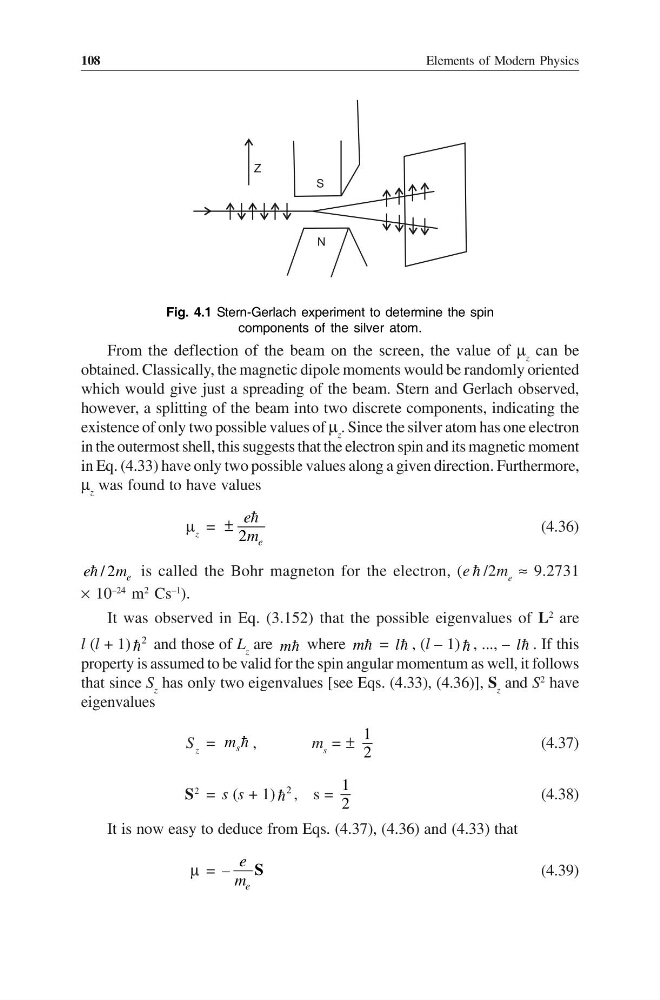
Fig. 4.1 Stern-Gerlach experiment to determine the spin
components of the silver atom.
From the deflection of the beam on the screen, the value of µ z can be
obtained. Classically, the magnetic dipole moments would be randomly oriented
which would give just a spreading of the beam. Stern and Gerlach observed,
however, a splitting of the beam into two discrete components, indicating the
existence of only two possible values of µ z . Since the silver atom has one electron
in the outermost shell, this suggests that the electron spin and its magnetic moment
in Eq. (4.33) have only two possible values along a given direction. Furthermore,
µ z was found to have values
µ z = 2 e
e
m
±
(4.36)
/ 2 e
e
m
is called the Bohr magneton for the electron, (e /2m e ≈ 9.2731
× 10
–24
m
2
Cs
–1
).
It was observed in Eq. (3.152) that the possible eigenvalues of L
2
are
l (l + 1)
2
and those of L z are m where m = l , (l – 1) , ..., – l . If this
property is assumed to be valid for the spin angular momentum as well, it follows
that since S z has only two eigenvalues [see Eqs. (4.33), (4.36)], S z and S
2
have
eigenvalues
S z = s
m ,
m s = ±
1
2
(4.37)
S
2
= s (s + 1)
2
, s =
1
2
(4.38)
It is now easy to deduce from Eqs. (4.37), (4.36) and (4.33) that
µ = –
e
e
m
S
(4.39)
108
Fig. 4.1 Stern-Gerlach experiment to determine the spin
components of the silver atom.
From the deflection of the beam on the screen, the value of µ z can be
obtained. Classically, the magnetic dipole moments would be randomly oriented
which would give just a spreading of the beam. Stern and Gerlach observed,
however, a splitting of the beam into two discrete components, indicating the
existence of only two possible values of µ z . Since the silver atom has one electron
in the outermost shell, this suggests that the electron spin and its magnetic moment
in Eq. (4.33) have only two possible values along a given direction. Furthermore,
µ z was found to have values
µ z = 2 e
e
m
±
(4.36)
/ 2 e
e
m
is called the Bohr magneton for the electron, (e /2m e ≈ 9.2731
× 10
–24
m
2
Cs
–1
).
It was observed in Eq. (3.152) that the possible eigenvalues of L
2
are
l (l + 1)
2
and those of L z are m where m = l , (l – 1) , ..., – l . If this
property is assumed to be valid for the spin angular momentum as well, it follows
that since S z has only two eigenvalues [see Eqs. (4.33), (4.36)], S z and S
2
have
eigenvalues
S z = s
m ,
m s = ±
1
2
(4.37)
S
2
= s (s + 1)
2
, s =
1
2
(4.38)
It is now easy to deduce from Eqs. (4.37), (4.36) and (4.33) that
µ = –
e
e
m
S
(4.39)