

92
W. C. Law and S. De W. Wong
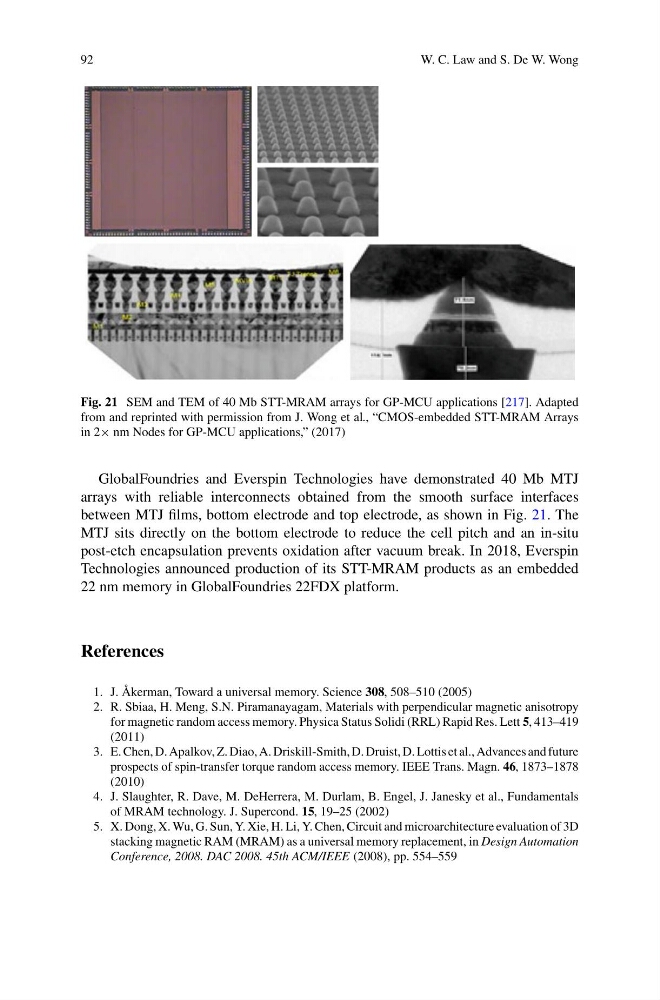
Fig. 21 SEM and TEM of 40 Mb STT-MRAM arrays for GP-MCU applications [217]. Adapted
from and reprinted with permission from J. Wong et al., “CMOS-embedded STT-MRAM Arrays
in 2× nm Nodes for GP-MCU applications,” (2017)
GlobalFoundries and Everspin Technologies have demonstrated 40 Mb MTJ
arrays with reliable interconnects obtained from the smooth surface interfaces
between MTJ films, bottom electrode and top electrode, as shown in Fig. 21. The
MTJ sits directly on the bottom electrode to reduce the cell pitch and an in-situ
post-etch encapsulation prevents oxidation after vacuum break. In 2018, Everspin
Technologies announced production of its STT-MRAM products as an embedded
22 nm memory in GlobalFoundries 22FDX platform.
References
1. J. Åkerman, Toward a universal memory. Science 308, 508–510 (2005)
2. R. Sbiaa, H. Meng, S.N. Piramanayagam, Materials with perpendicular magnetic anisotropy
for magnetic random access memory. Physica Status Solidi (RRL) Rapid Res. Lett 5, 413–419
(2011)
3. E. Chen, D. Apalkov, Z. Diao, A. Driskill-Smith, D. Druist, D. Lottis et al., Advances and future
prospects of spin-transfer torque random access memory. IEEE Trans. Magn. 46, 1873–1878
(2010)
4. J. Slaughter, R. Dave, M. DeHerrera, M. Durlam, B. Engel, J. Janesky et al., Fundamentals
of MRAM technology. J. Supercond. 15, 19–25 (2002)
5. X. Dong, X. Wu, G. Sun, Y. Xie, H. Li, Y. Chen, Circuit and microarchitecture evaluation of 3D
stacking magnetic RAM (MRAM) as a universal memory replacement, in Design Automation
Conference, 2008. DAC 2008. 45th ACM/IEEE (2008), pp. 554–559
W. C. Law and S. De W. Wong
Fig. 21 SEM and TEM of 40 Mb STT-MRAM arrays for GP-MCU applications [217]. Adapted
from and reprinted with permission from J. Wong et al., “CMOS-embedded STT-MRAM Arrays
in 2× nm Nodes for GP-MCU applications,” (2017)
GlobalFoundries and Everspin Technologies have demonstrated 40 Mb MTJ
arrays with reliable interconnects obtained from the smooth surface interfaces
between MTJ films, bottom electrode and top electrode, as shown in Fig. 21. The
MTJ sits directly on the bottom electrode to reduce the cell pitch and an in-situ
post-etch encapsulation prevents oxidation after vacuum break. In 2018, Everspin
Technologies announced production of its STT-MRAM products as an embedded
22 nm memory in GlobalFoundries 22FDX platform.
References
1. J. Åkerman, Toward a universal memory. Science 308, 508–510 (2005)
2. R. Sbiaa, H. Meng, S.N. Piramanayagam, Materials with perpendicular magnetic anisotropy
for magnetic random access memory. Physica Status Solidi (RRL) Rapid Res. Lett 5, 413–419
(2011)
3. E. Chen, D. Apalkov, Z. Diao, A. Driskill-Smith, D. Druist, D. Lottis et al., Advances and future
prospects of spin-transfer torque random access memory. IEEE Trans. Magn. 46, 1873–1878
(2010)
4. J. Slaughter, R. Dave, M. DeHerrera, M. Durlam, B. Engel, J. Janesky et al., Fundamentals
of MRAM technology. J. Supercond. 15, 19–25 (2002)
5. X. Dong, X. Wu, G. Sun, Y. Xie, H. Li, Y. Chen, Circuit and microarchitecture evaluation of 3D
stacking magnetic RAM (MRAM) as a universal memory replacement, in Design Automation
Conference, 2008. DAC 2008. 45th ACM/IEEE (2008), pp. 554–559