

Spin Transfer Torque Magnetoresistive Random Access Memory
75
where all the terms containing α
2
ω
2 are excluded, since it leads to zero in the case
for α << 1 in common ferromagnetic materials (CoFeB ~ 0.014). The imaginary
component follows the form of a general Lorentzian function L(x) =
K
(ω−ω 0 ) 2 +ω 2 ((ω) 2
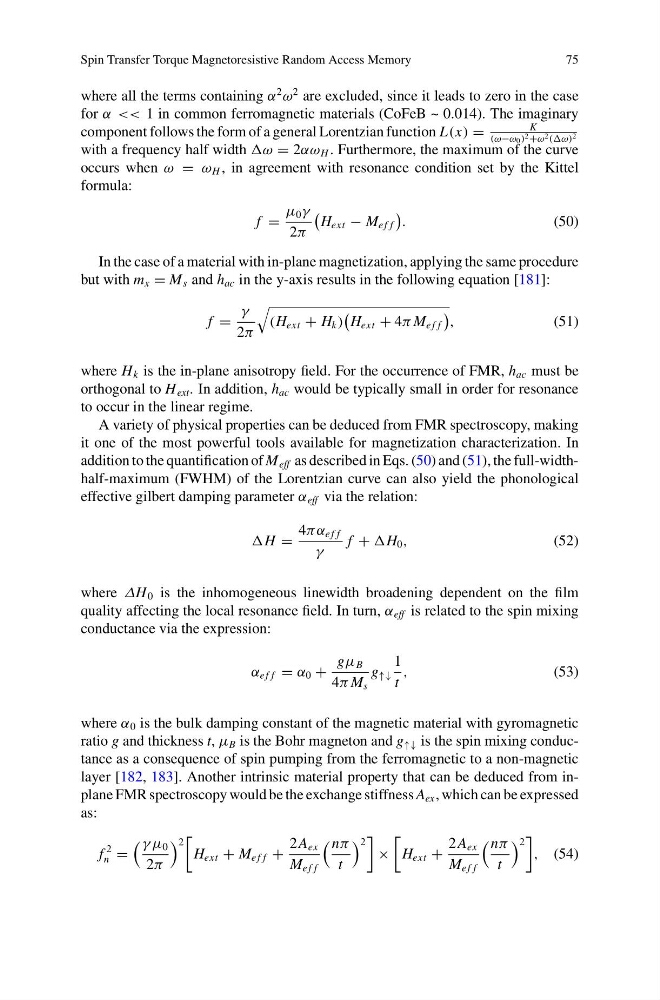
with a frequency half width ω = 2αω H . Furthermore, the maximum of the curve
occurs when ω = ω H , in agreement with resonance condition set by the Kittel
formula:
f =
μ 0 γ
2π
H ext − M e f f
.
(50)
In the case of a material with in-plane magnetization, applying the same procedure
but with m x = M s and h ac in the y-axis results in the following equation [181]:
f =
γ
2π
(H ext + H k )
H ext + 4π M e f f
,
(51)
where H k is the in-plane anisotropy field. For the occurrence of FMR, h ac must be
orthogonal to H ext . In addition, h ac would be typically small in order for resonance
to occur in the linear regime.
A variety of physical properties can be deduced from FMR spectroscopy, making
it one of the most powerful tools available for magnetization characterization. In
addition to the quantification of M eff as described in Eqs. (50) and (51), the full-widthhalf-maximum (FWHM) of the Lorentzian curve can also yield the phonological
effective gilbert damping parameter α eff via the relation:
H =
4πα e f f
γ
f + H 0 ,
(52)
where ΔH 0 is the inhomogeneous linewidth broadening dependent on the film
quality affecting the local resonance field. In turn, α eff is related to the spin mixing
conductance via the expression:
α e f f = α 0 +
gμ B
4π M s
g ↑↓
1
t
,
(53)
where α 0 is the bulk damping constant of the magnetic material with gyromagnetic
ratio g and thickness t, μ B is the Bohr magneton and g ↑↓ is the spin mixing conductance as a consequence of spin pumping from the ferromagnetic to a non-magnetic
layer [182, 183]. Another intrinsic material property that can be deduced from inplane FMR spectroscopy would be the exchange stiffness A ex , which can be expressed
as:
f
2
n =
γ μ 0
2π
2
H ext + M e f f +
2 A ex
M e f f
nπ
t
2
×
H ext +
2 A ex
M e f f
nπ
t
2
, (54)
75
where all the terms containing α
2
ω
2 are excluded, since it leads to zero in the case
for α << 1 in common ferromagnetic materials (CoFeB ~ 0.014). The imaginary
component follows the form of a general Lorentzian function L(x) =
K
(ω−ω 0 ) 2 +ω 2 ((ω) 2
with a frequency half width ω = 2αω H . Furthermore, the maximum of the curve
occurs when ω = ω H , in agreement with resonance condition set by the Kittel
formula:
f =
μ 0 γ
2π
H ext − M e f f
.
(50)
In the case of a material with in-plane magnetization, applying the same procedure
but with m x = M s and h ac in the y-axis results in the following equation [181]:
f =
γ
2π
(H ext + H k )
H ext + 4π M e f f
,
(51)
where H k is the in-plane anisotropy field. For the occurrence of FMR, h ac must be
orthogonal to H ext . In addition, h ac would be typically small in order for resonance
to occur in the linear regime.
A variety of physical properties can be deduced from FMR spectroscopy, making
it one of the most powerful tools available for magnetization characterization. In
addition to the quantification of M eff as described in Eqs. (50) and (51), the full-widthhalf-maximum (FWHM) of the Lorentzian curve can also yield the phonological
effective gilbert damping parameter α eff via the relation:
H =
4πα e f f
γ
f + H 0 ,
(52)
where ΔH 0 is the inhomogeneous linewidth broadening dependent on the film
quality affecting the local resonance field. In turn, α eff is related to the spin mixing
conductance via the expression:
α e f f = α 0 +
gμ B
4π M s
g ↑↓
1
t
,
(53)
where α 0 is the bulk damping constant of the magnetic material with gyromagnetic
ratio g and thickness t, μ B is the Bohr magneton and g ↑↓ is the spin mixing conductance as a consequence of spin pumping from the ferromagnetic to a non-magnetic
layer [182, 183]. Another intrinsic material property that can be deduced from inplane FMR spectroscopy would be the exchange stiffness A ex , which can be expressed
as:
f
2
n =
γ μ 0
2π
2
H ext + M e f f +
2 A ex
M e f f
nπ
t
2
×
H ext +
2 A ex
M e f f
nπ
t
2
, (54)