

74
W. C. Law and S. De W. Wong
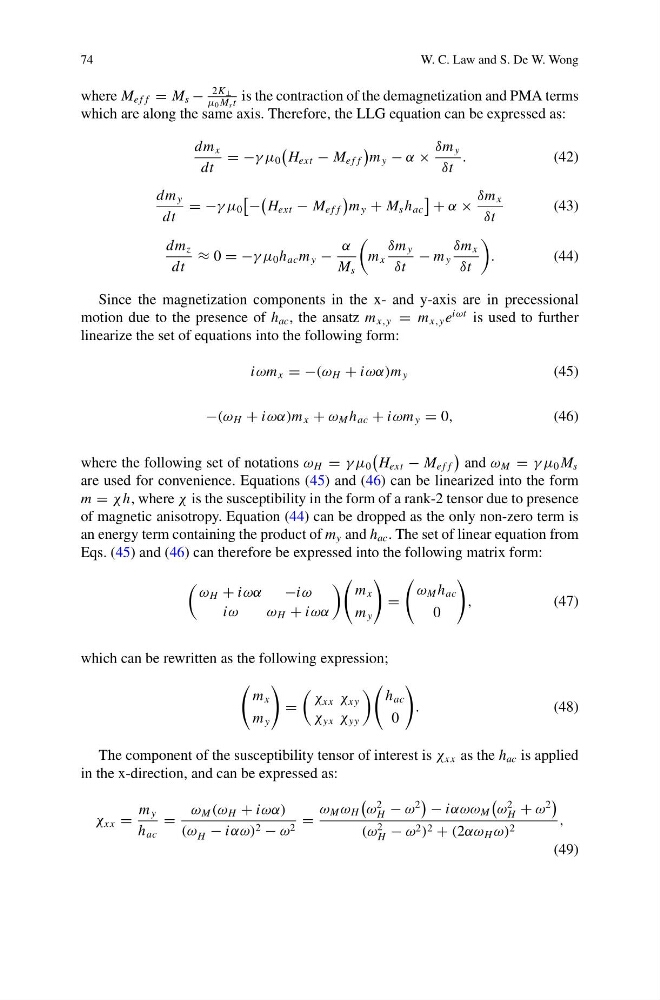
where M e f f = M s −
2K ⊥
μ 0 M s t
is the contraction of the demagnetization and PMA terms
which are along the same axis. Therefore, the LLG equation can be expressed as:
dm x
dt
= −γ μ 0
H ext − M e f f
m y − α ×
δm y
δt
.
(42)
dm y
dt
= −γ μ 0
−
H ext − M e f f
m y + M s h ac
+ α ×
δm x
δt
(43)
dm z
dt
≈ 0 = −γ μ 0 h ac m y −
α
M s
m x
δm y
δt
− m y
δm x
δt
.
(44)
Since the magnetization components in the x- and y-axis are in precessional
motion due to the presence of h ac , the ansatz m x,y = m x,y e
iωt is used to further
linearize the set of equations into the following form:
iωm x = −(ω H + iωα)m y
(45)
−(ω H + iωα)m x + ω M h ac + iωm y = 0,
(46)
where the following set of notations ω H = γ μ 0
H ext − M e f f
and ω M = γ μ 0 M s
are used for convenience. Equations (45) and (46) can be linearized into the form
m = χ h, where χ is the susceptibility in the form of a rank-2 tensor due to presence
of magnetic anisotropy. Equation (44) can be dropped as the only non-zero term is
an energy term containing the product of m y and h ac . The set of linear equation from
Eqs. (45) and (46) can therefore be expressed into the following matrix form:
ω H + iωα
−iω
iω
ω H + iωα
m x
m y
=
ω M h ac
0
,
(47)
which can be rewritten as the following expression;
m x
m y
=
χ xx χ xy
χ yx χ yy
h ac
0
.
(48)
The component of the susceptibility tensor of interest is χ xx as the h ac is applied
in the x-direction, and can be expressed as:
χ xx =
m y
h ac
=
ω M (ω H + iωα)
(ω H − iαω) 2 − ω 2 =
ω M ω H
ω
2
H − ω
2
− iαωω M
ω
2
H + ω
2
(ω
2
H − ω 2 ) 2 + (2αω H ω) 2
,
(49)
W. C. Law and S. De W. Wong
where M e f f = M s −
2K ⊥
μ 0 M s t
is the contraction of the demagnetization and PMA terms
which are along the same axis. Therefore, the LLG equation can be expressed as:
dm x
dt
= −γ μ 0
H ext − M e f f
m y − α ×
δm y
δt
.
(42)
dm y
dt
= −γ μ 0
−
H ext − M e f f
m y + M s h ac
+ α ×
δm x
δt
(43)
dm z
dt
≈ 0 = −γ μ 0 h ac m y −
α
M s
m x
δm y
δt
− m y
δm x
δt
.
(44)
Since the magnetization components in the x- and y-axis are in precessional
motion due to the presence of h ac , the ansatz m x,y = m x,y e
iωt is used to further
linearize the set of equations into the following form:
iωm x = −(ω H + iωα)m y
(45)
−(ω H + iωα)m x + ω M h ac + iωm y = 0,
(46)
where the following set of notations ω H = γ μ 0
H ext − M e f f
and ω M = γ μ 0 M s
are used for convenience. Equations (45) and (46) can be linearized into the form
m = χ h, where χ is the susceptibility in the form of a rank-2 tensor due to presence
of magnetic anisotropy. Equation (44) can be dropped as the only non-zero term is
an energy term containing the product of m y and h ac . The set of linear equation from
Eqs. (45) and (46) can therefore be expressed into the following matrix form:
ω H + iωα
−iω
iω
ω H + iωα
m x
m y
=
ω M h ac
0
,
(47)
which can be rewritten as the following expression;
m x
m y
=
χ xx χ xy
χ yx χ yy
h ac
0
.
(48)
The component of the susceptibility tensor of interest is χ xx as the h ac is applied
in the x-direction, and can be expressed as:
χ xx =
m y
h ac
=
ω M (ω H + iωα)
(ω H − iαω) 2 − ω 2 =
ω M ω H
ω
2
H − ω
2
− iαωω M
ω
2
H + ω
2
(ω
2
H − ω 2 ) 2 + (2αω H ω) 2
,
(49)