

60
W. C. Law and S. De W. Wong
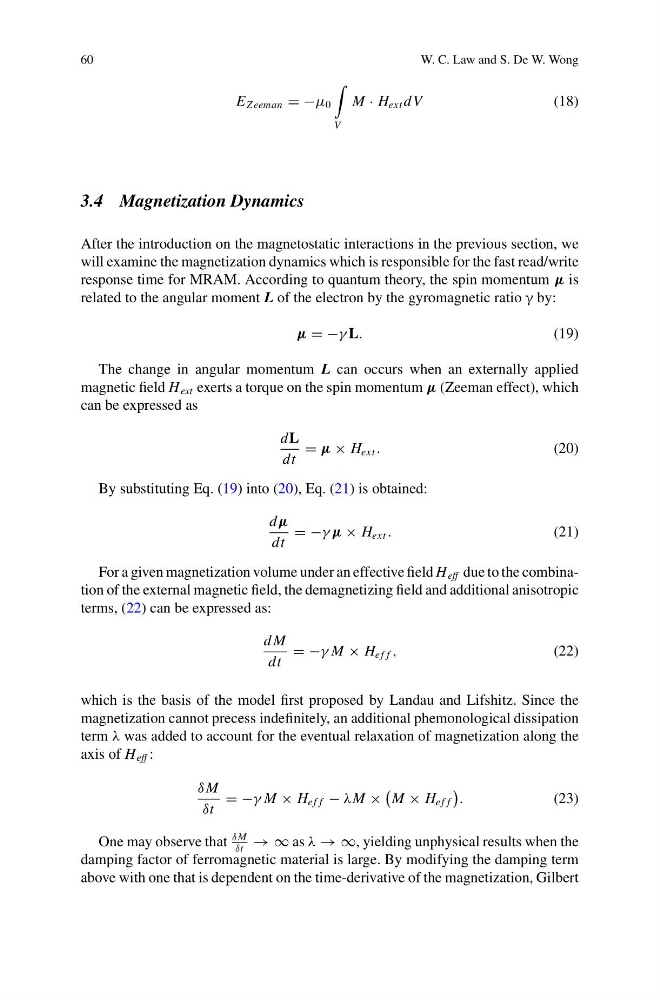
E Z eeman = −μ 0
V
M · H ext dV
(18)
3.4 Magnetization Dynamics
After the introduction on the magnetostatic interactions in the previous section, we
will examine the magnetization dynamics which is responsible for the fast read/write
response time for MRAM. According to quantum theory, the spin momentum µ is
related to the angular moment L of the electron by the gyromagnetic ratio γ by:
µ = −γ L.
(19)
The change in angular momentum L can occurs when an externally applied
magnetic field H ext exerts a torque on the spin momentum µ (Zeeman effect), which
can be expressed as
dL
dt
= µ × H ext .
(20)
By substituting Eq. (19) into (20), Eq. (21) is obtained:
dµ
dt
= −γ µ × H ext .
(21)
For a given magnetization volume under an effective field H eff due to the combination of the external magnetic field, the demagnetizing field and additional anisotropic
terms, (22) can be expressed as:
d M
dt
= −γ M × H e f f ,
(22)
which is the basis of the model first proposed by Landau and Lifshitz. Since the
magnetization cannot precess indefinitely, an additional phemonological dissipation
term λ was added to account for the eventual relaxation of magnetization along the
axis of H eff :
δ M
δt
= −γ M × H e f f − λM ×
M × H e f f
.
(23)
One may observe that
δ M
δt
→ ∞ as λ → ∞, yielding unphysical results when the
damping factor of ferromagnetic material is large. By modifying the damping term
above with one that is dependent on the time-derivative of the magnetization, Gilbert
W. C. Law and S. De W. Wong
E Z eeman = −μ 0
V
M · H ext dV
(18)
3.4 Magnetization Dynamics
After the introduction on the magnetostatic interactions in the previous section, we
will examine the magnetization dynamics which is responsible for the fast read/write
response time for MRAM. According to quantum theory, the spin momentum µ is
related to the angular moment L of the electron by the gyromagnetic ratio γ by:
µ = −γ L.
(19)
The change in angular momentum L can occurs when an externally applied
magnetic field H ext exerts a torque on the spin momentum µ (Zeeman effect), which
can be expressed as
dL
dt
= µ × H ext .
(20)
By substituting Eq. (19) into (20), Eq. (21) is obtained:
dµ
dt
= −γ µ × H ext .
(21)
For a given magnetization volume under an effective field H eff due to the combination of the external magnetic field, the demagnetizing field and additional anisotropic
terms, (22) can be expressed as:
d M
dt
= −γ M × H e f f ,
(22)
which is the basis of the model first proposed by Landau and Lifshitz. Since the
magnetization cannot precess indefinitely, an additional phemonological dissipation
term λ was added to account for the eventual relaxation of magnetization along the
axis of H eff :
δ M
δt
= −γ M × H e f f − λM ×
M × H e f f
.
(23)
One may observe that
δ M
δt
→ ∞ as λ → ∞, yielding unphysical results when the
damping factor of ferromagnetic material is large. By modifying the damping term
above with one that is dependent on the time-derivative of the magnetization, Gilbert