

Spin Transfer Torque Magnetoresistive Random Access Memory
59
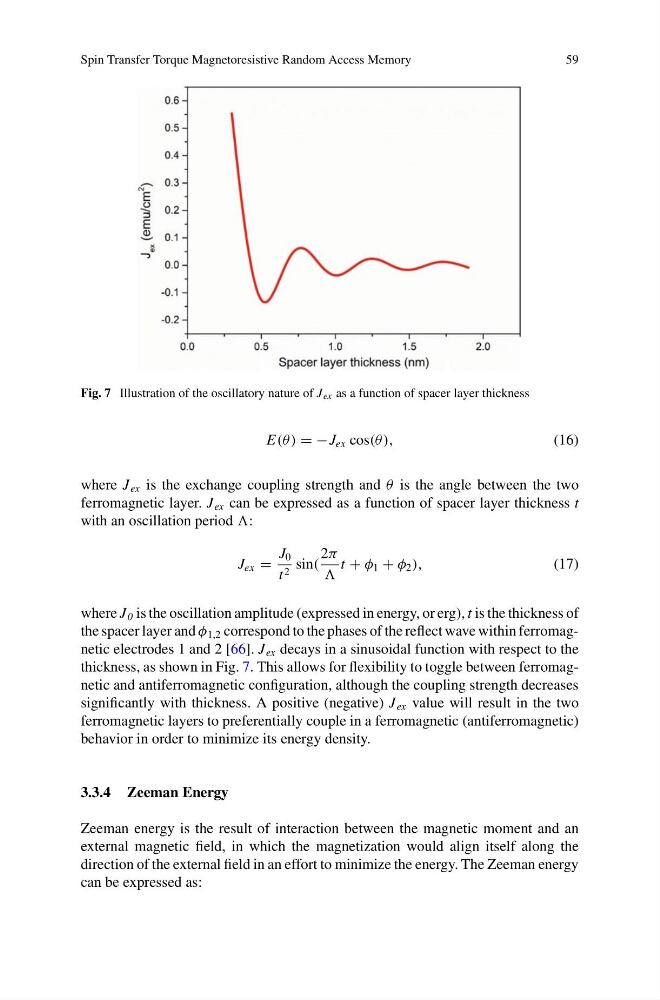
Fig. 7 Illustration of the oscillatory nature of J ex as a function of spacer layer thickness
E(θ ) = −J ex cos(θ ),
(16)
where J ex is the exchange coupling strength and θ is the angle between the two
ferromagnetic layer. J ex can be expressed as a function of spacer layer thickness t
with an oscillation period :
J ex =
J 0
t 2 sin(
2π
t + φ 1 + φ 2 ),
(17)
where J 0 is the oscillation amplitude (expressed in energy, or erg), t is the thickness of
the spacer layer and φ 1,2 correspond to the phases of the reflect wave within ferromagnetic electrodes 1 and 2 [66]. J ex decays in a sinusoidal function with respect to the
thickness, as shown in Fig. 7. This allows for flexibility to toggle between ferromagnetic and antiferromagnetic configuration, although the coupling strength decreases
significantly with thickness. A positive (negative) J ex value will result in the two
ferromagnetic layers to preferentially couple in a ferromagnetic (antiferromagnetic)
behavior in order to minimize its energy density.
3.3.4 Zeeman Energy
Zeeman energy is the result of interaction between the magnetic moment and an
external magnetic field, in which the magnetization would align itself along the
direction of the external field in an effort to minimize the energy. The Zeeman energy
can be expressed as:
59
Fig. 7 Illustration of the oscillatory nature of J ex as a function of spacer layer thickness
E(θ ) = −J ex cos(θ ),
(16)
where J ex is the exchange coupling strength and θ is the angle between the two
ferromagnetic layer. J ex can be expressed as a function of spacer layer thickness t
with an oscillation period :
J ex =
J 0
t 2 sin(
2π
t + φ 1 + φ 2 ),
(17)
where J 0 is the oscillation amplitude (expressed in energy, or erg), t is the thickness of
the spacer layer and φ 1,2 correspond to the phases of the reflect wave within ferromagnetic electrodes 1 and 2 [66]. J ex decays in a sinusoidal function with respect to the
thickness, as shown in Fig. 7. This allows for flexibility to toggle between ferromagnetic and antiferromagnetic configuration, although the coupling strength decreases
significantly with thickness. A positive (negative) J ex value will result in the two
ferromagnetic layers to preferentially couple in a ferromagnetic (antiferromagnetic)
behavior in order to minimize its energy density.
3.3.4 Zeeman Energy
Zeeman energy is the result of interaction between the magnetic moment and an
external magnetic field, in which the magnetization would align itself along the
direction of the external field in an effort to minimize the energy. The Zeeman energy
can be expressed as: