

58
W. C. Law and S. De W. Wong
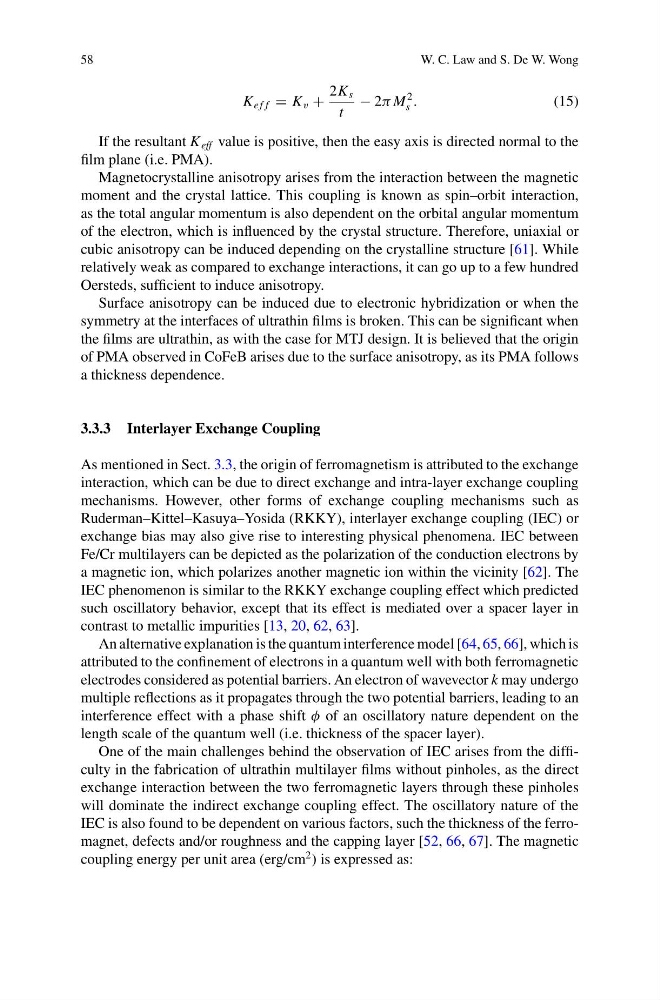
K e f f = K v +
2K s
t
− 2π M
2
s .
(15)
If the resultant K eff value is positive, then the easy axis is directed normal to the
film plane (i.e. PMA).
Magnetocrystalline anisotropy arises from the interaction between the magnetic
moment and the crystal lattice. This coupling is known as spin–orbit interaction,
as the total angular momentum is also dependent on the orbital angular momentum
of the electron, which is influenced by the crystal structure. Therefore, uniaxial or
cubic anisotropy can be induced depending on the crystalline structure [61]. While
relatively weak as compared to exchange interactions, it can go up to a few hundred
Oersteds, sufficient to induce anisotropy.
Surface anisotropy can be induced due to electronic hybridization or when the
symmetry at the interfaces of ultrathin films is broken. This can be significant when
the films are ultrathin, as with the case for MTJ design. It is believed that the origin
of PMA observed in CoFeB arises due to the surface anisotropy, as its PMA follows
a thickness dependence.
3.3.3 Interlayer Exchange Coupling
As mentioned in Sect. 3.3, the origin of ferromagnetism is attributed to the exchange
interaction, which can be due to direct exchange and intra-layer exchange coupling
mechanisms. However, other forms of exchange coupling mechanisms such as
Ruderman–Kittel–Kasuya–Yosida (RKKY), interlayer exchange coupling (IEC) or
exchange bias may also give rise to interesting physical phenomena. IEC between
Fe/Cr multilayers can be depicted as the polarization of the conduction electrons by
a magnetic ion, which polarizes another magnetic ion within the vicinity [62]. The
IEC phenomenon is similar to the RKKY exchange coupling effect which predicted
such oscillatory behavior, except that its effect is mediated over a spacer layer in
contrast to metallic impurities [13, 20, 62, 63].
An alternative explanation is the quantum interference model [64, 65, 66], which is
attributed to the confinement of electrons in a quantum well with both ferromagnetic
electrodes considered as potential barriers. An electron of wavevector k may undergo
multiple reflections as it propagates through the two potential barriers, leading to an
interference effect with a phase shift φ of an oscillatory nature dependent on the
length scale of the quantum well (i.e. thickness of the spacer layer).
One of the main challenges behind the observation of IEC arises from the difficulty in the fabrication of ultrathin multilayer films without pinholes, as the direct
exchange interaction between the two ferromagnetic layers through these pinholes
will dominate the indirect exchange coupling effect. The oscillatory nature of the
IEC is also found to be dependent on various factors, such the thickness of the ferromagnet, defects and/or roughness and the capping layer [52, 66, 67]. The magnetic
coupling energy per unit area (erg/cm
2 ) is expressed as:
W. C. Law and S. De W. Wong
K e f f = K v +
2K s
t
− 2π M
2
s .
(15)
If the resultant K eff value is positive, then the easy axis is directed normal to the
film plane (i.e. PMA).
Magnetocrystalline anisotropy arises from the interaction between the magnetic
moment and the crystal lattice. This coupling is known as spin–orbit interaction,
as the total angular momentum is also dependent on the orbital angular momentum
of the electron, which is influenced by the crystal structure. Therefore, uniaxial or
cubic anisotropy can be induced depending on the crystalline structure [61]. While
relatively weak as compared to exchange interactions, it can go up to a few hundred
Oersteds, sufficient to induce anisotropy.
Surface anisotropy can be induced due to electronic hybridization or when the
symmetry at the interfaces of ultrathin films is broken. This can be significant when
the films are ultrathin, as with the case for MTJ design. It is believed that the origin
of PMA observed in CoFeB arises due to the surface anisotropy, as its PMA follows
a thickness dependence.
3.3.3 Interlayer Exchange Coupling
As mentioned in Sect. 3.3, the origin of ferromagnetism is attributed to the exchange
interaction, which can be due to direct exchange and intra-layer exchange coupling
mechanisms. However, other forms of exchange coupling mechanisms such as
Ruderman–Kittel–Kasuya–Yosida (RKKY), interlayer exchange coupling (IEC) or
exchange bias may also give rise to interesting physical phenomena. IEC between
Fe/Cr multilayers can be depicted as the polarization of the conduction electrons by
a magnetic ion, which polarizes another magnetic ion within the vicinity [62]. The
IEC phenomenon is similar to the RKKY exchange coupling effect which predicted
such oscillatory behavior, except that its effect is mediated over a spacer layer in
contrast to metallic impurities [13, 20, 62, 63].
An alternative explanation is the quantum interference model [64, 65, 66], which is
attributed to the confinement of electrons in a quantum well with both ferromagnetic
electrodes considered as potential barriers. An electron of wavevector k may undergo
multiple reflections as it propagates through the two potential barriers, leading to an
interference effect with a phase shift φ of an oscillatory nature dependent on the
length scale of the quantum well (i.e. thickness of the spacer layer).
One of the main challenges behind the observation of IEC arises from the difficulty in the fabrication of ultrathin multilayer films without pinholes, as the direct
exchange interaction between the two ferromagnetic layers through these pinholes
will dominate the indirect exchange coupling effect. The oscillatory nature of the
IEC is also found to be dependent on various factors, such the thickness of the ferromagnet, defects and/or roughness and the capping layer [52, 66, 67]. The magnetic
coupling energy per unit area (erg/cm
2 ) is expressed as: