

Spin Transfer Torque Magnetoresistive Random Access Memory
61
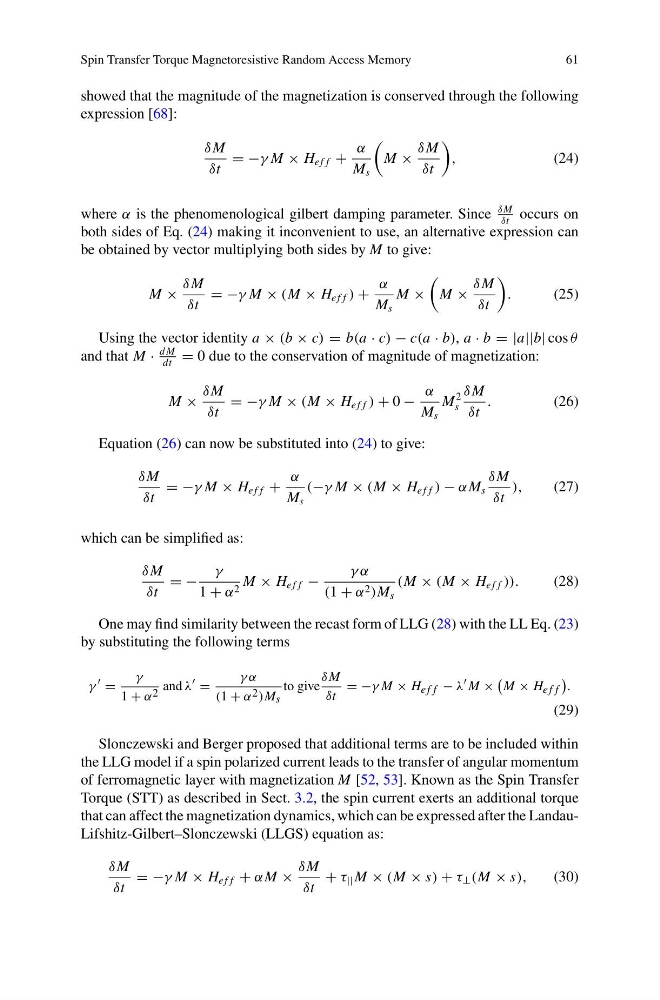
showed that the magnitude of the magnetization is conserved through the following
expression [68]:
δ M
δt
= −γ M × H e f f +
α
M s
M ×
δ M
δt
,
(24)
where α is the phenomenological gilbert damping parameter. Since
δ M
δt
occurs on
both sides of Eq. (24) making it inconvenient to use, an alternative expression can
be obtained by vector multiplying both sides by M to give:
M ×
δ M
δt
= −γ M × (M × H e f f ) +
α
M s
M ×
M ×
δ M
δt
.
(25)
Using the vector identity a × (b × c) = b(a · c) − c(a · b), a · b = |a||b| cos θ
and that M ·
d M
dt
= 0 due to the conservation of magnitude of magnetization:
M ×
δ M
δt
= −γ M × (M × H e f f ) + 0 −
α
M s
M
2
s
δ M
δt
.
(26)
Equation (26) can now be substituted into (24) to give:
δ M
δt
= −γ M × H e f f +
α
M s
(−γ M × (M × H e f f ) − α M s
δ M
δt
),
(27)
which can be simplified as:
δ M
δt
= −
γ
1 + α 2 M × H e f f −
γ α
(1 + α 2 )M s
(M × (M × H e f f )).
(28)
One may find similarity between the recast form of LLG (28) with the LL Eq. (23)
by substituting the following terms
γ =
γ
1 + α 2 and λ =
γ α
(1 + α 2 )M s
to give
δ M
δt
= −γ M × H e f f − λ M ×
M × H e f f
.
(29)
Slonczewski and Berger proposed that additional terms are to be included within
the LLG model if a spin polarized current leads to the transfer of angular momentum
of ferromagnetic layer with magnetization M [52, 53]. Known as the Spin Transfer
Torque (STT) as described in Sect. 3.2, the spin current exerts an additional torque
that can affect the magnetization dynamics, which can be expressed after the LandauLifshitz-Gilbert–Slonczewski (LLGS) equation as:
δ M
δt
= −γ M × H e f f + α M ×
δ M
δt
+ τ || M × (M × s) + τ ⊥ (M × s),
(30)
61
showed that the magnitude of the magnetization is conserved through the following
expression [68]:
δ M
δt
= −γ M × H e f f +
α
M s
M ×
δ M
δt
,
(24)
where α is the phenomenological gilbert damping parameter. Since
δ M
δt
occurs on
both sides of Eq. (24) making it inconvenient to use, an alternative expression can
be obtained by vector multiplying both sides by M to give:
M ×
δ M
δt
= −γ M × (M × H e f f ) +
α
M s
M ×
M ×
δ M
δt
.
(25)
Using the vector identity a × (b × c) = b(a · c) − c(a · b), a · b = |a||b| cos θ
and that M ·
d M
dt
= 0 due to the conservation of magnitude of magnetization:
M ×
δ M
δt
= −γ M × (M × H e f f ) + 0 −
α
M s
M
2
s
δ M
δt
.
(26)
Equation (26) can now be substituted into (24) to give:
δ M
δt
= −γ M × H e f f +
α
M s
(−γ M × (M × H e f f ) − α M s
δ M
δt
),
(27)
which can be simplified as:
δ M
δt
= −
γ
1 + α 2 M × H e f f −
γ α
(1 + α 2 )M s
(M × (M × H e f f )).
(28)
One may find similarity between the recast form of LLG (28) with the LL Eq. (23)
by substituting the following terms
γ =
γ
1 + α 2 and λ =
γ α
(1 + α 2 )M s
to give
δ M
δt
= −γ M × H e f f − λ M ×
M × H e f f
.
(29)
Slonczewski and Berger proposed that additional terms are to be included within
the LLG model if a spin polarized current leads to the transfer of angular momentum
of ferromagnetic layer with magnetization M [52, 53]. Known as the Spin Transfer
Torque (STT) as described in Sect. 3.2, the spin current exerts an additional torque
that can affect the magnetization dynamics, which can be expressed after the LandauLifshitz-Gilbert–Slonczewski (LLGS) equation as:
δ M
δt
= −γ M × H e f f + α M ×
δ M
δt
+ τ || M × (M × s) + τ ⊥ (M × s),
(30)