

46
W. C. Law and S. De W. Wong
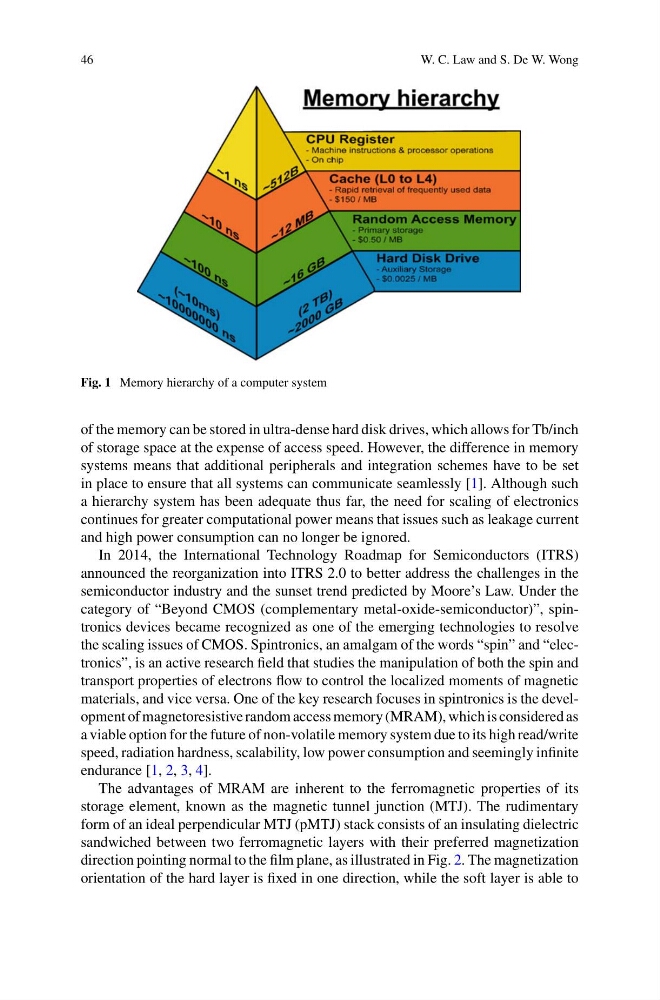
Fig. 1 Memory hierarchy of a computer system
of the memory can be stored in ultra-dense hard disk drives, which allows for Tb/inch
of storage space at the expense of access speed. However, the difference in memory
systems means that additional peripherals and integration schemes have to be set
in place to ensure that all systems can communicate seamlessly [1]. Although such
a hierarchy system has been adequate thus far, the need for scaling of electronics
continues for greater computational power means that issues such as leakage current
and high power consumption can no longer be ignored.
In 2014, the International Technology Roadmap for Semiconductors (ITRS)
announced the reorganization into ITRS 2.0 to better address the challenges in the
semiconductor industry and the sunset trend predicted by Moore’s Law. Under the
category of “Beyond CMOS (complementary metal-oxide-semiconductor)”, spintronics devices became recognized as one of the emerging technologies to resolve
the scaling issues of CMOS. Spintronics, an amalgam of the words “spin” and “electronics”, is an active research field that studies the manipulation of both the spin and
transport properties of electrons flow to control the localized moments of magnetic
materials, and vice versa. One of the key research focuses in spintronics is the development of magnetoresistive random access memory (MRAM), which is considered as
a viable option for the future of non-volatile memory system due to its high read/write
speed, radiation hardness, scalability, low power consumption and seemingly infinite
endurance [1, 2, 3, 4].
The advantages of MRAM are inherent to the ferromagnetic properties of its
storage element, known as the magnetic tunnel junction (MTJ). The rudimentary
form of an ideal perpendicular MTJ (pMTJ) stack consists of an insulating dielectric
sandwiched between two ferromagnetic layers with their preferred magnetization
direction pointing normal to the film plane, as illustrated in Fig. 2. The magnetization
orientation of the hard layer is fixed in one direction, while the soft layer is able to
W. C. Law and S. De W. Wong
Fig. 1 Memory hierarchy of a computer system
of the memory can be stored in ultra-dense hard disk drives, which allows for Tb/inch
of storage space at the expense of access speed. However, the difference in memory
systems means that additional peripherals and integration schemes have to be set
in place to ensure that all systems can communicate seamlessly [1]. Although such
a hierarchy system has been adequate thus far, the need for scaling of electronics
continues for greater computational power means that issues such as leakage current
and high power consumption can no longer be ignored.
In 2014, the International Technology Roadmap for Semiconductors (ITRS)
announced the reorganization into ITRS 2.0 to better address the challenges in the
semiconductor industry and the sunset trend predicted by Moore’s Law. Under the
category of “Beyond CMOS (complementary metal-oxide-semiconductor)”, spintronics devices became recognized as one of the emerging technologies to resolve
the scaling issues of CMOS. Spintronics, an amalgam of the words “spin” and “electronics”, is an active research field that studies the manipulation of both the spin and
transport properties of electrons flow to control the localized moments of magnetic
materials, and vice versa. One of the key research focuses in spintronics is the development of magnetoresistive random access memory (MRAM), which is considered as
a viable option for the future of non-volatile memory system due to its high read/write
speed, radiation hardness, scalability, low power consumption and seemingly infinite
endurance [1, 2, 3, 4].
The advantages of MRAM are inherent to the ferromagnetic properties of its
storage element, known as the magnetic tunnel junction (MTJ). The rudimentary
form of an ideal perpendicular MTJ (pMTJ) stack consists of an insulating dielectric
sandwiched between two ferromagnetic layers with their preferred magnetization
direction pointing normal to the film plane, as illustrated in Fig. 2. The magnetization
orientation of the hard layer is fixed in one direction, while the soft layer is able to