

374
P. Huang et al.
operation is followed. The fast pulse test consists of several these test waveforms, and
it could be applied to study the transition speed and cycle endurance characteristics.
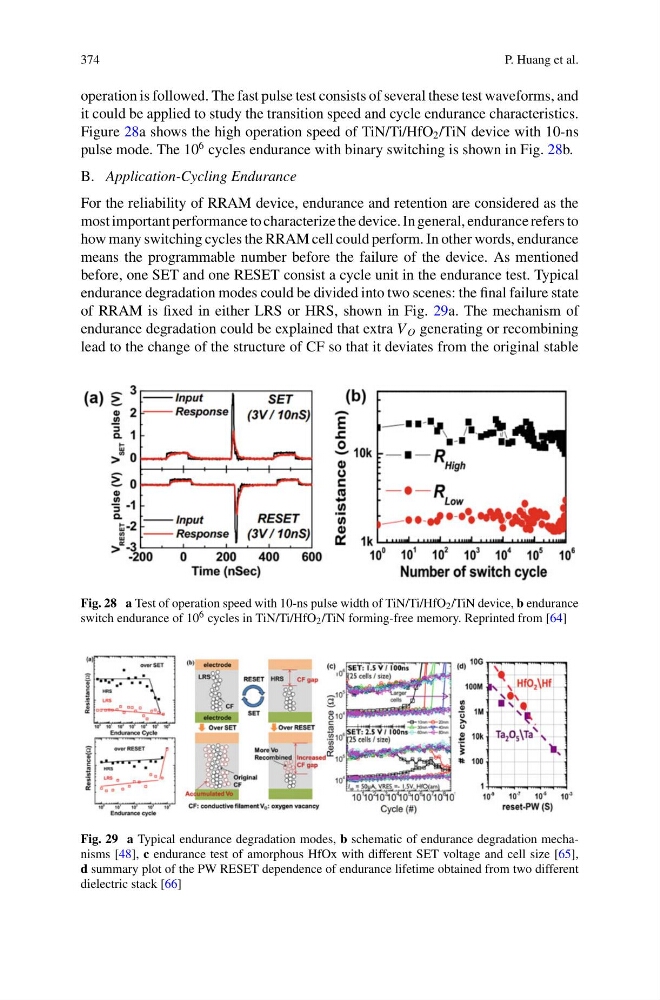
Figure 28a shows the high operation speed of TiN/Ti/HfO 2 /TiN device with 10-ns
pulse mode. The 10
6 cycles endurance with binary switching is shown in Fig. 28b.
B. Application-Cycling Endurance
For the reliability of RRAM device, endurance and retention are considered as the
most important performance to characterize the device. In general, endurance refers to
how many switching cycles the RRAM cell could perform. In other words, endurance
means the programmable number before the failure of the device. As mentioned
before, one SET and one RESET consist a cycle unit in the endurance test. Typical
endurance degradation modes could be divided into two scenes: the final failure state
of RRAM is fixed in either LRS or HRS, shown in Fig. 29a. The mechanism of
endurance degradation could be explained that extra V O generating or recombining
lead to the change of the structure of CF so that it deviates from the original stable
Fig. 28 a Test of operation speed with 10-ns pulse width of TiN/Ti/HfO 2 /TiN device, b endurance
switch endurance of 10 6 cycles in TiN/Ti/HfO 2 /TiN forming-free memory. Reprinted from [64]
Fig. 29 a Typical endurance degradation modes, b schematic of endurance degradation mechanisms [48], c endurance test of amorphous HfOx with different SET voltage and cell size [65],
d summary plot of the PW RESET dependence of endurance lifetime obtained from two different
dielectric stack [66]
P. Huang et al.
operation is followed. The fast pulse test consists of several these test waveforms, and
it could be applied to study the transition speed and cycle endurance characteristics.
Figure 28a shows the high operation speed of TiN/Ti/HfO 2 /TiN device with 10-ns
pulse mode. The 10
6 cycles endurance with binary switching is shown in Fig. 28b.
B. Application-Cycling Endurance
For the reliability of RRAM device, endurance and retention are considered as the
most important performance to characterize the device. In general, endurance refers to
how many switching cycles the RRAM cell could perform. In other words, endurance
means the programmable number before the failure of the device. As mentioned
before, one SET and one RESET consist a cycle unit in the endurance test. Typical
endurance degradation modes could be divided into two scenes: the final failure state
of RRAM is fixed in either LRS or HRS, shown in Fig. 29a. The mechanism of
endurance degradation could be explained that extra V O generating or recombining
lead to the change of the structure of CF so that it deviates from the original stable
Fig. 28 a Test of operation speed with 10-ns pulse width of TiN/Ti/HfO 2 /TiN device, b endurance
switch endurance of 10 6 cycles in TiN/Ti/HfO 2 /TiN forming-free memory. Reprinted from [64]
Fig. 29 a Typical endurance degradation modes, b schematic of endurance degradation mechanisms [48], c endurance test of amorphous HfOx with different SET voltage and cell size [65],
d summary plot of the PW RESET dependence of endurance lifetime obtained from two different
dielectric stack [66]