

366
P. Huang et al.
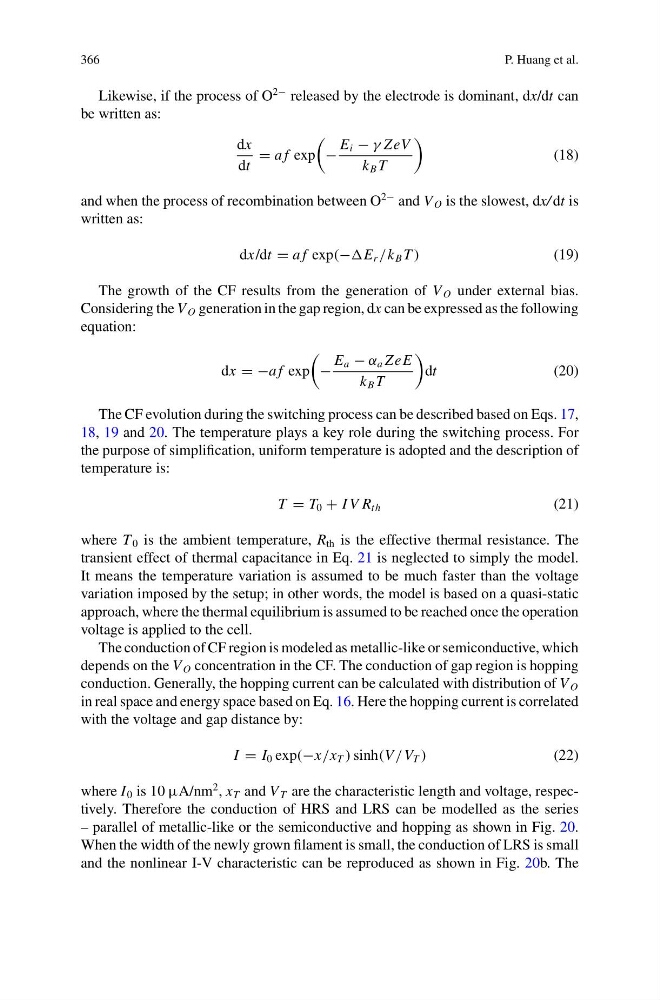
Likewise, if the process of O
2− released by the electrode is dominant, dx/dt can
be written as:
dx
dt
= a f exp
−
E i − γ ZeV
k B T
(18)
and when the process of recombination between O
2− and V O is the slowest, dx/ dt is
written as:
dx/dt = a f exp(−E r /k B T )
(19)
The growth of the CF results from the generation of V O under external bias.
Considering the V O generation in the gap region, dx can be expressed as the following
equation:
dx = −a f exp
−
E a − α a ZeE
k B T
dt
(20)
The CF evolution during the switching process can be described based on Eqs. 17,
18, 19 and 20. The temperature plays a key role during the switching process. For
the purpose of simplification, uniform temperature is adopted and the description of
temperature is:
T = T 0 + I V R th
(21)
where T 0 is the ambient temperature, R th is the effective thermal resistance. The
transient effect of thermal capacitance in Eq. 21 is neglected to simply the model.
It means the temperature variation is assumed to be much faster than the voltage
variation imposed by the setup; in other words, the model is based on a quasi-static
approach, where the thermal equilibrium is assumed to be reached once the operation
voltage is applied to the cell.
The conduction of CF region is modeled as metallic-like or semiconductive, which
depends on the V O concentration in the CF. The conduction of gap region is hopping
conduction. Generally, the hopping current can be calculated with distribution of V O
in real space and energy space based on Eq. 16. Here the hopping current is correlated
with the voltage and gap distance by:
I = I 0 exp(−x/x T ) sinh(V /V T )
(22)
where I 0 is 10 µA/nm
2 , x T and V T are the characteristic length and voltage, respectively. Therefore the conduction of HRS and LRS can be modelled as the series
– parallel of metallic-like or the semiconductive and hopping as shown in Fig. 20.
When the width of the newly grown filament is small, the conduction of LRS is small
and the nonlinear I-V characteristic can be reproduced as shown in Fig. 20b. The
P. Huang et al.
Likewise, if the process of O
2− released by the electrode is dominant, dx/dt can
be written as:
dx
dt
= a f exp
−
E i − γ ZeV
k B T
(18)
and when the process of recombination between O
2− and V O is the slowest, dx/ dt is
written as:
dx/dt = a f exp(−E r /k B T )
(19)
The growth of the CF results from the generation of V O under external bias.
Considering the V O generation in the gap region, dx can be expressed as the following
equation:
dx = −a f exp
−
E a − α a ZeE
k B T
dt
(20)
The CF evolution during the switching process can be described based on Eqs. 17,
18, 19 and 20. The temperature plays a key role during the switching process. For
the purpose of simplification, uniform temperature is adopted and the description of
temperature is:
T = T 0 + I V R th
(21)
where T 0 is the ambient temperature, R th is the effective thermal resistance. The
transient effect of thermal capacitance in Eq. 21 is neglected to simply the model.
It means the temperature variation is assumed to be much faster than the voltage
variation imposed by the setup; in other words, the model is based on a quasi-static
approach, where the thermal equilibrium is assumed to be reached once the operation
voltage is applied to the cell.
The conduction of CF region is modeled as metallic-like or semiconductive, which
depends on the V O concentration in the CF. The conduction of gap region is hopping
conduction. Generally, the hopping current can be calculated with distribution of V O
in real space and energy space based on Eq. 16. Here the hopping current is correlated
with the voltage and gap distance by:
I = I 0 exp(−x/x T ) sinh(V /V T )
(22)
where I 0 is 10 µA/nm
2 , x T and V T are the characteristic length and voltage, respectively. Therefore the conduction of HRS and LRS can be modelled as the series
– parallel of metallic-like or the semiconductive and hopping as shown in Fig. 20.
When the width of the newly grown filament is small, the conduction of LRS is small
and the nonlinear I-V characteristic can be reproduced as shown in Fig. 20b. The