

RRAM Device Characterizations and Modelling
365
8 Physical Electro-Thermal Model
In 2012, Huang et al. proposed a comprehensive physical model for bipolar RRAM.
Its major feature is linking the resistive switching behavior with the evolution of
CF geometry, which depends on multitude of factors. Based on the Monte Carlo
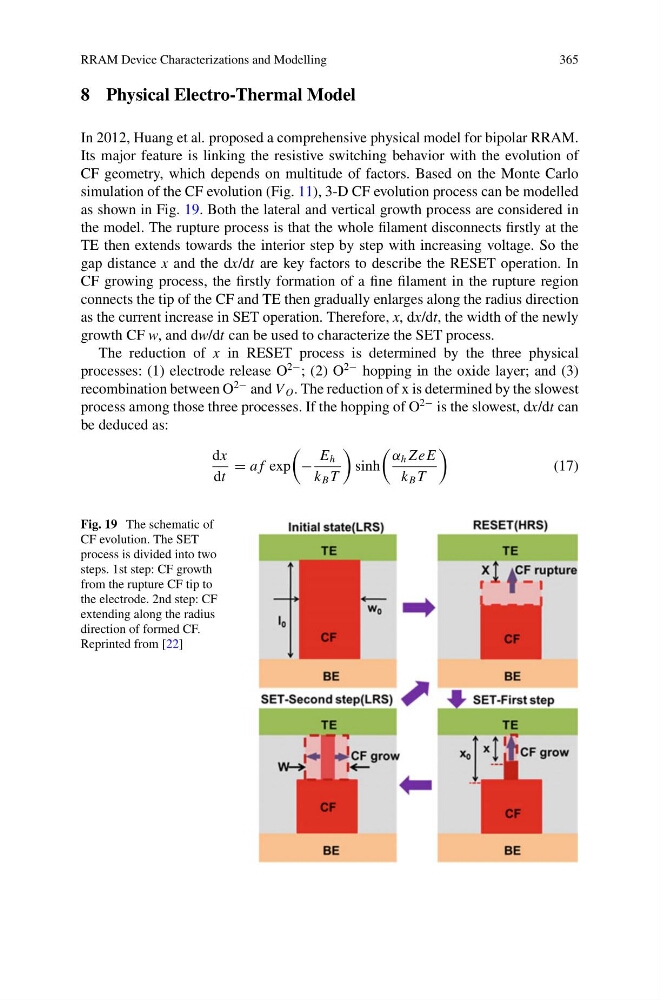
simulation of the CF evolution (Fig. 11), 3-D CF evolution process can be modelled
as shown in Fig. 19. Both the lateral and vertical growth process are considered in
the model. The rupture process is that the whole filament disconnects firstly at the
TE then extends towards the interior step by step with increasing voltage. So the
gap distance x and the dx/dt are key factors to describe the RESET operation. In
CF growing process, the firstly formation of a fine filament in the rupture region
connects the tip of the CF and TE then gradually enlarges along the radius direction
as the current increase in SET operation. Therefore, x, dx/dt, the width of the newly
growth CF w, and dw/dt can be used to characterize the SET process.
The reduction of x in RESET process is determined by the three physical
processes: (1) electrode release O
2− ; (2) O
2− hopping in the oxide layer; and (3)
recombination between O
2− and V O . The reduction of x is determined by the slowest
process among those three processes. If the hopping of O
2− is the slowest, dx/dt can
be deduced as:
dx
dt
= a f exp
−
E h
k B T
sinh
α h ZeE
k B T
(17)
Fig. 19 The schematic of
CF evolution. The SET
process is divided into two
steps. 1st step: CF growth
from the rupture CF tip to
the electrode. 2nd step: CF
extending along the radius
direction of formed CF.
Reprinted from [22]
365
8 Physical Electro-Thermal Model
In 2012, Huang et al. proposed a comprehensive physical model for bipolar RRAM.
Its major feature is linking the resistive switching behavior with the evolution of
CF geometry, which depends on multitude of factors. Based on the Monte Carlo
simulation of the CF evolution (Fig. 11), 3-D CF evolution process can be modelled
as shown in Fig. 19. Both the lateral and vertical growth process are considered in
the model. The rupture process is that the whole filament disconnects firstly at the
TE then extends towards the interior step by step with increasing voltage. So the
gap distance x and the dx/dt are key factors to describe the RESET operation. In
CF growing process, the firstly formation of a fine filament in the rupture region
connects the tip of the CF and TE then gradually enlarges along the radius direction
as the current increase in SET operation. Therefore, x, dx/dt, the width of the newly
growth CF w, and dw/dt can be used to characterize the SET process.
The reduction of x in RESET process is determined by the three physical
processes: (1) electrode release O
2− ; (2) O
2− hopping in the oxide layer; and (3)
recombination between O
2− and V O . The reduction of x is determined by the slowest
process among those three processes. If the hopping of O
2− is the slowest, dx/dt can
be deduced as:
dx
dt
= a f exp
−
E h
k B T
sinh
α h ZeE
k B T
(17)
Fig. 19 The schematic of
CF evolution. The SET
process is divided into two
steps. 1st step: CF growth
from the rupture CF tip to
the electrode. 2nd step: CF
extending along the radius
direction of formed CF.
Reprinted from [22]