

RRAM Device Characterizations and Modelling
351
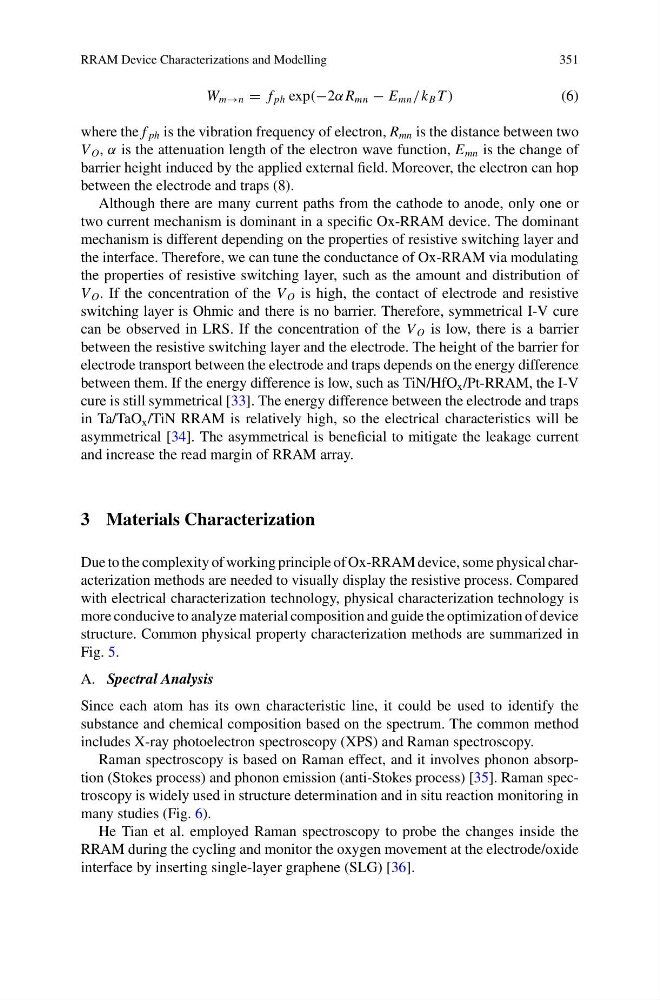
W m→n = f ph exp(−2α R mn − E mn /k B T )
(6)
where the f ph is the vibration frequency of electron, R mn is the distance between two
V O , α is the attenuation length of the electron wave function, E mn is the change of
barrier height induced by the applied external field. Moreover, the electron can hop
between the electrode and traps (8).
Although there are many current paths from the cathode to anode, only one or
two current mechanism is dominant in a specific Ox-RRAM device. The dominant
mechanism is different depending on the properties of resistive switching layer and
the interface. Therefore, we can tune the conductance of Ox-RRAM via modulating
the properties of resistive switching layer, such as the amount and distribution of
V O . If the concentration of the V O is high, the contact of electrode and resistive
switching layer is Ohmic and there is no barrier. Therefore, symmetrical I-V cure
can be observed in LRS. If the concentration of the V O is low, there is a barrier
between the resistive switching layer and the electrode. The height of the barrier for
electrode transport between the electrode and traps depends on the energy difference
between them. If the energy difference is low, such as TiN/HfO x /Pt-RRAM, the I-V
cure is still symmetrical [33]. The energy difference between the electrode and traps
in Ta/TaO x /TiN RRAM is relatively high, so the electrical characteristics will be
asymmetrical [34]. The asymmetrical is beneficial to mitigate the leakage current
and increase the read margin of RRAM array.
3 Materials Characterization
Due to the complexity of working principle of Ox-RRAM device, some physical characterization methods are needed to visually display the resistive process. Compared
with electrical characterization technology, physical characterization technology is
more conducive to analyze material composition and guide the optimization of device
structure. Common physical property characterization methods are summarized in
Fig. 5.
A. Spectral Analysis
Since each atom has its own characteristic line, it could be used to identify the
substance and chemical composition based on the spectrum. The common method
includes X-ray photoelectron spectroscopy (XPS) and Raman spectroscopy.
Raman spectroscopy is based on Raman effect, and it involves phonon absorption (Stokes process) and phonon emission (anti-Stokes process) [35]. Raman spectroscopy is widely used in structure determination and in situ reaction monitoring in
many studies (Fig. 6).
He Tian et al. employed Raman spectroscopy to probe the changes inside the
RRAM during the cycling and monitor the oxygen movement at the electrode/oxide
interface by inserting single-layer graphene (SLG) [36].
351
W m→n = f ph exp(−2α R mn − E mn /k B T )
(6)
where the f ph is the vibration frequency of electron, R mn is the distance between two
V O , α is the attenuation length of the electron wave function, E mn is the change of
barrier height induced by the applied external field. Moreover, the electron can hop
between the electrode and traps (8).
Although there are many current paths from the cathode to anode, only one or
two current mechanism is dominant in a specific Ox-RRAM device. The dominant
mechanism is different depending on the properties of resistive switching layer and
the interface. Therefore, we can tune the conductance of Ox-RRAM via modulating
the properties of resistive switching layer, such as the amount and distribution of
V O . If the concentration of the V O is high, the contact of electrode and resistive
switching layer is Ohmic and there is no barrier. Therefore, symmetrical I-V cure
can be observed in LRS. If the concentration of the V O is low, there is a barrier
between the resistive switching layer and the electrode. The height of the barrier for
electrode transport between the electrode and traps depends on the energy difference
between them. If the energy difference is low, such as TiN/HfO x /Pt-RRAM, the I-V
cure is still symmetrical [33]. The energy difference between the electrode and traps
in Ta/TaO x /TiN RRAM is relatively high, so the electrical characteristics will be
asymmetrical [34]. The asymmetrical is beneficial to mitigate the leakage current
and increase the read margin of RRAM array.
3 Materials Characterization
Due to the complexity of working principle of Ox-RRAM device, some physical characterization methods are needed to visually display the resistive process. Compared
with electrical characterization technology, physical characterization technology is
more conducive to analyze material composition and guide the optimization of device
structure. Common physical property characterization methods are summarized in
Fig. 5.
A. Spectral Analysis
Since each atom has its own characteristic line, it could be used to identify the
substance and chemical composition based on the spectrum. The common method
includes X-ray photoelectron spectroscopy (XPS) and Raman spectroscopy.
Raman spectroscopy is based on Raman effect, and it involves phonon absorption (Stokes process) and phonon emission (anti-Stokes process) [35]. Raman spectroscopy is widely used in structure determination and in situ reaction monitoring in
many studies (Fig. 6).
He Tian et al. employed Raman spectroscopy to probe the changes inside the
RRAM during the cycling and monitor the oxygen movement at the electrode/oxide
interface by inserting single-layer graphene (SLG) [36].