

350
P. Huang et al.
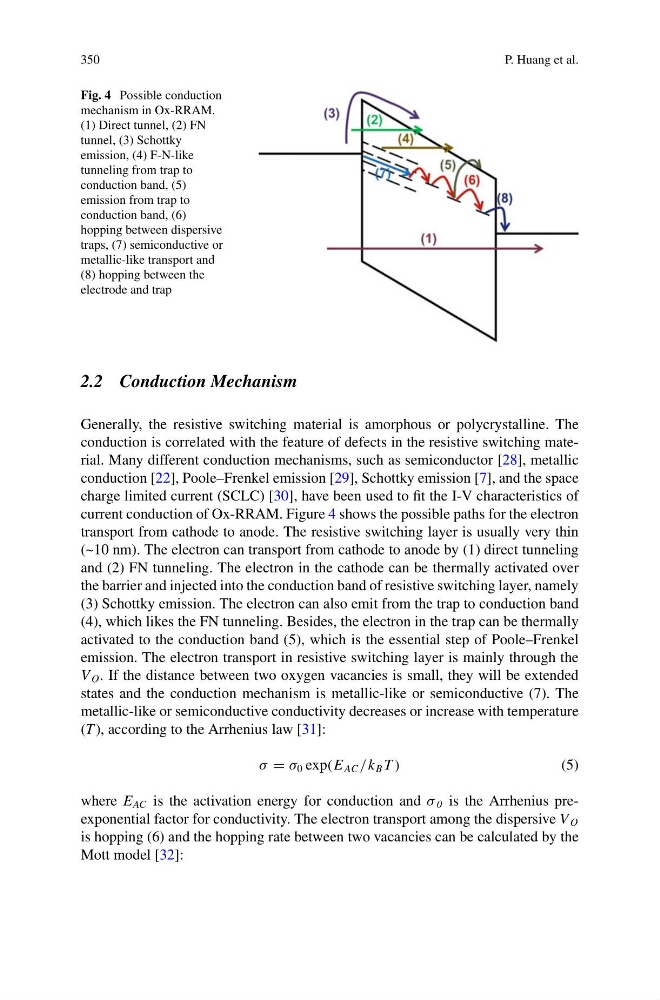
Fig. 4 Possible conduction
mechanism in Ox-RRAM.
(1) Direct tunnel, (2) FN
tunnel, (3) Schottky
emission, (4) F-N-like
tunneling from trap to
conduction band, (5)
emission from trap to
conduction band, (6)
hopping between dispersive
traps, (7) semiconductive or
metallic-like transport and
(8) hopping between the
electrode and trap
2.2 Conduction Mechanism
Generally, the resistive switching material is amorphous or polycrystalline. The
conduction is correlated with the feature of defects in the resistive switching material. Many different conduction mechanisms, such as semiconductor [28], metallic
conduction [22], Poole–Frenkel emission [29], Schottky emission [7], and the space
charge limited current (SCLC) [30], have been used to fit the I-V characteristics of
current conduction of Ox-RRAM. Figure 4 shows the possible paths for the electron
transport from cathode to anode. The resistive switching layer is usually very thin
(~10 nm). The electron can transport from cathode to anode by (1) direct tunneling
and (2) FN tunneling. The electron in the cathode can be thermally activated over
the barrier and injected into the conduction band of resistive switching layer, namely
(3) Schottky emission. The electron can also emit from the trap to conduction band
(4), which likes the FN tunneling. Besides, the electron in the trap can be thermally
activated to the conduction band (5), which is the essential step of Poole–Frenkel
emission. The electron transport in resistive switching layer is mainly through the
V O . If the distance between two oxygen vacancies is small, they will be extended
states and the conduction mechanism is metallic-like or semiconductive (7). The
metallic-like or semiconductive conductivity decreases or increase with temperature
(T ), according to the Arrhenius law [31]:
σ = σ 0 exp(E AC /k B T )
(5)
where E AC is the activation energy for conduction and σ 0 is the Arrhenius preexponential factor for conductivity. The electron transport among the dispersive V O
is hopping (6) and the hopping rate between two vacancies can be calculated by the
Mott model [32]:
P. Huang et al.
Fig. 4 Possible conduction
mechanism in Ox-RRAM.
(1) Direct tunnel, (2) FN
tunnel, (3) Schottky
emission, (4) F-N-like
tunneling from trap to
conduction band, (5)
emission from trap to
conduction band, (6)
hopping between dispersive
traps, (7) semiconductive or
metallic-like transport and
(8) hopping between the
electrode and trap
2.2 Conduction Mechanism
Generally, the resistive switching material is amorphous or polycrystalline. The
conduction is correlated with the feature of defects in the resistive switching material. Many different conduction mechanisms, such as semiconductor [28], metallic
conduction [22], Poole–Frenkel emission [29], Schottky emission [7], and the space
charge limited current (SCLC) [30], have been used to fit the I-V characteristics of
current conduction of Ox-RRAM. Figure 4 shows the possible paths for the electron
transport from cathode to anode. The resistive switching layer is usually very thin
(~10 nm). The electron can transport from cathode to anode by (1) direct tunneling
and (2) FN tunneling. The electron in the cathode can be thermally activated over
the barrier and injected into the conduction band of resistive switching layer, namely
(3) Schottky emission. The electron can also emit from the trap to conduction band
(4), which likes the FN tunneling. Besides, the electron in the trap can be thermally
activated to the conduction band (5), which is the essential step of Poole–Frenkel
emission. The electron transport in resistive switching layer is mainly through the
V O . If the distance between two oxygen vacancies is small, they will be extended
states and the conduction mechanism is metallic-like or semiconductive (7). The
metallic-like or semiconductive conductivity decreases or increase with temperature
(T ), according to the Arrhenius law [31]:
σ = σ 0 exp(E AC /k B T )
(5)
where E AC is the activation energy for conduction and σ 0 is the Arrhenius preexponential factor for conductivity. The electron transport among the dispersive V O
is hopping (6) and the hopping rate between two vacancies can be calculated by the
Mott model [32]: