

306
G. J. Lim et al.
allows it to traverse past minor defects, in contrast to DWs that are sensitive to
defects which causes pinning.
Beyond storage and memory devices, skyrmions have been explored for applications in other fields such as microwave detector and harvester [33], probabilistic
computing [34, 35], and artificial neuromorphic devices [36, 37]. With the abundant proposed uses of magnetic skyrmion illustrated in micromagnetic simulation,
the experimental study of magnetic skyrmions on magnetic thin films becomes
increasingly important and desired.
2.4 Spin Orbit Torque
STT-MTJ devices rely on high spin polarization factor offered by the PL. The high
voltage and drive current required to effectively switch the FL magnetization can
gradually damage the tunnel barrier, limiting the reliability and lifespan of MTJs. In
order to reduce the required drive current, tunnel barriers under 1 nm are necessary
to achieve a low resistance-area (RA) product. Furthermore, read-disturb can affect
MTJ device reliability due to the shared read and write current paths, causing the
device magnetization to unintentionally switch [38, 39]. An alternative technique to
switch a FM layer magnetization is via spin-orbit torque (SOT) switching, allowing
for separate read and write current paths, and improving the reliability and longevity
of the MTJ. While the SOT has two possible origins—the spin Hall effect (SHE) and
the Rashba effect – we will focus mainly on the SHE as the dominant contribution to
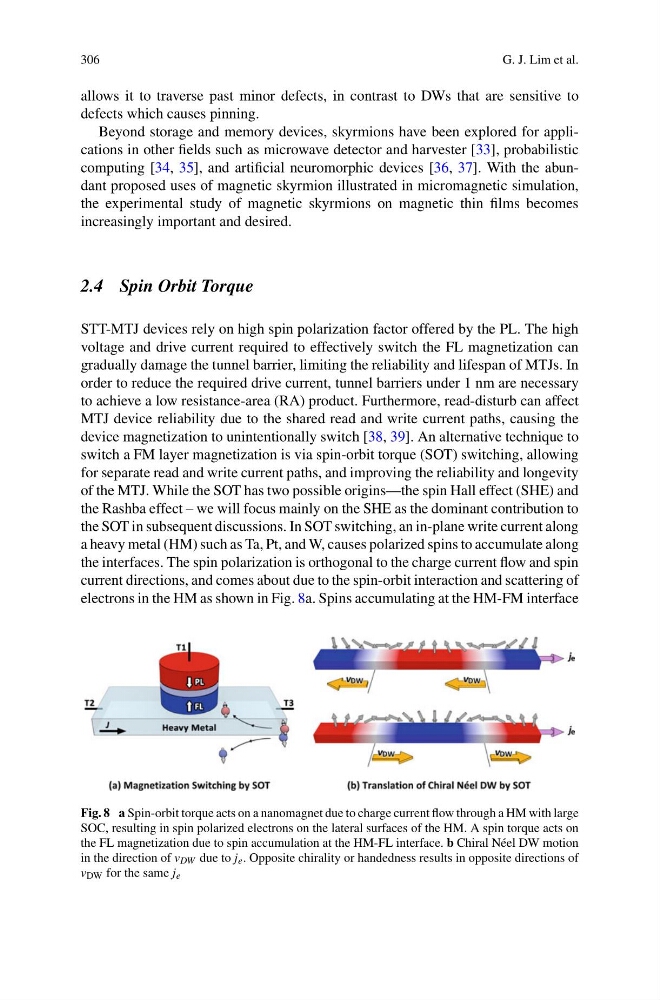
the SOT in subsequent discussions. In SOT switching, an in-plane write current along
a heavy metal (HM) such as Ta, Pt, and W, causes polarized spins to accumulate along
the interfaces. The spin polarization is orthogonal to the charge current flow and spin
current directions, and comes about due to the spin-orbit interaction and scattering of
electrons in the HM as shown in Fig. 8a. Spins accumulating at the HM-FM interface
Fig. 8 a Spin-orbit torque acts on a nanomagnet due to charge current flow through a HM with large
SOC, resulting in spin polarized electrons on the lateral surfaces of the HM. A spin torque acts on
the FL magnetization due to spin accumulation at the HM-FL interface. b Chiral Néel DW motion
in the direction of v DW due to j e . Opposite chirality or handedness results in opposite directions of
v DW for the same j e
G. J. Lim et al.
allows it to traverse past minor defects, in contrast to DWs that are sensitive to
defects which causes pinning.
Beyond storage and memory devices, skyrmions have been explored for applications in other fields such as microwave detector and harvester [33], probabilistic
computing [34, 35], and artificial neuromorphic devices [36, 37]. With the abundant proposed uses of magnetic skyrmion illustrated in micromagnetic simulation,
the experimental study of magnetic skyrmions on magnetic thin films becomes
increasingly important and desired.
2.4 Spin Orbit Torque
STT-MTJ devices rely on high spin polarization factor offered by the PL. The high
voltage and drive current required to effectively switch the FL magnetization can
gradually damage the tunnel barrier, limiting the reliability and lifespan of MTJs. In
order to reduce the required drive current, tunnel barriers under 1 nm are necessary
to achieve a low resistance-area (RA) product. Furthermore, read-disturb can affect
MTJ device reliability due to the shared read and write current paths, causing the
device magnetization to unintentionally switch [38, 39]. An alternative technique to
switch a FM layer magnetization is via spin-orbit torque (SOT) switching, allowing
for separate read and write current paths, and improving the reliability and longevity
of the MTJ. While the SOT has two possible origins—the spin Hall effect (SHE) and
the Rashba effect – we will focus mainly on the SHE as the dominant contribution to
the SOT in subsequent discussions. In SOT switching, an in-plane write current along
a heavy metal (HM) such as Ta, Pt, and W, causes polarized spins to accumulate along
the interfaces. The spin polarization is orthogonal to the charge current flow and spin
current directions, and comes about due to the spin-orbit interaction and scattering of
electrons in the HM as shown in Fig. 8a. Spins accumulating at the HM-FM interface
Fig. 8 a Spin-orbit torque acts on a nanomagnet due to charge current flow through a HM with large
SOC, resulting in spin polarized electrons on the lateral surfaces of the HM. A spin torque acts on
the FL magnetization due to spin accumulation at the HM-FL interface. b Chiral Néel DW motion
in the direction of v DW due to j e . Opposite chirality or handedness results in opposite directions of
v DW for the same j e