

Spintronics for Neuromorphic Engineering
307
then acts on the magnetization of the FM, thereby switching it [40]. In materials with
PMA, an externally applied field along the direction of the input charge current is
necessary in order to break the switching symmetry [40, 41]. The SOT switching
efficiency is dependent on the degree of spin polarization and spin current density J s ,
described by the spin Hall angle θ S H and input charge current density J e [42]. SOT
has also enabled high speed movement of chiral DWs along nanowires as illustrated
in Fig. 8b [23]. The direction of DW propagation v DW relative to injected current j e
is dependent on the chirality of the DW.
3 Biological Neurons and Synapses
Unlike conventional von Neumann computers, the biological brain consumes much
less power, operates through massively parallel processing, is plastic and reconfigurable, and co-locates processing with memory. Brain-inspired models attempt to
closely describe the various mechanisms to the likeness of the biological brain. The
degree of likeness of the model to the biological brain is termed bio-fidelity. The
nervous system of the biological brain is primarily composed of neurons, specialised
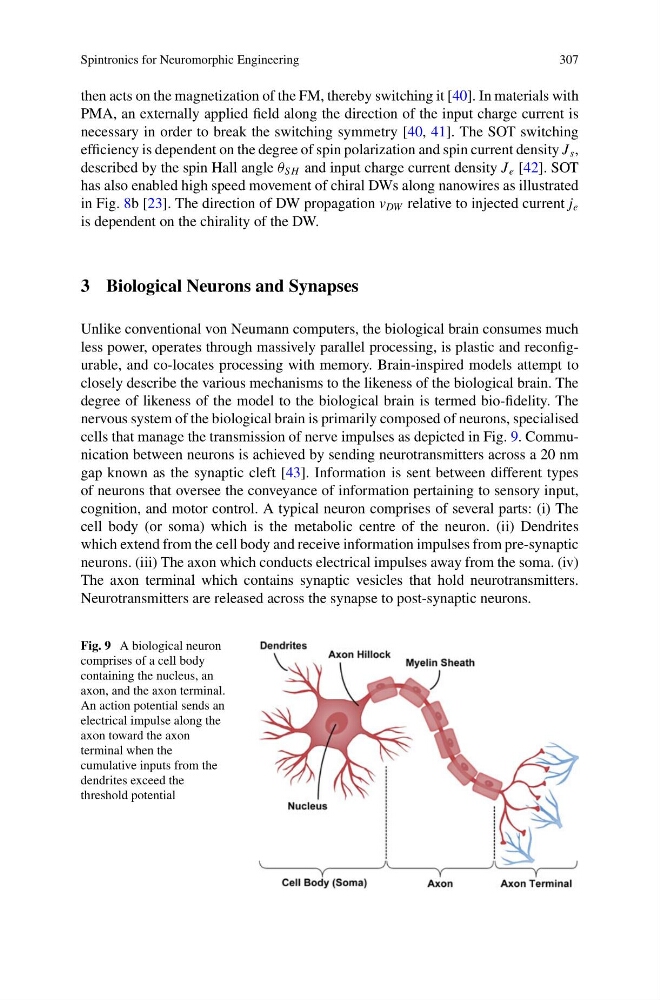
cells that manage the transmission of nerve impulses as depicted in Fig. 9. Communication between neurons is achieved by sending neurotransmitters across a 20 nm
gap known as the synaptic cleft [43]. Information is sent between different types
of neurons that oversee the conveyance of information pertaining to sensory input,
cognition, and motor control. A typical neuron comprises of several parts: (i) The
cell body (or soma) which is the metabolic centre of the neuron. (ii) Dendrites
which extend from the cell body and receive information impulses from pre-synaptic
neurons. (iii) The axon which conducts electrical impulses away from the soma. (iv)
The axon terminal which contains synaptic vesicles that hold neurotransmitters.
Neurotransmitters are released across the synapse to post-synaptic neurons.
Fig. 9 A biological neuron
comprises of a cell body
containing the nucleus, an
axon, and the axon terminal.
An action potential sends an
electrical impulse along the
axon toward the axon
terminal when the
cumulative inputs from the
dendrites exceed the
threshold potential
307
then acts on the magnetization of the FM, thereby switching it [40]. In materials with
PMA, an externally applied field along the direction of the input charge current is
necessary in order to break the switching symmetry [40, 41]. The SOT switching
efficiency is dependent on the degree of spin polarization and spin current density J s ,
described by the spin Hall angle θ S H and input charge current density J e [42]. SOT
has also enabled high speed movement of chiral DWs along nanowires as illustrated
in Fig. 8b [23]. The direction of DW propagation v DW relative to injected current j e
is dependent on the chirality of the DW.
3 Biological Neurons and Synapses
Unlike conventional von Neumann computers, the biological brain consumes much
less power, operates through massively parallel processing, is plastic and reconfigurable, and co-locates processing with memory. Brain-inspired models attempt to
closely describe the various mechanisms to the likeness of the biological brain. The
degree of likeness of the model to the biological brain is termed bio-fidelity. The
nervous system of the biological brain is primarily composed of neurons, specialised
cells that manage the transmission of nerve impulses as depicted in Fig. 9. Communication between neurons is achieved by sending neurotransmitters across a 20 nm
gap known as the synaptic cleft [43]. Information is sent between different types
of neurons that oversee the conveyance of information pertaining to sensory input,
cognition, and motor control. A typical neuron comprises of several parts: (i) The
cell body (or soma) which is the metabolic centre of the neuron. (ii) Dendrites
which extend from the cell body and receive information impulses from pre-synaptic
neurons. (iii) The axon which conducts electrical impulses away from the soma. (iv)
The axon terminal which contains synaptic vesicles that hold neurotransmitters.
Neurotransmitters are released across the synapse to post-synaptic neurons.
Fig. 9 A biological neuron
comprises of a cell body
containing the nucleus, an
axon, and the axon terminal.
An action potential sends an
electrical impulse along the
axon toward the axon
terminal when the
cumulative inputs from the
dendrites exceed the
threshold potential