

Spintronics for Neuromorphic Engineering
305
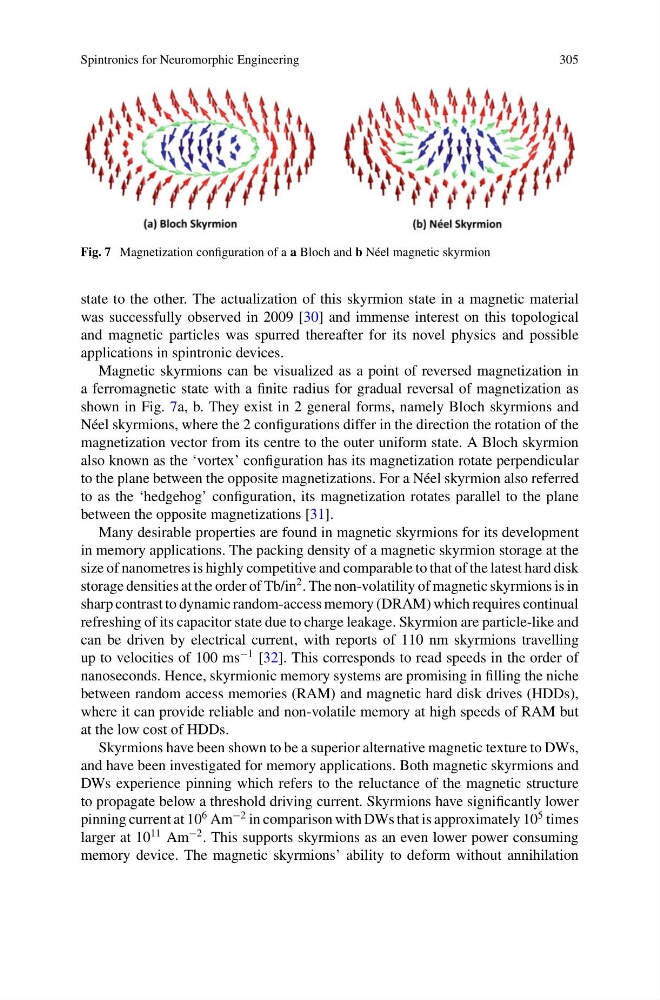
Fig. 7 Magnetization configuration of a a Bloch and b Néel magnetic skyrmion
state to the other. The actualization of this skyrmion state in a magnetic material
was successfully observed in 2009 [30] and immense interest on this topological
and magnetic particles was spurred thereafter for its novel physics and possible
applications in spintronic devices.
Magnetic skyrmions can be visualized as a point of reversed magnetization in
a ferromagnetic state with a finite radius for gradual reversal of magnetization as
shown in Fig. 7a, b. They exist in 2 general forms, namely Bloch skyrmions and
Néel skyrmions, where the 2 configurations differ in the direction the rotation of the
magnetization vector from its centre to the outer uniform state. A Bloch skyrmion
also known as the ‘vortex’ configuration has its magnetization rotate perpendicular
to the plane between the opposite magnetizations. For a Néel skyrmion also referred
to as the ‘hedgehog’ configuration, its magnetization rotates parallel to the plane
between the opposite magnetizations [31].
Many desirable properties are found in magnetic skyrmions for its development
in memory applications. The packing density of a magnetic skyrmion storage at the
size of nanometres is highly competitive and comparable to that of the latest hard disk
storage densities at the order of Tb/in
2 . The non-volatility of magnetic skyrmions is in
sharp contrast to dynamic random-access memory (DRAM) which requires continual
refreshing of its capacitor state due to charge leakage. Skyrmion are particle-like and
can be driven by electrical current, with reports of 110 nm skyrmions travelling
up to velocities of 100 ms
−1 [32]. This corresponds to read speeds in the order of
nanoseconds. Hence, skyrmionic memory systems are promising in filling the niche
between random access memories (RAM) and magnetic hard disk drives (HDDs),
where it can provide reliable and non-volatile memory at high speeds of RAM but
at the low cost of HDDs.
Skyrmions have been shown to be a superior alternative magnetic texture to DWs,
and have been investigated for memory applications. Both magnetic skyrmions and
DWs experience pinning which refers to the reluctance of the magnetic structure
to propagate below a threshold driving current. Skyrmions have significantly lower
pinning current at 10
6 Am
−2 in comparison with DWs that is approximately 10
5 times
larger at 10
11 Am
−2 . This supports skyrmions as an even lower power consuming
memory device. The magnetic skyrmions’ ability to deform without annihilation
305
Fig. 7 Magnetization configuration of a a Bloch and b Néel magnetic skyrmion
state to the other. The actualization of this skyrmion state in a magnetic material
was successfully observed in 2009 [30] and immense interest on this topological
and magnetic particles was spurred thereafter for its novel physics and possible
applications in spintronic devices.
Magnetic skyrmions can be visualized as a point of reversed magnetization in
a ferromagnetic state with a finite radius for gradual reversal of magnetization as
shown in Fig. 7a, b. They exist in 2 general forms, namely Bloch skyrmions and
Néel skyrmions, where the 2 configurations differ in the direction the rotation of the
magnetization vector from its centre to the outer uniform state. A Bloch skyrmion
also known as the ‘vortex’ configuration has its magnetization rotate perpendicular
to the plane between the opposite magnetizations. For a Néel skyrmion also referred
to as the ‘hedgehog’ configuration, its magnetization rotates parallel to the plane
between the opposite magnetizations [31].
Many desirable properties are found in magnetic skyrmions for its development
in memory applications. The packing density of a magnetic skyrmion storage at the
size of nanometres is highly competitive and comparable to that of the latest hard disk
storage densities at the order of Tb/in
2 . The non-volatility of magnetic skyrmions is in
sharp contrast to dynamic random-access memory (DRAM) which requires continual
refreshing of its capacitor state due to charge leakage. Skyrmion are particle-like and
can be driven by electrical current, with reports of 110 nm skyrmions travelling
up to velocities of 100 ms
−1 [32]. This corresponds to read speeds in the order of
nanoseconds. Hence, skyrmionic memory systems are promising in filling the niche
between random access memories (RAM) and magnetic hard disk drives (HDDs),
where it can provide reliable and non-volatile memory at high speeds of RAM but
at the low cost of HDDs.
Skyrmions have been shown to be a superior alternative magnetic texture to DWs,
and have been investigated for memory applications. Both magnetic skyrmions and
DWs experience pinning which refers to the reluctance of the magnetic structure
to propagate below a threshold driving current. Skyrmions have significantly lower
pinning current at 10
6 Am
−2 in comparison with DWs that is approximately 10
5 times
larger at 10
11 Am
−2 . This supports skyrmions as an even lower power consuming
memory device. The magnetic skyrmions’ ability to deform without annihilation