

304
G. J. Lim et al.
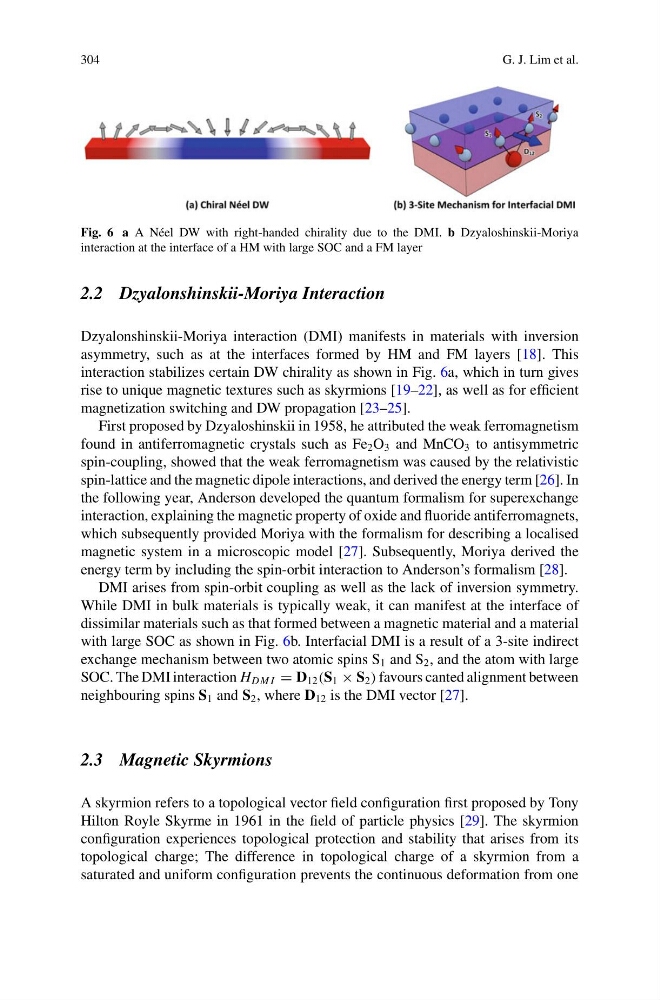
Fig. 6 a A Néel DW with right-handed chirality due to the DMI. b Dzyaloshinskii-Moriya
interaction at the interface of a HM with large SOC and a FM layer
2.2 Dzyalonshinskii-Moriya Interaction
Dzyalonshinskii-Moriya interaction (DMI) manifests in materials with inversion
asymmetry, such as at the interfaces formed by HM and FM layers [18]. This
interaction stabilizes certain DW chirality as shown in Fig. 6a, which in turn gives
rise to unique magnetic textures such as skyrmions [19–22], as well as for efficient
magnetization switching and DW propagation [23–25].
First proposed by Dzyaloshinskii in 1958, he attributed the weak ferromagnetism
found in antiferromagnetic crystals such as Fe 2 O 3 and MnCO 3 to antisymmetric
spin-coupling, showed that the weak ferromagnetism was caused by the relativistic
spin-lattice and the magnetic dipole interactions, and derived the energy term [26]. In
the following year, Anderson developed the quantum formalism for superexchange
interaction, explaining the magnetic property of oxide and fluoride antiferromagnets,
which subsequently provided Moriya with the formalism for describing a localised
magnetic system in a microscopic model [27]. Subsequently, Moriya derived the
energy term by including the spin-orbit interaction to Anderson’s formalism [28].
DMI arises from spin-orbit coupling as well as the lack of inversion symmetry.
While DMI in bulk materials is typically weak, it can manifest at the interface of
dissimilar materials such as that formed between a magnetic material and a material
with large SOC as shown in Fig. 6b. Interfacial DMI is a result of a 3-site indirect
exchange mechanism between two atomic spins S 1 and S 2 , and the atom with large
SOC. The DMI interaction H DM I = D 12 (S 1 × S 2 ) favours canted alignment between
neighbouring spins S 1 and S 2 , where D 12 is the DMI vector [27].
2.3 Magnetic Skyrmions
A skyrmion refers to a topological vector field configuration first proposed by Tony
Hilton Royle Skyrme in 1961 in the field of particle physics [29]. The skyrmion
configuration experiences topological protection and stability that arises from its
topological charge; The difference in topological charge of a skyrmion from a
saturated and uniform configuration prevents the continuous deformation from one
G. J. Lim et al.
Fig. 6 a A Néel DW with right-handed chirality due to the DMI. b Dzyaloshinskii-Moriya
interaction at the interface of a HM with large SOC and a FM layer
2.2 Dzyalonshinskii-Moriya Interaction
Dzyalonshinskii-Moriya interaction (DMI) manifests in materials with inversion
asymmetry, such as at the interfaces formed by HM and FM layers [18]. This
interaction stabilizes certain DW chirality as shown in Fig. 6a, which in turn gives
rise to unique magnetic textures such as skyrmions [19–22], as well as for efficient
magnetization switching and DW propagation [23–25].
First proposed by Dzyaloshinskii in 1958, he attributed the weak ferromagnetism
found in antiferromagnetic crystals such as Fe 2 O 3 and MnCO 3 to antisymmetric
spin-coupling, showed that the weak ferromagnetism was caused by the relativistic
spin-lattice and the magnetic dipole interactions, and derived the energy term [26]. In
the following year, Anderson developed the quantum formalism for superexchange
interaction, explaining the magnetic property of oxide and fluoride antiferromagnets,
which subsequently provided Moriya with the formalism for describing a localised
magnetic system in a microscopic model [27]. Subsequently, Moriya derived the
energy term by including the spin-orbit interaction to Anderson’s formalism [28].
DMI arises from spin-orbit coupling as well as the lack of inversion symmetry.
While DMI in bulk materials is typically weak, it can manifest at the interface of
dissimilar materials such as that formed between a magnetic material and a material
with large SOC as shown in Fig. 6b. Interfacial DMI is a result of a 3-site indirect
exchange mechanism between two atomic spins S 1 and S 2 , and the atom with large
SOC. The DMI interaction H DM I = D 12 (S 1 × S 2 ) favours canted alignment between
neighbouring spins S 1 and S 2 , where D 12 is the DMI vector [27].
2.3 Magnetic Skyrmions
A skyrmion refers to a topological vector field configuration first proposed by Tony
Hilton Royle Skyrme in 1961 in the field of particle physics [29]. The skyrmion
configuration experiences topological protection and stability that arises from its
topological charge; The difference in topological charge of a skyrmion from a
saturated and uniform configuration prevents the continuous deformation from one