

Spintronics for Neuromorphic Engineering
303
oriented along the same direction. A single domain can exist in a sufficiently small
region of magnetic material with strongly coupled magnetic moments, effectively
forming monodomain magnets. The magnetization orientation transitions across the
boundaries of domains to form a DW. DWs can form in magnetic materials with IMA
and PMA. The types of DW formation differs between IMA and PMA nanowires. In
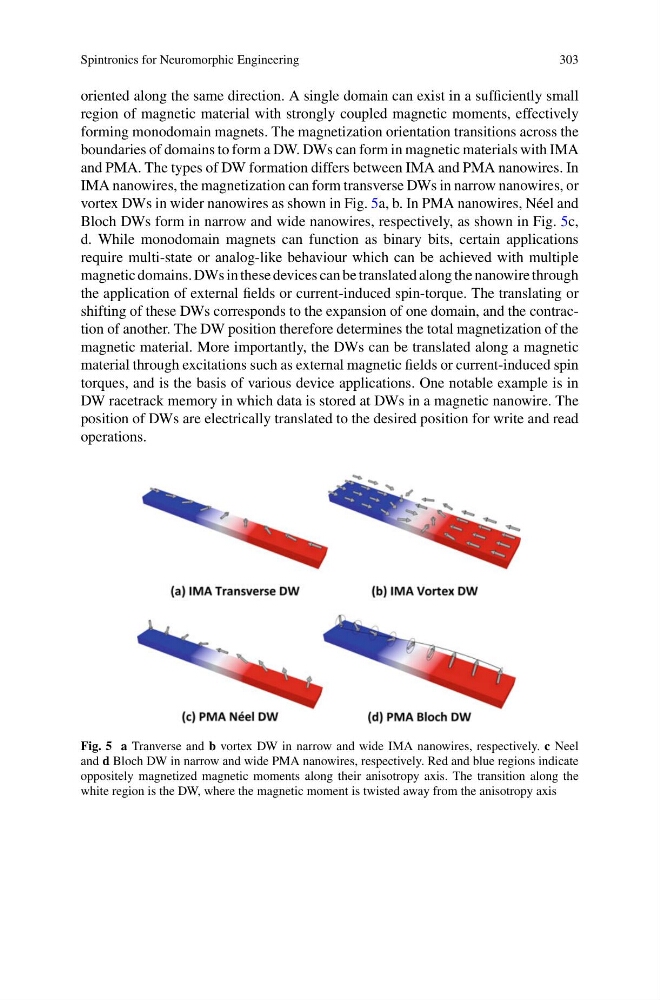
IMA nanowires, the magnetization can form transverse DWs in narrow nanowires, or
vortex DWs in wider nanowires as shown in Fig. 5a, b. In PMA nanowires, Néel and
Bloch DWs form in narrow and wide nanowires, respectively, as shown in Fig. 5c,
d. While monodomain magnets can function as binary bits, certain applications
require multi-state or analog-like behaviour which can be achieved with multiple
magnetic domains. DWs in these devices can be translated along the nanowire through
the application of external fields or current-induced spin-torque. The translating or
shifting of these DWs corresponds to the expansion of one domain, and the contraction of another. The DW position therefore determines the total magnetization of the
magnetic material. More importantly, the DWs can be translated along a magnetic
material through excitations such as external magnetic fields or current-induced spin
torques, and is the basis of various device applications. One notable example is in
DW racetrack memory in which data is stored at DWs in a magnetic nanowire. The
position of DWs are electrically translated to the desired position for write and read
operations.
Fig. 5 a Tranverse and b vortex DW in narrow and wide IMA nanowires, respectively. c Neel
and d Bloch DW in narrow and wide PMA nanowires, respectively. Red and blue regions indicate
oppositely magnetized magnetic moments along their anisotropy axis. The transition along the
white region is the DW, where the magnetic moment is twisted away from the anisotropy axis
303
oriented along the same direction. A single domain can exist in a sufficiently small
region of magnetic material with strongly coupled magnetic moments, effectively
forming monodomain magnets. The magnetization orientation transitions across the
boundaries of domains to form a DW. DWs can form in magnetic materials with IMA
and PMA. The types of DW formation differs between IMA and PMA nanowires. In
IMA nanowires, the magnetization can form transverse DWs in narrow nanowires, or
vortex DWs in wider nanowires as shown in Fig. 5a, b. In PMA nanowires, Néel and
Bloch DWs form in narrow and wide nanowires, respectively, as shown in Fig. 5c,
d. While monodomain magnets can function as binary bits, certain applications
require multi-state or analog-like behaviour which can be achieved with multiple
magnetic domains. DWs in these devices can be translated along the nanowire through
the application of external fields or current-induced spin-torque. The translating or
shifting of these DWs corresponds to the expansion of one domain, and the contraction of another. The DW position therefore determines the total magnetization of the
magnetic material. More importantly, the DWs can be translated along a magnetic
material through excitations such as external magnetic fields or current-induced spin
torques, and is the basis of various device applications. One notable example is in
DW racetrack memory in which data is stored at DWs in a magnetic nanowire. The
position of DWs are electrically translated to the desired position for write and read
operations.
Fig. 5 a Tranverse and b vortex DW in narrow and wide IMA nanowires, respectively. c Neel
and d Bloch DW in narrow and wide PMA nanowires, respectively. Red and blue regions indicate
oppositely magnetized magnetic moments along their anisotropy axis. The transition along the
white region is the DW, where the magnetic moment is twisted away from the anisotropy axis