

3D Nanomagnetic Logic
275
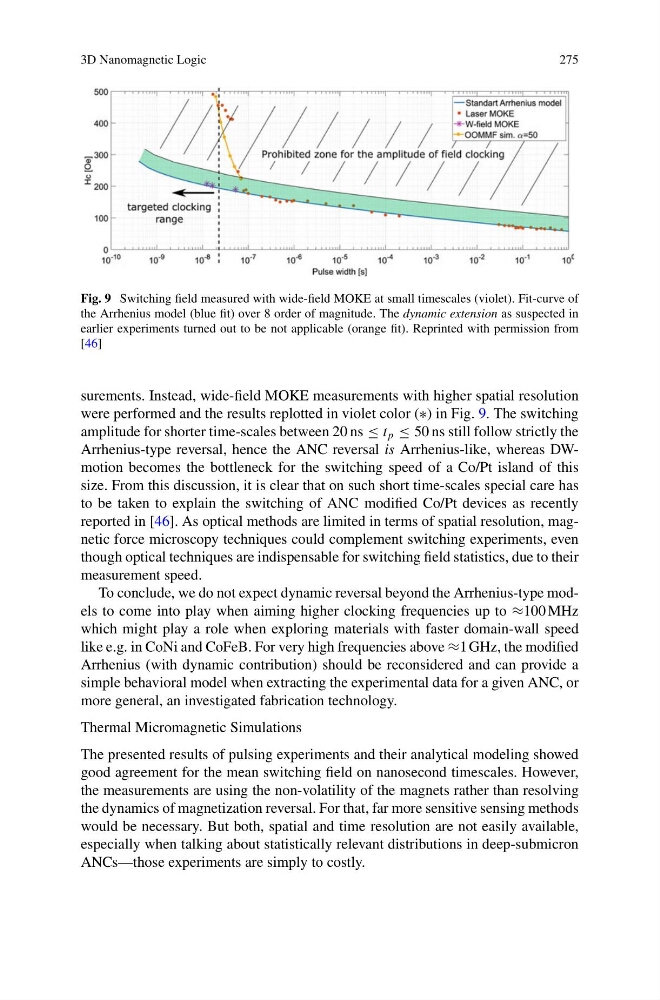
Fig. 9 Switching field measured with wide-field MOKE at small timescales (violet). Fit-curve of
the Arrhenius model (blue fit) over 8 order of magnitude. The dynamic extension as suspected in
earlier experiments turned out to be not applicable (orange fit). Reprinted with permission from
[46]
surements. Instead, wide-field MOKE measurements with higher spatial resolution
were performed and the results replotted in violet color (∗) in Fig. 9. The switching
amplitude for shorter time-scales between 20 ns ≤ t p ≤ 50 ns still follow strictly the
Arrhenius-type reversal, hence the ANC reversal is Arrhenius-like, whereas DWmotion becomes the bottleneck for the switching speed of a Co/Pt island of this
size. From this discussion, it is clear that on such short time-scales special care has
to be taken to explain the switching of ANC modified Co/Pt devices as recently
reported in [46]. As optical methods are limited in terms of spatial resolution, magnetic force microscopy techniques could complement switching experiments, even
though optical techniques are indispensable for switching field statistics, due to their
measurement speed.
To conclude, we do not expect dynamic reversal beyond the Arrhenius-type models to come into play when aiming higher clocking frequencies up to ≈100 MHz
which might play a role when exploring materials with faster domain-wall speed
like e.g. in CoNi and CoFeB. For very high frequencies above ≈1 GHz, the modified
Arrhenius (with dynamic contribution) should be reconsidered and can provide a
simple behavioral model when extracting the experimental data for a given ANC, or
more general, an investigated fabrication technology.
Thermal Micromagnetic Simulations
The presented results of pulsing experiments and their analytical modeling showed
good agreement for the mean switching field on nanosecond timescales. However,
the measurements are using the non-volatility of the magnets rather than resolving
the dynamics of magnetization reversal. For that, far more sensitive sensing methods
would be necessary. But both, spatial and time resolution are not easily available,
especially when talking about statistically relevant distributions in deep-submicron
ANCs—those experiments are simply to costly.
275
Fig. 9 Switching field measured with wide-field MOKE at small timescales (violet). Fit-curve of
the Arrhenius model (blue fit) over 8 order of magnitude. The dynamic extension as suspected in
earlier experiments turned out to be not applicable (orange fit). Reprinted with permission from
[46]
surements. Instead, wide-field MOKE measurements with higher spatial resolution
were performed and the results replotted in violet color (∗) in Fig. 9. The switching
amplitude for shorter time-scales between 20 ns ≤ t p ≤ 50 ns still follow strictly the
Arrhenius-type reversal, hence the ANC reversal is Arrhenius-like, whereas DWmotion becomes the bottleneck for the switching speed of a Co/Pt island of this
size. From this discussion, it is clear that on such short time-scales special care has
to be taken to explain the switching of ANC modified Co/Pt devices as recently
reported in [46]. As optical methods are limited in terms of spatial resolution, magnetic force microscopy techniques could complement switching experiments, even
though optical techniques are indispensable for switching field statistics, due to their
measurement speed.
To conclude, we do not expect dynamic reversal beyond the Arrhenius-type models to come into play when aiming higher clocking frequencies up to ≈100 MHz
which might play a role when exploring materials with faster domain-wall speed
like e.g. in CoNi and CoFeB. For very high frequencies above ≈1 GHz, the modified
Arrhenius (with dynamic contribution) should be reconsidered and can provide a
simple behavioral model when extracting the experimental data for a given ANC, or
more general, an investigated fabrication technology.
Thermal Micromagnetic Simulations
The presented results of pulsing experiments and their analytical modeling showed
good agreement for the mean switching field on nanosecond timescales. However,
the measurements are using the non-volatility of the magnets rather than resolving
the dynamics of magnetization reversal. For that, far more sensitive sensing methods
would be necessary. But both, spatial and time resolution are not easily available,
especially when talking about statistically relevant distributions in deep-submicron
ANCs—those experiments are simply to costly.