

274
M. Becherer
But another important aspect became obvious: the measured time-scales, where
dynamic switching is starting to dominate, is still somewhat surprising. One would
expect dynamic effects for ANC reversal to take place far below 10 ns and one can
speculate, that either damping in the investigated Co/Pt stacks is very high and/or
domain-wall-speed in the device-under-test (DUT) is ‘hiding’ the dynamics of ANC
reversal. Recapitulating, that the MOKE laser beam is integrating over the whole
magnet area, DW-speed indeed becomes important when the magnet is pulsed at
short-time scales. Special care was taken to apply a magnetic propagation field
slightly lower than the effective switching field of the DUT in order to fully propagate
the DW throughout the magnet after the short field pulse.
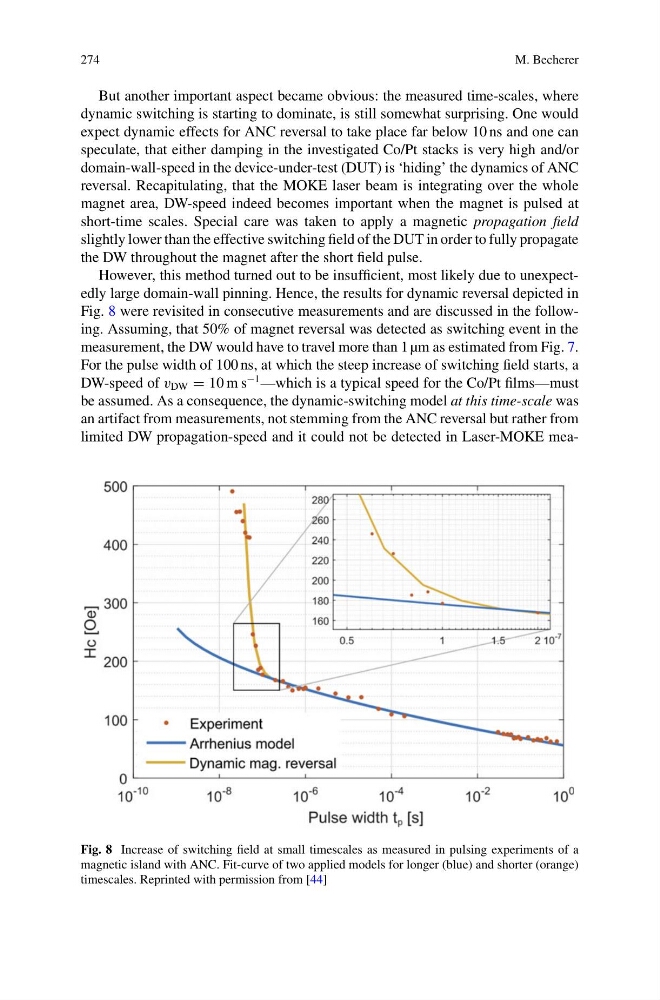
However, this method turned out to be insufficient, most likely due to unexpectedly large domain-wall pinning. Hence, the results for dynamic reversal depicted in
Fig. 8 were revisited in consecutive measurements and are discussed in the following. Assuming, that 50% of magnet reversal was detected as switching event in the
measurement, the DW would have to travel more than 1 µm as estimated from Fig. 7.
For the pulse width of 100 ns, at which the steep increase of switching field starts, a
DW-speed of v DW = 10 m s
−1 —which is a typical speed for the Co/Pt films—must
be assumed. As a consequence, the dynamic-switching model at this time-scale was
an artifact from measurements, not stemming from the ANC reversal but rather from
limited DW propagation-speed and it could not be detected in Laser-MOKE meaFig. 8 Increase of switching field at small timescales as measured in pulsing experiments of a
magnetic island with ANC. Fit-curve of two applied models for longer (blue) and shorter (orange)
timescales. Reprinted with permission from [44]
M. Becherer
But another important aspect became obvious: the measured time-scales, where
dynamic switching is starting to dominate, is still somewhat surprising. One would
expect dynamic effects for ANC reversal to take place far below 10 ns and one can
speculate, that either damping in the investigated Co/Pt stacks is very high and/or
domain-wall-speed in the device-under-test (DUT) is ‘hiding’ the dynamics of ANC
reversal. Recapitulating, that the MOKE laser beam is integrating over the whole
magnet area, DW-speed indeed becomes important when the magnet is pulsed at
short-time scales. Special care was taken to apply a magnetic propagation field
slightly lower than the effective switching field of the DUT in order to fully propagate
the DW throughout the magnet after the short field pulse.
However, this method turned out to be insufficient, most likely due to unexpectedly large domain-wall pinning. Hence, the results for dynamic reversal depicted in
Fig. 8 were revisited in consecutive measurements and are discussed in the following. Assuming, that 50% of magnet reversal was detected as switching event in the
measurement, the DW would have to travel more than 1 µm as estimated from Fig. 7.
For the pulse width of 100 ns, at which the steep increase of switching field starts, a
DW-speed of v DW = 10 m s
−1 —which is a typical speed for the Co/Pt films—must
be assumed. As a consequence, the dynamic-switching model at this time-scale was
an artifact from measurements, not stemming from the ANC reversal but rather from
limited DW propagation-speed and it could not be detected in Laser-MOKE meaFig. 8 Increase of switching field at small timescales as measured in pulsing experiments of a
magnetic island with ANC. Fit-curve of two applied models for longer (blue) and shorter (orange)
timescales. Reprinted with permission from [44]