

276
M. Becherer
In order to look at the underlying time evolution of magnetization during the
pulsing experiments, micromagnetic simulations are the method of choice. By using
the thermal module of [36] implemented by the Wiesendanger group [47], which
adds a stochastic differential equation of the Langevin type, extensive simulations
were performed, mapping the pulsing experiment in reasonable good agreement.
For that, both the time-scale of up to hundreds of nano-seconds and the area of the
ANC under investigation, are to be modeled. In order to extract statistically relevant
data, at least 100 repeated simulations per pulsing amplitude are performed. The
computing cost for one simulation run are several hours on a single computing core,
hence the parallel-script [48] was beneficially used to distribute the large amount of
stochastical simulations on far more than 100 cores in parallel.
In the following, a typical procedure for combined in-plane and out-of-plane
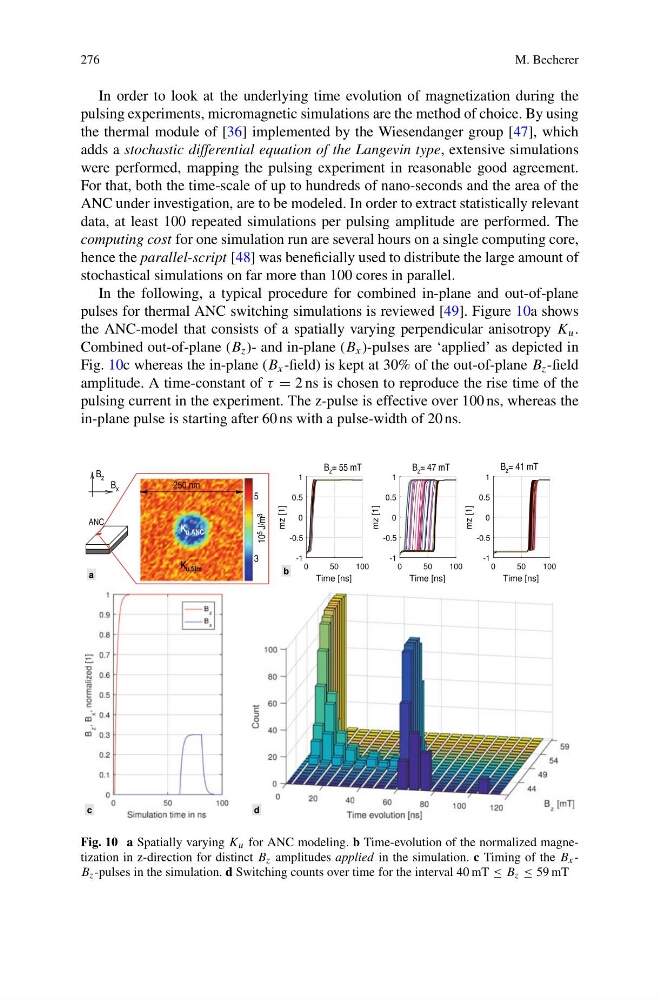
pulses for thermal ANC switching simulations is reviewed [49]. Figure 10a shows
the ANC-model that consists of a spatially varying perpendicular anisotropy K u .
Combined out-of-plane (B z )- and in-plane (B x )-pulses are ‘applied’ as depicted in
Fig. 10c whereas the in-plane (B x -field) is kept at 30% of the out-of-plane B z -field
amplitude. A time-constant of τ = 2 ns is chosen to reproduce the rise time of the
pulsing current in the experiment. The z-pulse is effective over 100 ns, whereas the
in-plane pulse is starting after 60 ns with a pulse-width of 20 ns.
Fig. 10 a Spatially varying K u for ANC modeling. b Time-evolution of the normalized magnetization in z-direction for distinct B z amplitudes applied in the simulation. c Timing of the B x -
B z -pulses in the simulation. d Switching counts over time for the interval 40 mT ≤ B z ≤ 59 mT
M. Becherer
In order to look at the underlying time evolution of magnetization during the
pulsing experiments, micromagnetic simulations are the method of choice. By using
the thermal module of [36] implemented by the Wiesendanger group [47], which
adds a stochastic differential equation of the Langevin type, extensive simulations
were performed, mapping the pulsing experiment in reasonable good agreement.
For that, both the time-scale of up to hundreds of nano-seconds and the area of the
ANC under investigation, are to be modeled. In order to extract statistically relevant
data, at least 100 repeated simulations per pulsing amplitude are performed. The
computing cost for one simulation run are several hours on a single computing core,
hence the parallel-script [48] was beneficially used to distribute the large amount of
stochastical simulations on far more than 100 cores in parallel.
In the following, a typical procedure for combined in-plane and out-of-plane
pulses for thermal ANC switching simulations is reviewed [49]. Figure 10a shows
the ANC-model that consists of a spatially varying perpendicular anisotropy K u .
Combined out-of-plane (B z )- and in-plane (B x )-pulses are ‘applied’ as depicted in
Fig. 10c whereas the in-plane (B x -field) is kept at 30% of the out-of-plane B z -field
amplitude. A time-constant of τ = 2 ns is chosen to reproduce the rise time of the
pulsing current in the experiment. The z-pulse is effective over 100 ns, whereas the
in-plane pulse is starting after 60 ns with a pulse-width of 20 ns.
Fig. 10 a Spatially varying K u for ANC modeling. b Time-evolution of the normalized magnetization in z-direction for distinct B z amplitudes applied in the simulation. c Timing of the B x -
B z -pulses in the simulation. d Switching counts over time for the interval 40 mT ≤ B z ≤ 59 mT