

Domain Wall Programmable Magnetic Logic
237
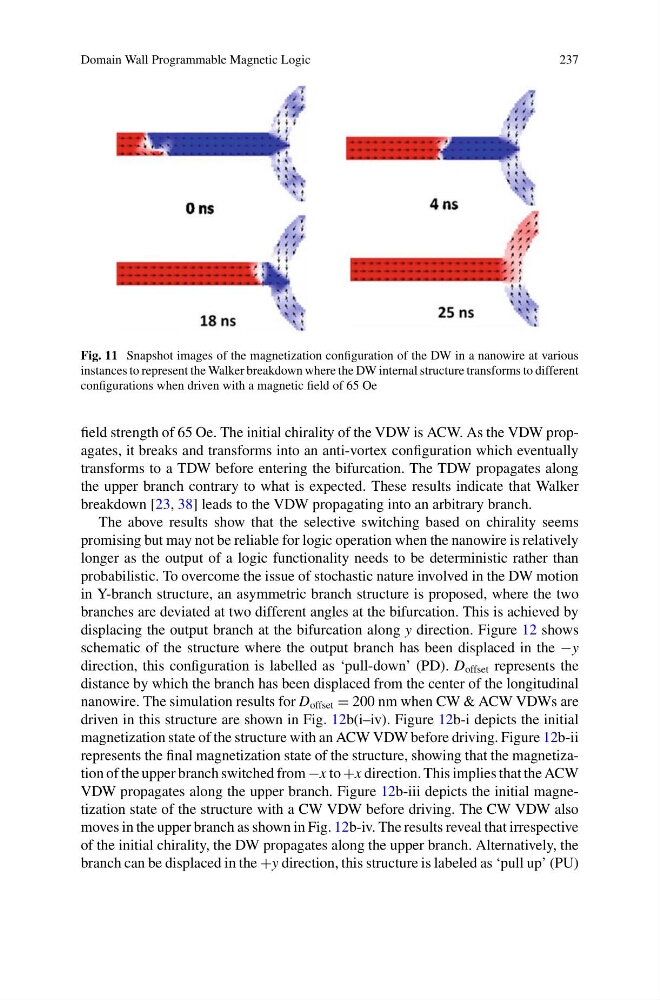
Fig. 11 Snapshot images of the magnetization configuration of the DW in a nanowire at various
instances to represent the Walker breakdown where the DW internal structure transforms to different
configurations when driven with a magnetic field of 65 Oe
field strength of 65 Oe. The initial chirality of the VDW is ACW. As the VDW propagates, it breaks and transforms into an anti-vortex configuration which eventually
transforms to a TDW before entering the bifurcation. The TDW propagates along
the upper branch contrary to what is expected. These results indicate that Walker
breakdown [23, 38] leads to the VDW propagating into an arbitrary branch.
The above results show that the selective switching based on chirality seems
promising but may not be reliable for logic operation when the nanowire is relatively
longer as the output of a logic functionality needs to be deterministic rather than
probabilistic. To overcome the issue of stochastic nature involved in the DW motion
in Y-branch structure, an asymmetric branch structure is proposed, where the two
branches are deviated at two different angles at the bifurcation. This is achieved by
displacing the output branch at the bifurcation along y direction. Figure 12 shows
schematic of the structure where the output branch has been displaced in the −y
direction, this configuration is labelled as ‘pull-down’ (PD). D offset represents the
distance by which the branch has been displaced from the center of the longitudinal
nanowire. The simulation results for D offset = 200 nm when CW & ACW VDWs are
driven in this structure are shown in Fig. 12b(i–iv). Figure 12b-i depicts the initial
magnetization state of the structure with an ACW VDW before driving. Figure 12b-ii
represents the final magnetization state of the structure, showing that the magnetization of the upper branch switched from −x to +x direction. This implies that the ACW
VDW propagates along the upper branch. Figure 12b-iii depicts the initial magnetization state of the structure with a CW VDW before driving. The CW VDW also
moves in the upper branch as shown in Fig. 12b-iv. The results reveal that irrespective
of the initial chirality, the DW propagates along the upper branch. Alternatively, the
branch can be displaced in the +y direction, this structure is labeled as ‘pull up’ (PU)
237
Fig. 11 Snapshot images of the magnetization configuration of the DW in a nanowire at various
instances to represent the Walker breakdown where the DW internal structure transforms to different
configurations when driven with a magnetic field of 65 Oe
field strength of 65 Oe. The initial chirality of the VDW is ACW. As the VDW propagates, it breaks and transforms into an anti-vortex configuration which eventually
transforms to a TDW before entering the bifurcation. The TDW propagates along
the upper branch contrary to what is expected. These results indicate that Walker
breakdown [23, 38] leads to the VDW propagating into an arbitrary branch.
The above results show that the selective switching based on chirality seems
promising but may not be reliable for logic operation when the nanowire is relatively
longer as the output of a logic functionality needs to be deterministic rather than
probabilistic. To overcome the issue of stochastic nature involved in the DW motion
in Y-branch structure, an asymmetric branch structure is proposed, where the two
branches are deviated at two different angles at the bifurcation. This is achieved by
displacing the output branch at the bifurcation along y direction. Figure 12 shows
schematic of the structure where the output branch has been displaced in the −y
direction, this configuration is labelled as ‘pull-down’ (PD). D offset represents the
distance by which the branch has been displaced from the center of the longitudinal
nanowire. The simulation results for D offset = 200 nm when CW & ACW VDWs are
driven in this structure are shown in Fig. 12b(i–iv). Figure 12b-i depicts the initial
magnetization state of the structure with an ACW VDW before driving. Figure 12b-ii
represents the final magnetization state of the structure, showing that the magnetization of the upper branch switched from −x to +x direction. This implies that the ACW
VDW propagates along the upper branch. Figure 12b-iii depicts the initial magnetization state of the structure with a CW VDW before driving. The CW VDW also
moves in the upper branch as shown in Fig. 12b-iv. The results reveal that irrespective
of the initial chirality, the DW propagates along the upper branch. Alternatively, the
branch can be displaced in the +y direction, this structure is labeled as ‘pull up’ (PU)