

194
K. Lee et al.
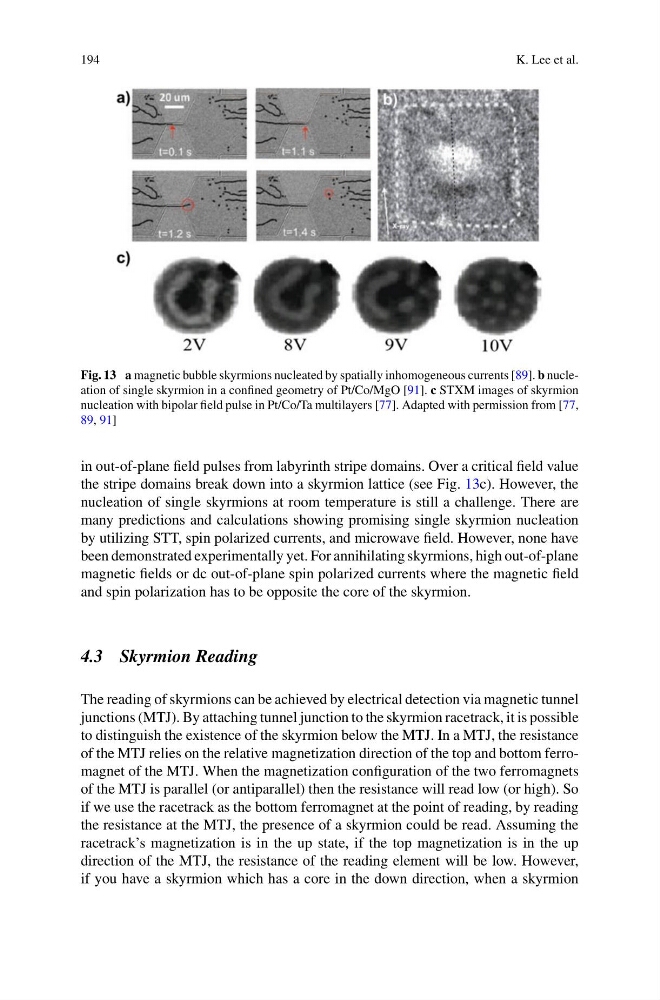
Fig. 13 a magnetic bubble skyrmions nucleated by spatially inhomogeneous currents [89]. b nucleation of single skyrmion in a confined geometry of Pt/Co/MgO [91]. c STXM images of skyrmion
nucleation with bipolar field pulse in Pt/Co/Ta multilayers [77]. Adapted with permission from [77,
89, 91]
in out-of-plane field pulses from labyrinth stripe domains. Over a critical field value
the stripe domains break down into a skyrmion lattice (see Fig. 13c). However, the
nucleation of single skyrmions at room temperature is still a challenge. There are
many predictions and calculations showing promising single skyrmion nucleation
by utilizing STT, spin polarized currents, and microwave field. However, none have
been demonstrated experimentally yet. For annihilating skyrmions, high out-of-plane
magnetic fields or dc out-of-plane spin polarized currents where the magnetic field
and spin polarization has to be opposite the core of the skyrmion.
4.3 Skyrmion Reading
The reading of skyrmions can be achieved by electrical detection via magnetic tunnel
junctions (MTJ). By attaching tunnel junction to the skyrmion racetrack, it is possible
to distinguish the existence of the skyrmion below the MTJ. In a MTJ, the resistance
of the MTJ relies on the relative magnetization direction of the top and bottom ferromagnet of the MTJ. When the magnetization configuration of the two ferromagnets
of the MTJ is parallel (or antiparallel) then the resistance will read low (or high). So
if we use the racetrack as the bottom ferromagnet at the point of reading, by reading
the resistance at the MTJ, the presence of a skyrmion could be read. Assuming the
racetrack’s magnetization is in the up state, if the top magnetization is in the up
direction of the MTJ, the resistance of the reading element will be low. However,
if you have a skyrmion which has a core in the down direction, when a skyrmion
K. Lee et al.
Fig. 13 a magnetic bubble skyrmions nucleated by spatially inhomogeneous currents [89]. b nucleation of single skyrmion in a confined geometry of Pt/Co/MgO [91]. c STXM images of skyrmion
nucleation with bipolar field pulse in Pt/Co/Ta multilayers [77]. Adapted with permission from [77,
89, 91]
in out-of-plane field pulses from labyrinth stripe domains. Over a critical field value
the stripe domains break down into a skyrmion lattice (see Fig. 13c). However, the
nucleation of single skyrmions at room temperature is still a challenge. There are
many predictions and calculations showing promising single skyrmion nucleation
by utilizing STT, spin polarized currents, and microwave field. However, none have
been demonstrated experimentally yet. For annihilating skyrmions, high out-of-plane
magnetic fields or dc out-of-plane spin polarized currents where the magnetic field
and spin polarization has to be opposite the core of the skyrmion.
4.3 Skyrmion Reading
The reading of skyrmions can be achieved by electrical detection via magnetic tunnel
junctions (MTJ). By attaching tunnel junction to the skyrmion racetrack, it is possible
to distinguish the existence of the skyrmion below the MTJ. In a MTJ, the resistance
of the MTJ relies on the relative magnetization direction of the top and bottom ferromagnet of the MTJ. When the magnetization configuration of the two ferromagnets
of the MTJ is parallel (or antiparallel) then the resistance will read low (or high). So
if we use the racetrack as the bottom ferromagnet at the point of reading, by reading
the resistance at the MTJ, the presence of a skyrmion could be read. Assuming the
racetrack’s magnetization is in the up state, if the top magnetization is in the up
direction of the MTJ, the resistance of the reading element will be low. However,
if you have a skyrmion which has a core in the down direction, when a skyrmion