

Chiral Magnetic Domain Wall and Skyrmion Memory Devices
193
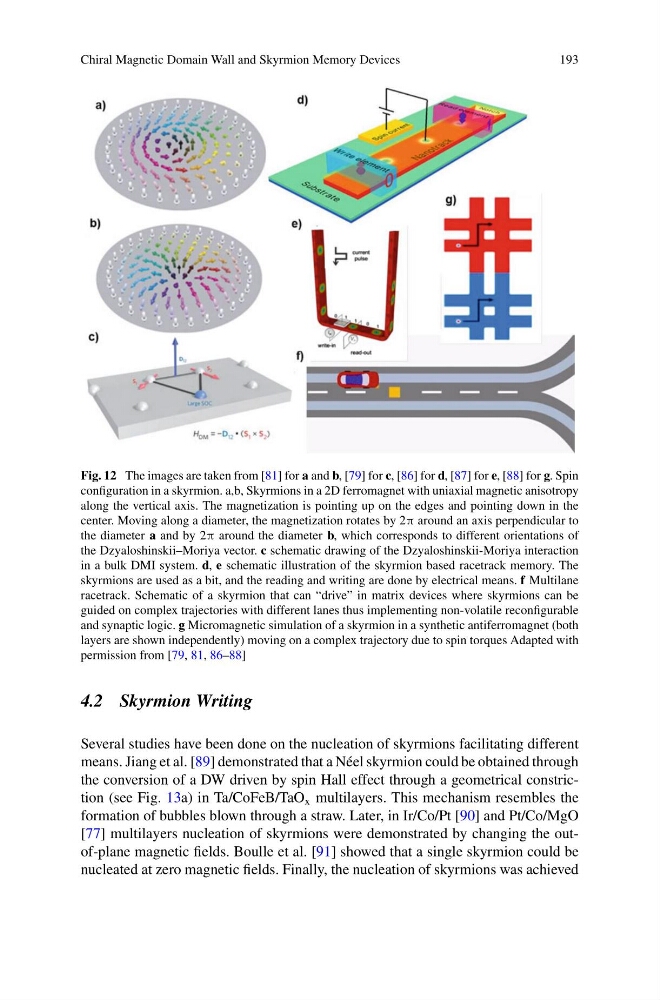
Fig. 12 The images are taken from [81] for a and b, [79] for c, [86] for d, [87] for e, [88] for g. Spin
configuration in a skyrmion. a,b, Skyrmions in a 2D ferromagnet with uniaxial magnetic anisotropy
along the vertical axis. The magnetization is pointing up on the edges and pointing down in the
center. Moving along a diameter, the magnetization rotates by 2π around an axis perpendicular to
the diameter a and by 2π around the diameter b, which corresponds to different orientations of
the Dzyaloshinskii–Moriya vector. c schematic drawing of the Dzyaloshinskii-Moriya interaction
in a bulk DMI system. d, e schematic illustration of the skyrmion based racetrack memory. The
skyrmions are used as a bit, and the reading and writing are done by electrical means. f Multilane
racetrack. Schematic of a skyrmion that can “drive” in matrix devices where skyrmions can be
guided on complex trajectories with different lanes thus implementing non-volatile reconfigurable
and synaptic logic. g Micromagnetic simulation of a skyrmion in a synthetic antiferromagnet (both
layers are shown independently) moving on a complex trajectory due to spin torques Adapted with
permission from [79, 81, 86–88]
4.2 Skyrmion Writing
Several studies have been done on the nucleation of skyrmions facilitating different
means. Jiang et al. [89] demonstrated that a Néel skyrmion could be obtained through
the conversion of a DW driven by spin Hall effect through a geometrical constriction (see Fig. 13a) in Ta/CoFeB/TaO x multilayers. This mechanism resembles the
formation of bubbles blown through a straw. Later, in Ir/Co/Pt [90] and Pt/Co/MgO
[77] multilayers nucleation of skyrmions were demonstrated by changing the outof-plane magnetic fields. Boulle et al. [91] showed that a single skyrmion could be
nucleated at zero magnetic fields. Finally, the nucleation of skyrmions was achieved
193
Fig. 12 The images are taken from [81] for a and b, [79] for c, [86] for d, [87] for e, [88] for g. Spin
configuration in a skyrmion. a,b, Skyrmions in a 2D ferromagnet with uniaxial magnetic anisotropy
along the vertical axis. The magnetization is pointing up on the edges and pointing down in the
center. Moving along a diameter, the magnetization rotates by 2π around an axis perpendicular to
the diameter a and by 2π around the diameter b, which corresponds to different orientations of
the Dzyaloshinskii–Moriya vector. c schematic drawing of the Dzyaloshinskii-Moriya interaction
in a bulk DMI system. d, e schematic illustration of the skyrmion based racetrack memory. The
skyrmions are used as a bit, and the reading and writing are done by electrical means. f Multilane
racetrack. Schematic of a skyrmion that can “drive” in matrix devices where skyrmions can be
guided on complex trajectories with different lanes thus implementing non-volatile reconfigurable
and synaptic logic. g Micromagnetic simulation of a skyrmion in a synthetic antiferromagnet (both
layers are shown independently) moving on a complex trajectory due to spin torques Adapted with
permission from [79, 81, 86–88]
4.2 Skyrmion Writing
Several studies have been done on the nucleation of skyrmions facilitating different
means. Jiang et al. [89] demonstrated that a Néel skyrmion could be obtained through
the conversion of a DW driven by spin Hall effect through a geometrical constriction (see Fig. 13a) in Ta/CoFeB/TaO x multilayers. This mechanism resembles the
formation of bubbles blown through a straw. Later, in Ir/Co/Pt [90] and Pt/Co/MgO
[77] multilayers nucleation of skyrmions were demonstrated by changing the outof-plane magnetic fields. Boulle et al. [91] showed that a single skyrmion could be
nucleated at zero magnetic fields. Finally, the nucleation of skyrmions was achieved