

188
K. Lee et al.
motion without a magnetic field. Furthermore, two DWs with the opposite polarities
(up-down and down-up) have the same chirality and this leads to the behaviour that
two DWs move in the same direction when the current is applied.
3.1 Physical Origin of the Interfacial DMI
The DMI has been introduced to explain weak ferromagnetism in an antiferromagnet
arising from a misalignment of the sublattices with respect to the totally antiparallel
configuration. This anomalous behavior was at first introduced by Dzyaloshinskii
[52] who explained the phenomenon with the non-centrosymmetric property of the
system. After his phenomenological explanation, Moriya [53] connected his name to
this term as he analytically found that the mechanism behind this interaction partially
arises from spin–orbit coupling. This interaction was studied in a compound that
lacks inversion symmetry like B20 group [54, 55] in the beginning. However, it has
been recently recognized that the DMI may appear in ultrathin film systems where a
structural inversion symmetry from interfaces and a large spin–orbit coupling exist.
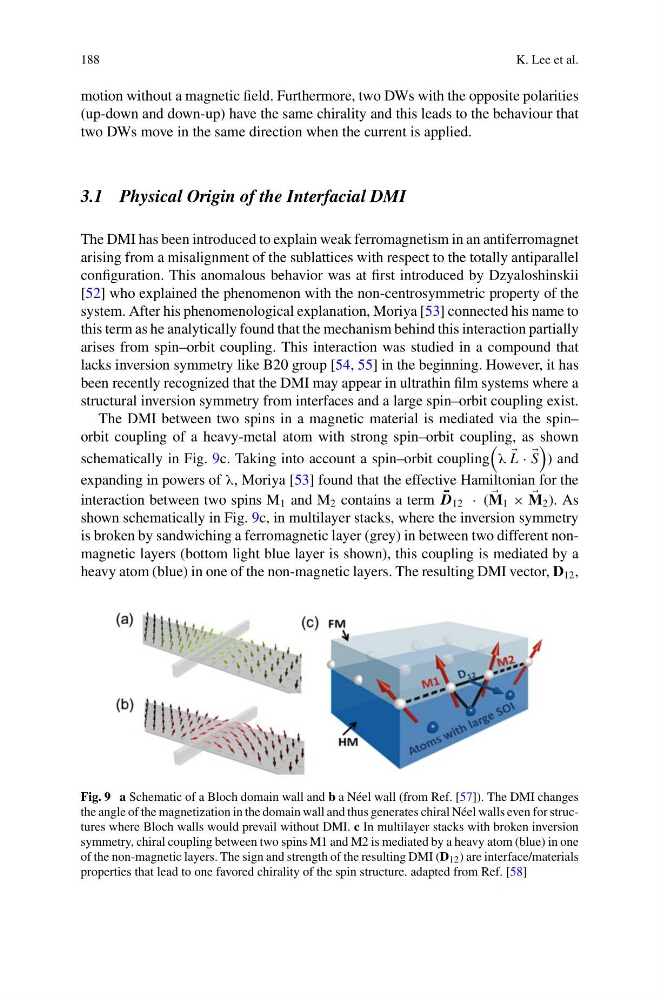
The DMI between two spins in a magnetic material is mediated via the spin–
orbit coupling of a heavy-metal atom with strong spin–orbit coupling, as shown
schematically in Fig. 9c. Taking into account a spin–orbit coupling
λ
L ·
S
) and
expanding in powers of λ, Moriya [53] found that the effective Hamiltonian for the
interaction between two spins M 1 and M 2 contains a term
D 12 · (
M 1 ×
M 2 ). As
shown schematically in Fig. 9c, in multilayer stacks, where the inversion symmetry
is broken by sandwiching a ferromagnetic layer (grey) in between two different nonmagnetic layers (bottom light blue layer is shown), this coupling is mediated by a
heavy atom (blue) in one of the non-magnetic layers. The resulting DMI vector, D 12 ,
Fig. 9 a Schematic of a Bloch domain wall and b a Néel wall (from Ref. [57]). The DMI changes
the angle of the magnetization in the domain wall and thus generates chiral Néel walls even for structures where Bloch walls would prevail without DMI. c In multilayer stacks with broken inversion
symmetry, chiral coupling between two spins M1 and M2 is mediated by a heavy atom (blue) in one
of the non-magnetic layers. The sign and strength of the resulting DMI (D 12 ) are interface/materials
properties that lead to one favored chirality of the spin structure. adapted from Ref. [58]
K. Lee et al.
motion without a magnetic field. Furthermore, two DWs with the opposite polarities
(up-down and down-up) have the same chirality and this leads to the behaviour that
two DWs move in the same direction when the current is applied.
3.1 Physical Origin of the Interfacial DMI
The DMI has been introduced to explain weak ferromagnetism in an antiferromagnet
arising from a misalignment of the sublattices with respect to the totally antiparallel
configuration. This anomalous behavior was at first introduced by Dzyaloshinskii
[52] who explained the phenomenon with the non-centrosymmetric property of the
system. After his phenomenological explanation, Moriya [53] connected his name to
this term as he analytically found that the mechanism behind this interaction partially
arises from spin–orbit coupling. This interaction was studied in a compound that
lacks inversion symmetry like B20 group [54, 55] in the beginning. However, it has
been recently recognized that the DMI may appear in ultrathin film systems where a
structural inversion symmetry from interfaces and a large spin–orbit coupling exist.
The DMI between two spins in a magnetic material is mediated via the spin–
orbit coupling of a heavy-metal atom with strong spin–orbit coupling, as shown
schematically in Fig. 9c. Taking into account a spin–orbit coupling
λ
L ·
S
) and
expanding in powers of λ, Moriya [53] found that the effective Hamiltonian for the
interaction between two spins M 1 and M 2 contains a term
D 12 · (
M 1 ×
M 2 ). As
shown schematically in Fig. 9c, in multilayer stacks, where the inversion symmetry
is broken by sandwiching a ferromagnetic layer (grey) in between two different nonmagnetic layers (bottom light blue layer is shown), this coupling is mediated by a
heavy atom (blue) in one of the non-magnetic layers. The resulting DMI vector, D 12 ,
Fig. 9 a Schematic of a Bloch domain wall and b a Néel wall (from Ref. [57]). The DMI changes
the angle of the magnetization in the domain wall and thus generates chiral Néel walls even for structures where Bloch walls would prevail without DMI. c In multilayer stacks with broken inversion
symmetry, chiral coupling between two spins M1 and M2 is mediated by a heavy atom (blue) in one
of the non-magnetic layers. The sign and strength of the resulting DMI (D 12 ) are interface/materials
properties that lead to one favored chirality of the spin structure. adapted from Ref. [58]