

Chiral Magnetic Domain Wall and Skyrmion Memory Devices
187
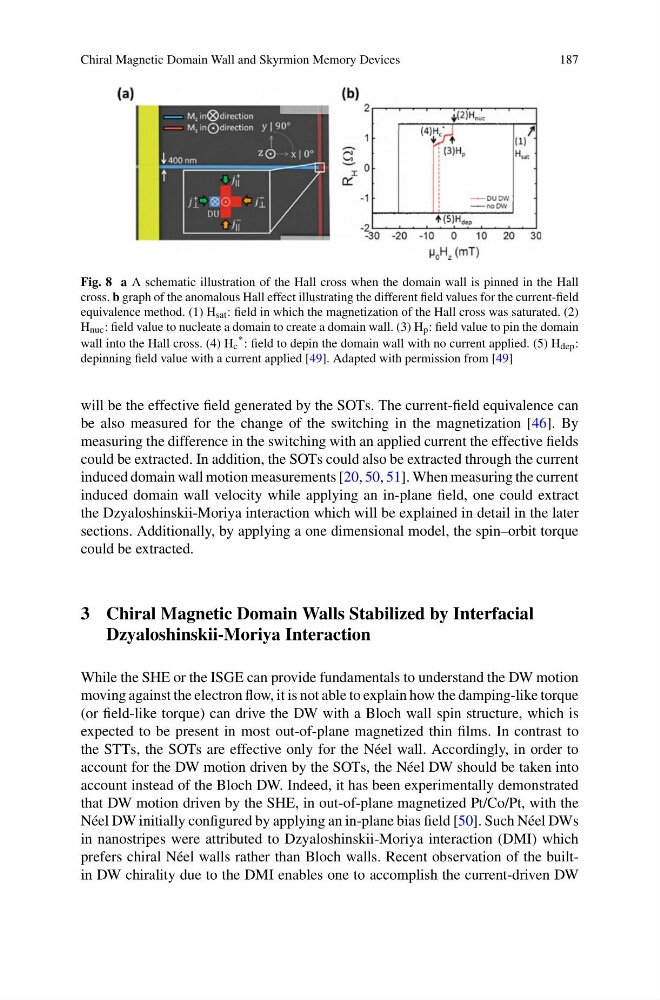
Fig. 8 a A schematic illustration of the Hall cross when the domain wall is pinned in the Hall
cross. b graph of the anomalous Hall effect illustrating the different field values for the current-field
equivalence method. (1) H sat : field in which the magnetization of the Hall cross was saturated. (2)
H nuc : field value to nucleate a domain to create a domain wall. (3) H p : field value to pin the domain
wall into the Hall cross. (4) H c
* : field to depin the domain wall with no current applied. (5) H dep :
depinning field value with a current applied [49]. Adapted with permission from [49]
will be the effective field generated by the SOTs. The current-field equivalence can
be also measured for the change of the switching in the magnetization [46]. By
measuring the difference in the switching with an applied current the effective fields
could be extracted. In addition, the SOTs could also be extracted through the current
induced domain wall motion measurements [20, 50, 51]. When measuring the current
induced domain wall velocity while applying an in-plane field, one could extract
the Dzyaloshinskii-Moriya interaction which will be explained in detail in the later
sections. Additionally, by applying a one dimensional model, the spin–orbit torque
could be extracted.
3 Chiral Magnetic Domain Walls Stabilized by Interfacial
Dzyaloshinskii-Moriya Interaction
While the SHE or the ISGE can provide fundamentals to understand the DW motion
moving against the electron flow, it is not able to explain how the damping-like torque
(or field-like torque) can drive the DW with a Bloch wall spin structure, which is
expected to be present in most out-of-plane magnetized thin films. In contrast to
the STTs, the SOTs are effective only for the Néel wall. Accordingly, in order to
account for the DW motion driven by the SOTs, the Néel DW should be taken into
account instead of the Bloch DW. Indeed, it has been experimentally demonstrated
that DW motion driven by the SHE, in out-of-plane magnetized Pt/Co/Pt, with the
Néel DW initially configured by applying an in-plane bias field [50]. Such Néel DWs
in nanostripes were attributed to Dzyaloshinskii-Moriya interaction (DMI) which
prefers chiral Néel walls rather than Bloch walls. Recent observation of the builtin DW chirality due to the DMI enables one to accomplish the current-driven DW
187
Fig. 8 a A schematic illustration of the Hall cross when the domain wall is pinned in the Hall
cross. b graph of the anomalous Hall effect illustrating the different field values for the current-field
equivalence method. (1) H sat : field in which the magnetization of the Hall cross was saturated. (2)
H nuc : field value to nucleate a domain to create a domain wall. (3) H p : field value to pin the domain
wall into the Hall cross. (4) H c
* : field to depin the domain wall with no current applied. (5) H dep :
depinning field value with a current applied [49]. Adapted with permission from [49]
will be the effective field generated by the SOTs. The current-field equivalence can
be also measured for the change of the switching in the magnetization [46]. By
measuring the difference in the switching with an applied current the effective fields
could be extracted. In addition, the SOTs could also be extracted through the current
induced domain wall motion measurements [20, 50, 51]. When measuring the current
induced domain wall velocity while applying an in-plane field, one could extract
the Dzyaloshinskii-Moriya interaction which will be explained in detail in the later
sections. Additionally, by applying a one dimensional model, the spin–orbit torque
could be extracted.
3 Chiral Magnetic Domain Walls Stabilized by Interfacial
Dzyaloshinskii-Moriya Interaction
While the SHE or the ISGE can provide fundamentals to understand the DW motion
moving against the electron flow, it is not able to explain how the damping-like torque
(or field-like torque) can drive the DW with a Bloch wall spin structure, which is
expected to be present in most out-of-plane magnetized thin films. In contrast to
the STTs, the SOTs are effective only for the Néel wall. Accordingly, in order to
account for the DW motion driven by the SOTs, the Néel DW should be taken into
account instead of the Bloch DW. Indeed, it has been experimentally demonstrated
that DW motion driven by the SHE, in out-of-plane magnetized Pt/Co/Pt, with the
Néel DW initially configured by applying an in-plane bias field [50]. Such Néel DWs
in nanostripes were attributed to Dzyaloshinskii-Moriya interaction (DMI) which
prefers chiral Néel walls rather than Bloch walls. Recent observation of the builtin DW chirality due to the DMI enables one to accomplish the current-driven DW