

154
J. Lourembam and J. Huang
ξ =
M AE.t F M
E
.
(3)
By probing the electric-field effect on the anomalous Hall signal, it was reported
that Ta/CoFeB/MgO showed an efficiency of + 33 fJV
−1 m
−1 for t FM = 1.33 nm
[51]. Further investigation by Lau et. al. showed that in this system, ξ has a strong
thickness dependence and the magnitude decreases by ~ 50% with decreasing
ferromagnetic thickness from ~0.5 nm to ~1nm [52]. On the other hand, for
W/CoFeB/MgO heterostructures, ξ varies by ~ 50% with thickness [52]. Utilising a
similar technique, it was also found that annealing decreases electric-field efficiency
in Mo/CoFeB/MgO, which showed ξ value of + 40 fJV
−1 m
−1 at an annealing
temperature of 430 °C [39].
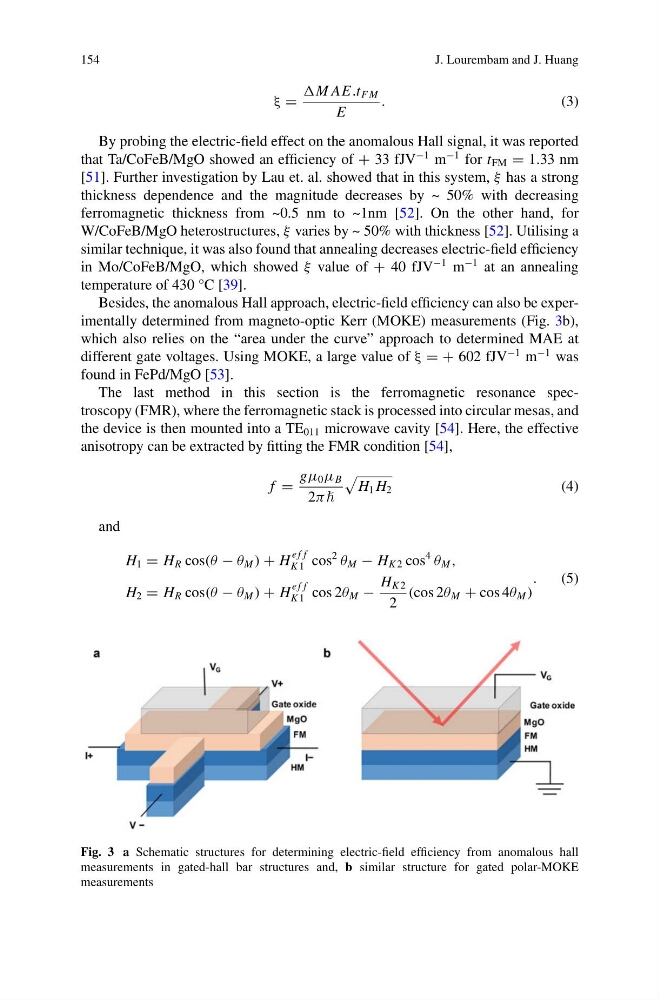
Besides, the anomalous Hall approach, electric-field efficiency can also be experimentally determined from magneto-optic Kerr (MOKE) measurements (Fig. 3b),
which also relies on the “area under the curve” approach to determined MAE at
different gate voltages. Using MOKE, a large value of ξ = + 602 fJV
−1 m
−1 was
found in FePd/MgO [53].
The last method in this section is the ferromagnetic resonance spectroscopy (FMR), where the ferromagnetic stack is processed into circular mesas, and
the device is then mounted into a TE 011 microwave cavity [54]. Here, the effective
anisotropy can be extracted by fitting the FMR condition [54],
f =
gμ 0 μ B
2π
H 1 H 2
(4)
and
H 1 = H R cos(θ − θ M ) + H
e f f
K 1 cos
2
θ M − H K 2 cos
4
θ M ,
H 2 = H R cos(θ − θ M ) + H
e f f
K 1 cos 2θ M −
H K 2
2
(cos 2θ M + cos 4θ M )
.
(5)
Fig. 3 a Schematic structures for determining electric-field efficiency from anomalous hall
measurements in gated-hall bar structures and, b similar structure for gated polar-MOKE
measurements
J. Lourembam and J. Huang
ξ =
M AE.t F M
E
.
(3)
By probing the electric-field effect on the anomalous Hall signal, it was reported
that Ta/CoFeB/MgO showed an efficiency of + 33 fJV
−1 m
−1 for t FM = 1.33 nm
[51]. Further investigation by Lau et. al. showed that in this system, ξ has a strong
thickness dependence and the magnitude decreases by ~ 50% with decreasing
ferromagnetic thickness from ~0.5 nm to ~1nm [52]. On the other hand, for
W/CoFeB/MgO heterostructures, ξ varies by ~ 50% with thickness [52]. Utilising a
similar technique, it was also found that annealing decreases electric-field efficiency
in Mo/CoFeB/MgO, which showed ξ value of + 40 fJV
−1 m
−1 at an annealing
temperature of 430 °C [39].
Besides, the anomalous Hall approach, electric-field efficiency can also be experimentally determined from magneto-optic Kerr (MOKE) measurements (Fig. 3b),
which also relies on the “area under the curve” approach to determined MAE at
different gate voltages. Using MOKE, a large value of ξ = + 602 fJV
−1 m
−1 was
found in FePd/MgO [53].
The last method in this section is the ferromagnetic resonance spectroscopy (FMR), where the ferromagnetic stack is processed into circular mesas, and
the device is then mounted into a TE 011 microwave cavity [54]. Here, the effective
anisotropy can be extracted by fitting the FMR condition [54],
f =
gμ 0 μ B
2π
H 1 H 2
(4)
and
H 1 = H R cos(θ − θ M ) + H
e f f
K 1 cos
2
θ M − H K 2 cos
4
θ M ,
H 2 = H R cos(θ − θ M ) + H
e f f
K 1 cos 2θ M −
H K 2
2
(cos 2θ M + cos 4θ M )
.
(5)
Fig. 3 a Schematic structures for determining electric-field efficiency from anomalous hall
measurements in gated-hall bar structures and, b similar structure for gated polar-MOKE
measurements