

Current-Driven Domain Wall Dynamics in Magnetic …
139
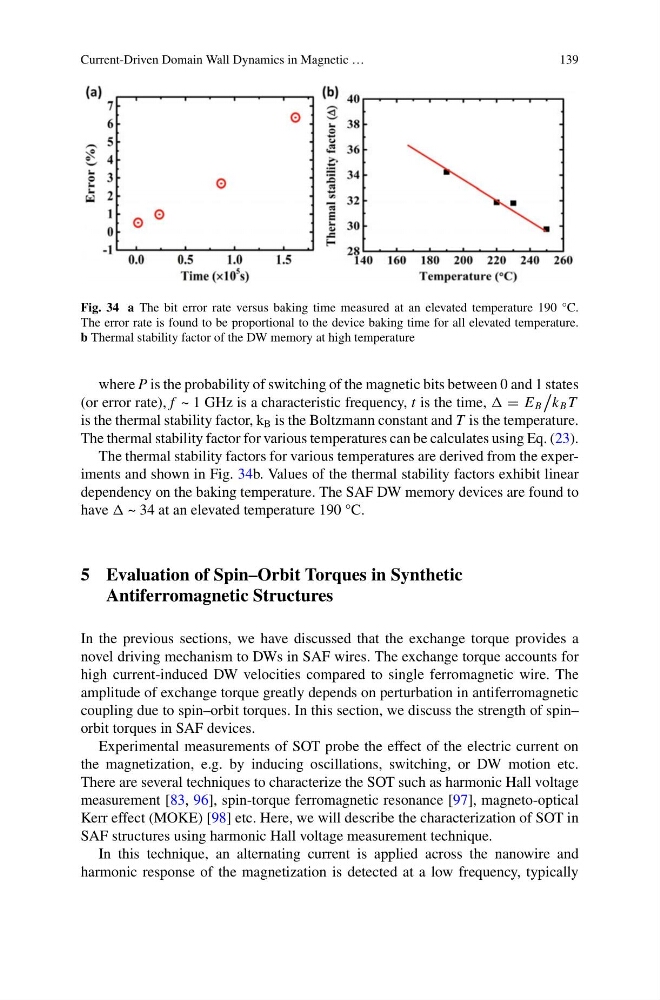
Fig. 34 a The bit error rate versus baking time measured at an elevated temperature 190 °C.
The error rate is found to be proportional to the device baking time for all elevated temperature.
b Thermal stability factor of the DW memory at high temperature
where P is the probability of switching of the magnetic bits between 0 and 1 states
(or error rate), f ~ 1 GHz is a characteristic frequency, t is the time, = E B
k B T
is the thermal stability factor, k B is the Boltzmann constant and T is the temperature.
The thermal stability factor for various temperatures can be calculates using Eq. (23).
The thermal stability factors for various temperatures are derived from the experiments and shown in Fig. 34b. Values of the thermal stability factors exhibit linear
dependency on the baking temperature. The SAF DW memory devices are found to
have ~ 34 at an elevated temperature 190 °C.
5 Evaluation of Spin–Orbit Torques in Synthetic
Antiferromagnetic Structures
In the previous sections, we have discussed that the exchange torque provides a
novel driving mechanism to DWs in SAF wires. The exchange torque accounts for
high current-induced DW velocities compared to single ferromagnetic wire. The
amplitude of exchange torque greatly depends on perturbation in antiferromagnetic
coupling due to spin–orbit torques. In this section, we discuss the strength of spin–
orbit torques in SAF devices.
Experimental measurements of SOT probe the effect of the electric current on
the magnetization, e.g. by inducing oscillations, switching, or DW motion etc.
There are several techniques to characterize the SOT such as harmonic Hall voltage
measurement [83, 96], spin-torque ferromagnetic resonance [97], magneto-optical
Kerr effect (MOKE) [98] etc. Here, we will describe the characterization of SOT in
SAF structures using harmonic Hall voltage measurement technique.
In this technique, an alternating current is applied across the nanowire and
harmonic response of the magnetization is detected at a low frequency, typically
139
Fig. 34 a The bit error rate versus baking time measured at an elevated temperature 190 °C.
The error rate is found to be proportional to the device baking time for all elevated temperature.
b Thermal stability factor of the DW memory at high temperature
where P is the probability of switching of the magnetic bits between 0 and 1 states
(or error rate), f ~ 1 GHz is a characteristic frequency, t is the time, = E B
k B T
is the thermal stability factor, k B is the Boltzmann constant and T is the temperature.
The thermal stability factor for various temperatures can be calculates using Eq. (23).
The thermal stability factors for various temperatures are derived from the experiments and shown in Fig. 34b. Values of the thermal stability factors exhibit linear
dependency on the baking temperature. The SAF DW memory devices are found to
have ~ 34 at an elevated temperature 190 °C.
5 Evaluation of Spin–Orbit Torques in Synthetic
Antiferromagnetic Structures
In the previous sections, we have discussed that the exchange torque provides a
novel driving mechanism to DWs in SAF wires. The exchange torque accounts for
high current-induced DW velocities compared to single ferromagnetic wire. The
amplitude of exchange torque greatly depends on perturbation in antiferromagnetic
coupling due to spin–orbit torques. In this section, we discuss the strength of spin–
orbit torques in SAF devices.
Experimental measurements of SOT probe the effect of the electric current on
the magnetization, e.g. by inducing oscillations, switching, or DW motion etc.
There are several techniques to characterize the SOT such as harmonic Hall voltage
measurement [83, 96], spin-torque ferromagnetic resonance [97], magneto-optical
Kerr effect (MOKE) [98] etc. Here, we will describe the characterization of SOT in
SAF structures using harmonic Hall voltage measurement technique.
In this technique, an alternating current is applied across the nanowire and
harmonic response of the magnetization is detected at a low frequency, typically