

130
S. Krishnia and W. S. Lew
densities [30]. The higher DW speed in the SAF wires is due to presence of interlayer antiferromagnetic exchange torque due to the SHE-induced perturbation in
DWs antiferromagnetic alignment [86, 89]. In the next section, lets us investigate
the role of exchange torque on current-driven DW dynamics in SAF wires using
micro-magnetic simulations.
In the SAF wire, the two ferromagnetic layers are interfaced with heavy metals
which are the sources of spin currents. Since the SAF structures are grown on Pt heavy
metal, the DMI interaction is naturally involved. In addition to the DMI, the heavy
metals also act as a spin current generators. In the absence of current, the DWs in
lower ferromagnetic layers is Néel type. A Néel DW of similar chirality is stabilized
in the upper ferromagnetic layer due to antiferromagnetic exchange coupling. The
exchange torque is zero in the absence of current as both the DWs were perfectly
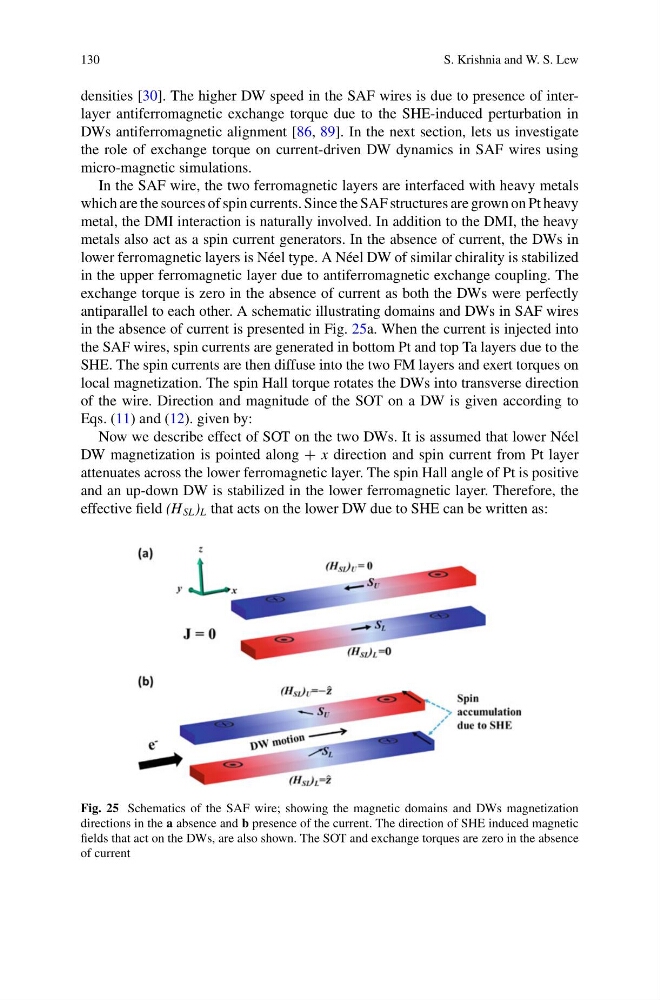
antiparallel to each other. A schematic illustrating domains and DWs in SAF wires
in the absence of current is presented in Fig. 25a. When the current is injected into
the SAF wires, spin currents are generated in bottom Pt and top Ta layers due to the
SHE. The spin currents are then diffuse into the two FM layers and exert torques on
local magnetization. The spin Hall torque rotates the DWs into transverse direction
of the wire. Direction and magnitude of the SOT on a DW is given according to
Eqs. (11) and (12). given by:
Now we describe effect of SOT on the two DWs. It is assumed that lower Néel
DW magnetization is pointed along + x direction and spin current from Pt layer
attenuates across the lower ferromagnetic layer. The spin Hall angle of Pt is positive
and an up-down DW is stabilized in the lower ferromagnetic layer. Therefore, the
effective field (H SL ) L that acts on the lower DW due to SHE can be written as:
Fig. 25 Schematics of the SAF wire; showing the magnetic domains and DWs magnetization
directions in the a absence and b presence of the current. The direction of SHE induced magnetic
fields that act on the DWs, are also shown. The SOT and exchange torques are zero in the absence
of current
S. Krishnia and W. S. Lew
densities [30]. The higher DW speed in the SAF wires is due to presence of interlayer antiferromagnetic exchange torque due to the SHE-induced perturbation in
DWs antiferromagnetic alignment [86, 89]. In the next section, lets us investigate
the role of exchange torque on current-driven DW dynamics in SAF wires using
micro-magnetic simulations.
In the SAF wire, the two ferromagnetic layers are interfaced with heavy metals
which are the sources of spin currents. Since the SAF structures are grown on Pt heavy
metal, the DMI interaction is naturally involved. In addition to the DMI, the heavy
metals also act as a spin current generators. In the absence of current, the DWs in
lower ferromagnetic layers is Néel type. A Néel DW of similar chirality is stabilized
in the upper ferromagnetic layer due to antiferromagnetic exchange coupling. The
exchange torque is zero in the absence of current as both the DWs were perfectly
antiparallel to each other. A schematic illustrating domains and DWs in SAF wires
in the absence of current is presented in Fig. 25a. When the current is injected into
the SAF wires, spin currents are generated in bottom Pt and top Ta layers due to the
SHE. The spin currents are then diffuse into the two FM layers and exert torques on
local magnetization. The spin Hall torque rotates the DWs into transverse direction
of the wire. Direction and magnitude of the SOT on a DW is given according to
Eqs. (11) and (12). given by:
Now we describe effect of SOT on the two DWs. It is assumed that lower Néel
DW magnetization is pointed along + x direction and spin current from Pt layer
attenuates across the lower ferromagnetic layer. The spin Hall angle of Pt is positive
and an up-down DW is stabilized in the lower ferromagnetic layer. Therefore, the
effective field (H SL ) L that acts on the lower DW due to SHE can be written as:
Fig. 25 Schematics of the SAF wire; showing the magnetic domains and DWs magnetization
directions in the a absence and b presence of the current. The direction of SHE induced magnetic
fields that act on the DWs, are also shown. The SOT and exchange torques are zero in the absence
of current