

Current-Driven Domain Wall Dynamics in Magnetic …
123
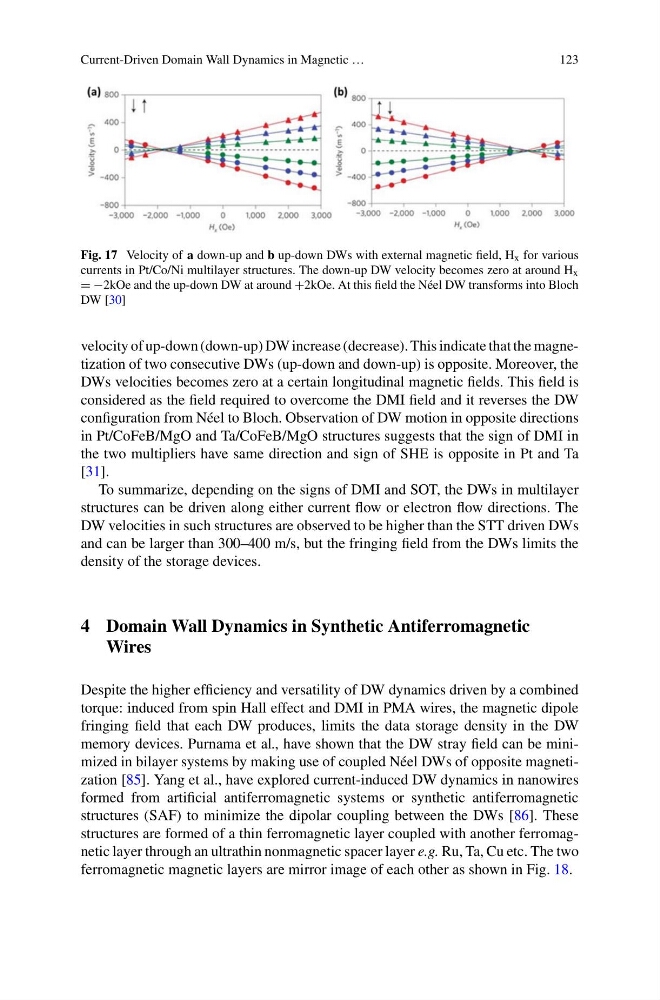
Fig. 17 Velocity of a down-up and b up-down DWs with external magnetic field, H x for various
currents in Pt/Co/Ni multilayer structures. The down-up DW velocity becomes zero at around H x
= −2kOe and the up-down DW at around +2kOe. At this field the Néel DW transforms into Bloch
DW [30]
velocity of up-down (down-up) DW increase (decrease). This indicate that the magnetization of two consecutive DWs (up-down and down-up) is opposite. Moreover, the
DWs velocities becomes zero at a certain longitudinal magnetic fields. This field is
considered as the field required to overcome the DMI field and it reverses the DW
configuration from Néel to Bloch. Observation of DW motion in opposite directions
in Pt/CoFeB/MgO and Ta/CoFeB/MgO structures suggests that the sign of DMI in
the two multipliers have same direction and sign of SHE is opposite in Pt and Ta
[31].
To summarize, depending on the signs of DMI and SOT, the DWs in multilayer
structures can be driven along either current flow or electron flow directions. The
DW velocities in such structures are observed to be higher than the STT driven DWs
and can be larger than 300–400 m/s, but the fringing field from the DWs limits the
density of the storage devices.
4 Domain Wall Dynamics in Synthetic Antiferromagnetic
Wires
Despite the higher efficiency and versatility of DW dynamics driven by a combined
torque: induced from spin Hall effect and DMI in PMA wires, the magnetic dipole
fringing field that each DW produces, limits the data storage density in the DW
memory devices. Purnama et al., have shown that the DW stray field can be minimized in bilayer systems by making use of coupled Néel DWs of opposite magnetization [85]. Yang et al., have explored current-induced DW dynamics in nanowires
formed from artificial antiferromagnetic systems or synthetic antiferromagnetic
structures (SAF) to minimize the dipolar coupling between the DWs [86]. These
structures are formed of a thin ferromagnetic layer coupled with another ferromagnetic layer through an ultrathin nonmagnetic spacer layer e.g. Ru, Ta, Cu etc. The two
ferromagnetic magnetic layers are mirror image of each other as shown in Fig. 18.
123
Fig. 17 Velocity of a down-up and b up-down DWs with external magnetic field, H x for various
currents in Pt/Co/Ni multilayer structures. The down-up DW velocity becomes zero at around H x
= −2kOe and the up-down DW at around +2kOe. At this field the Néel DW transforms into Bloch
DW [30]
velocity of up-down (down-up) DW increase (decrease). This indicate that the magnetization of two consecutive DWs (up-down and down-up) is opposite. Moreover, the
DWs velocities becomes zero at a certain longitudinal magnetic fields. This field is
considered as the field required to overcome the DMI field and it reverses the DW
configuration from Néel to Bloch. Observation of DW motion in opposite directions
in Pt/CoFeB/MgO and Ta/CoFeB/MgO structures suggests that the sign of DMI in
the two multipliers have same direction and sign of SHE is opposite in Pt and Ta
[31].
To summarize, depending on the signs of DMI and SOT, the DWs in multilayer
structures can be driven along either current flow or electron flow directions. The
DW velocities in such structures are observed to be higher than the STT driven DWs
and can be larger than 300–400 m/s, but the fringing field from the DWs limits the
density of the storage devices.
4 Domain Wall Dynamics in Synthetic Antiferromagnetic
Wires
Despite the higher efficiency and versatility of DW dynamics driven by a combined
torque: induced from spin Hall effect and DMI in PMA wires, the magnetic dipole
fringing field that each DW produces, limits the data storage density in the DW
memory devices. Purnama et al., have shown that the DW stray field can be minimized in bilayer systems by making use of coupled Néel DWs of opposite magnetization [85]. Yang et al., have explored current-induced DW dynamics in nanowires
formed from artificial antiferromagnetic systems or synthetic antiferromagnetic
structures (SAF) to minimize the dipolar coupling between the DWs [86]. These
structures are formed of a thin ferromagnetic layer coupled with another ferromagnetic layer through an ultrathin nonmagnetic spacer layer e.g. Ru, Ta, Cu etc. The two
ferromagnetic magnetic layers are mirror image of each other as shown in Fig. 18.