

124
S. Krishnia and W. S. Lew
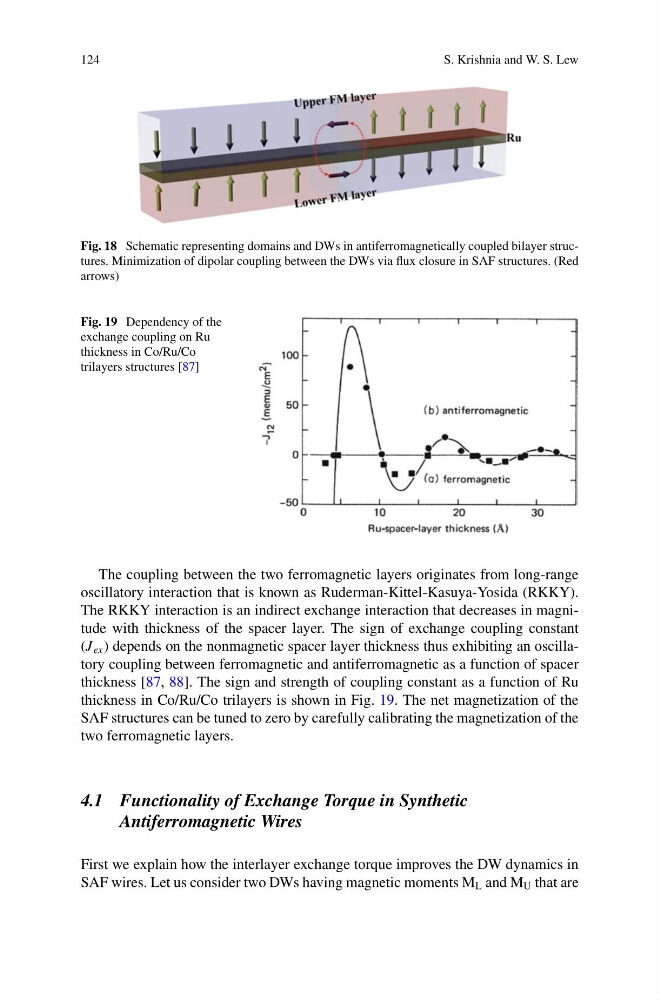
Fig. 18 Schematic representing domains and DWs in antiferromagnetically coupled bilayer structures. Minimization of dipolar coupling between the DWs via flux closure in SAF structures. (Red
arrows)
Fig. 19 Dependency of the
exchange coupling on Ru
thickness in Co/Ru/Co
trilayers structures [87]
The coupling between the two ferromagnetic layers originates from long-range
oscillatory interaction that is known as Ruderman-Kittel-Kasuya-Yosida (RKKY).
The RKKY interaction is an indirect exchange interaction that decreases in magnitude with thickness of the spacer layer. The sign of exchange coupling constant
(J ex ) depends on the nonmagnetic spacer layer thickness thus exhibiting an oscillatory coupling between ferromagnetic and antiferromagnetic as a function of spacer
thickness [87, 88]. The sign and strength of coupling constant as a function of Ru
thickness in Co/Ru/Co trilayers is shown in Fig. 19. The net magnetization of the
SAF structures can be tuned to zero by carefully calibrating the magnetization of the
two ferromagnetic layers.
4.1 Functionality of Exchange Torque in Synthetic
Antiferromagnetic Wires
First we explain how the interlayer exchange torque improves the DW dynamics in
SAF wires. Let us consider two DWs having magnetic moments M L and M U that are
S. Krishnia and W. S. Lew
Fig. 18 Schematic representing domains and DWs in antiferromagnetically coupled bilayer structures. Minimization of dipolar coupling between the DWs via flux closure in SAF structures. (Red
arrows)
Fig. 19 Dependency of the
exchange coupling on Ru
thickness in Co/Ru/Co
trilayers structures [87]
The coupling between the two ferromagnetic layers originates from long-range
oscillatory interaction that is known as Ruderman-Kittel-Kasuya-Yosida (RKKY).
The RKKY interaction is an indirect exchange interaction that decreases in magnitude with thickness of the spacer layer. The sign of exchange coupling constant
(J ex ) depends on the nonmagnetic spacer layer thickness thus exhibiting an oscillatory coupling between ferromagnetic and antiferromagnetic as a function of spacer
thickness [87, 88]. The sign and strength of coupling constant as a function of Ru
thickness in Co/Ru/Co trilayers is shown in Fig. 19. The net magnetization of the
SAF structures can be tuned to zero by carefully calibrating the magnetization of the
two ferromagnetic layers.
4.1 Functionality of Exchange Torque in Synthetic
Antiferromagnetic Wires
First we explain how the interlayer exchange torque improves the DW dynamics in
SAF wires. Let us consider two DWs having magnetic moments M L and M U that are