

Current-Driven Domain Wall Dynamics in Magnetic …
121
where J a is the applied current density in −x direction, M s is the saturation magnetization, t is the thickness of magnetic layer, m is the magnetization vector, ˆ
u y is a unit
vector in y-direction, |e
− | is the absolute value of the electron charge and θ SH is the
effective spin Hall angle. The spin Hall angle is the ratio of spin current (I s ) to charge
current (I e ), i.e. θ S H = I s
I e . However, according to Eqs. (11) and (12), the torque
from SHE can not drive the Bloch DWs. The DW configuration must be stabilized in
Néel to drive it by the SHE torque. Haazen et al. have demonstrated the SHE induced
DW motion by forcing the Bloch DW into Néel configuration using external in-plane
magnetic fields [80]. Whether the magnetization switching is due to Rashba effect
or spin Hall effect is still under debate. Liu et al. have shown that magnetization
switching in Pt/Co/AlO x stacks [76, 77] similar to that studied by Miron et al. [56],
is due to the strong spin Hall effect in Pt heavy metal layer. Following these works,
various experimental methods have been proposed to measure the Rashba field and
SL-field in such structures and the SL field is found to be dominated over the Rashba
field [81–84].
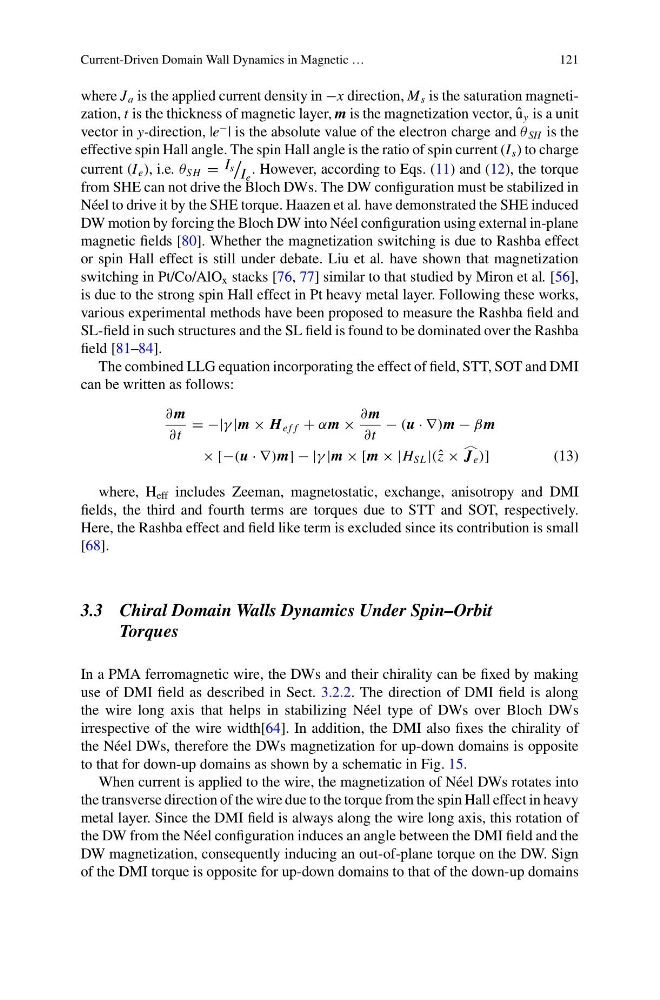
The combined LLG equation incorporating the effect of field, STT, SOT and DMI
can be written as follows:
∂ m
∂t
= −|γ |m × H e f f + αm ×
∂ m
∂t
− (u · ∇)m − βm
× [−(u · ∇)m] − |γ |m × [m × |H SL |(ˆ z × J e
)]
(13)
where, H eff includes Zeeman, magnetostatic, exchange, anisotropy and DMI
fields, the third and fourth terms are torques due to STT and SOT, respectively.
Here, the Rashba effect and field like term is excluded since its contribution is small
[68].
3.3 Chiral Domain Walls Dynamics Under Spin–Orbit
Torques
In a PMA ferromagnetic wire, the DWs and their chirality can be fixed by making
use of DMI field as described in Sect. 3.2.2. The direction of DMI field is along
the wire long axis that helps in stabilizing Néel type of DWs over Bloch DWs
irrespective of the wire width[64]. In addition, the DMI also fixes the chirality of
the Néel DWs, therefore the DWs magnetization for up-down domains is opposite
to that for down-up domains as shown by a schematic in Fig. 15.
When current is applied to the wire, the magnetization of Néel DWs rotates into
the transverse direction of the wire due to the torque from the spin Hall effect in heavy
metal layer. Since the DMI field is always along the wire long axis, this rotation of
the DW from the Néel configuration induces an angle between the DMI field and the
DW magnetization, consequently inducing an out-of-plane torque on the DW. Sign
of the DMI torque is opposite for up-down domains to that of the down-up domains
121
where J a is the applied current density in −x direction, M s is the saturation magnetization, t is the thickness of magnetic layer, m is the magnetization vector, ˆ
u y is a unit
vector in y-direction, |e
− | is the absolute value of the electron charge and θ SH is the
effective spin Hall angle. The spin Hall angle is the ratio of spin current (I s ) to charge
current (I e ), i.e. θ S H = I s
I e . However, according to Eqs. (11) and (12), the torque
from SHE can not drive the Bloch DWs. The DW configuration must be stabilized in
Néel to drive it by the SHE torque. Haazen et al. have demonstrated the SHE induced
DW motion by forcing the Bloch DW into Néel configuration using external in-plane
magnetic fields [80]. Whether the magnetization switching is due to Rashba effect
or spin Hall effect is still under debate. Liu et al. have shown that magnetization
switching in Pt/Co/AlO x stacks [76, 77] similar to that studied by Miron et al. [56],
is due to the strong spin Hall effect in Pt heavy metal layer. Following these works,
various experimental methods have been proposed to measure the Rashba field and
SL-field in such structures and the SL field is found to be dominated over the Rashba
field [81–84].
The combined LLG equation incorporating the effect of field, STT, SOT and DMI
can be written as follows:
∂ m
∂t
= −|γ |m × H e f f + αm ×
∂ m
∂t
− (u · ∇)m − βm
× [−(u · ∇)m] − |γ |m × [m × |H SL |(ˆ z × J e
)]
(13)
where, H eff includes Zeeman, magnetostatic, exchange, anisotropy and DMI
fields, the third and fourth terms are torques due to STT and SOT, respectively.
Here, the Rashba effect and field like term is excluded since its contribution is small
[68].
3.3 Chiral Domain Walls Dynamics Under Spin–Orbit
Torques
In a PMA ferromagnetic wire, the DWs and their chirality can be fixed by making
use of DMI field as described in Sect. 3.2.2. The direction of DMI field is along
the wire long axis that helps in stabilizing Néel type of DWs over Bloch DWs
irrespective of the wire width[64]. In addition, the DMI also fixes the chirality of
the Néel DWs, therefore the DWs magnetization for up-down domains is opposite
to that for down-up domains as shown by a schematic in Fig. 15.
When current is applied to the wire, the magnetization of Néel DWs rotates into
the transverse direction of the wire due to the torque from the spin Hall effect in heavy
metal layer. Since the DMI field is always along the wire long axis, this rotation of
the DW from the Néel configuration induces an angle between the DMI field and the
DW magnetization, consequently inducing an out-of-plane torque on the DW. Sign
of the DMI torque is opposite for up-down domains to that of the down-up domains